SIGN OUR PETITION – ‘GLL: It’s called Charlton Lido because it’s in Charlton!’

lido petition

UPDATE 30TH SEPTEMBER, 2013:

Our campaign against changing the name of Charlton Lido to ‘Royal Greenwich Lido, Charlton’ continues to show real results. The News Shopper reports that a GLL spokeswoman has suggested that residents write to GLL using the mail address lidoname@gll.org to suggest the name of the revamped facility, and confirmed that GLL’s preferred name is still ‘Charlton Leisure Centre and Lido’

Please consider writing to GLL with your preferred name – and let us know in the comments below what you’ve told them!

UPDATE 27th SEPTEMBER, 2013: Nearly a week in, and our campaign has gained more coverage than we had thought possible – thanks to everyone who’s signed the petition, RT’d our tweets, contacted the local press and councillors, and encouraged us along the way. It’s worth summarising some of the support we have as of today:

  • Clive Efford, MP for Eltham and Shadow Minister for Sport tweeted to praise GLL for rethinking the decision (see below)
  • Over 350 signatories to our petition to date.
  • Local councillors – including Cllrs Hayley Fletcher, Matthew Pennycook, Kevin Bonavia, and John Fahy – have tweeted support and signed the petition
  • The Charlton Society and Charlton Central Residents Association
  • Kidbrooke with Hornfair and Eltham Labour branches; Kidbrooke with Hornfair Conservative Party candidates.

Some press coverage from this week:
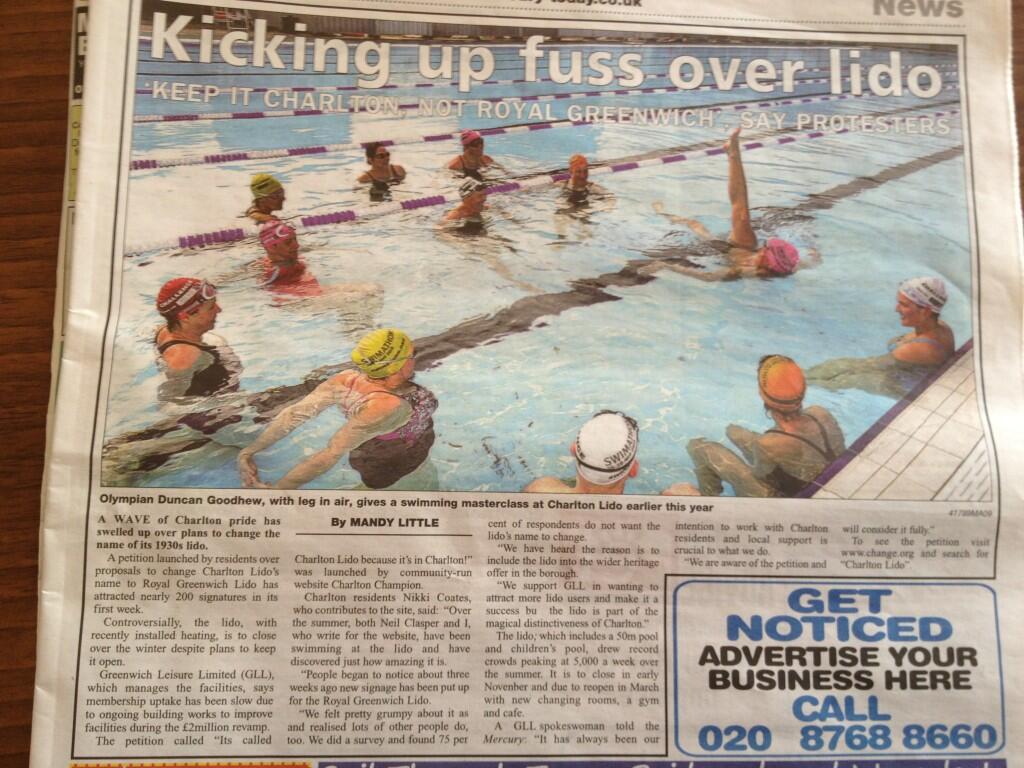
Charlton Mercury coverage - September 25 2013
Charlton Mercury coverage – September 25 2013
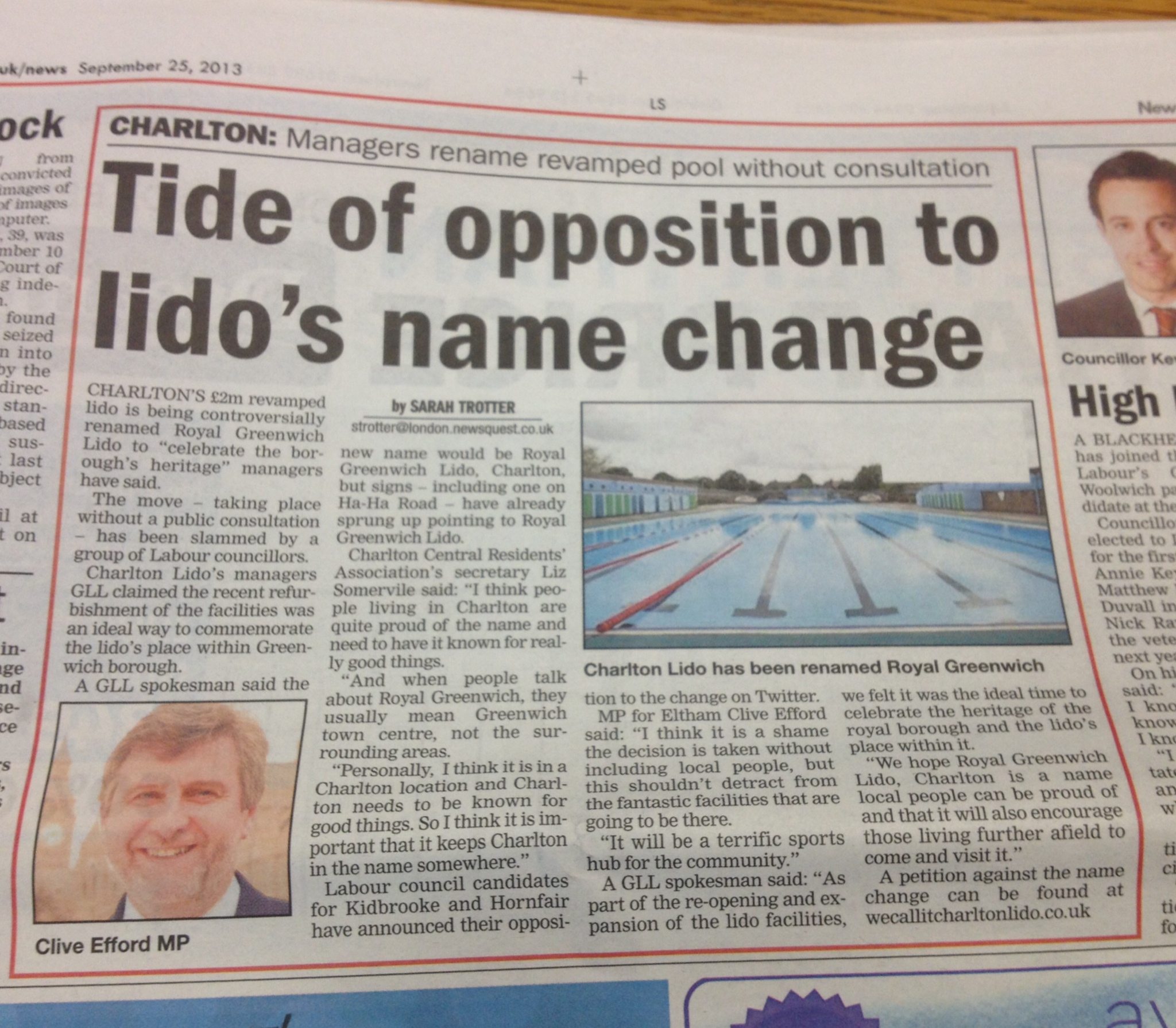
News Shopper coverage - September 25 2013
News Shopper coverage – September 25 2013

And some highlights from Twitter:

To repeat our message from earlier in the week, though, the decision’s not been finalised yet, so please: sign the petition, pass it on; and let us know what you think of GLL’s new proposal in the comments below Mr Sesnan’s.

UPDATE 24th SEPTEMBER 2013: Mark Sesnan, MD of GLL, has left this comment in our original post about the plans to rename Charlton Lido:

Dear Charlton Champion,

I am pleased to be able to inform your readers that GLL has discussed the naming of the Lido further with the Council and we have agreed that there needs to be more consultation as to what is the best name for the new facility.

GLL’s preference is now ‘Charlton Leisure Centre and Lido’, thus retaining Charlton in the name, but being clear that it is ‘more than’ just a Lido, but we are happy to hear other suggestions, however, as the owners and the people making the millions of pounds of investment and the organisation that actually has responsibility to make it work, GLL will of course make the final call on the name.

We very much appreciate the level of local interest in the Lido and hope that this will be reflected in patronage when we are fully up and running.

As soon as we have the relevant information we will let you know the plans for opening the new facilities in the new year and what date the pools will be back up and running in the Spring. Meantime, the pool will stay open until the end of October half term and a timetable leaflet is available at the Lido or on the web. Kids for £1 will run throughout this period.

Lets all look forward to a Charlton success story (in the Royal Borough of Greenwich – of course!).

Mark

Mark Sesnan
Managing Director
GLL (Greenwich Leisure Limited)

Many thanks to all who have supported our campaign asking GLL and Royal Borough of Greenwich to rethink their lido renaming plans – those who’ve signed the petition, RT’d our Twitter feed, spoken to their councillors, and so on – it’s clearly an issue that’s provoked strong feelings in SE7 and beyond. The decision’s not been finalised yet, though, so please: sign the petition, pass it on; and let us know what you think of GLL’s new proposal in the comments below Mr Sesnan’s.

————————————————————————————-

Let’s tell the Royal Borough of Greenwich and GLL that our lido’s called Charlton Lido

As covered on this site recently, GLL plan to re-name our local lido as “Royal Greenwich Lido, Charlton”. We polled our readers and found over 75% rejected this new name; many commenters raised passionate objections to the idea and the way that GLL have pushed it without any local consultation.
Our new petition asks GLL and our councillors to reconsider: wecallitcharltonlido.co.uk.

Please sign it – and share it with your friends, family, and colleagues. Even if you’re not a lido user you might want to raise an objection to this loss of local identity (and who know what else our royal-obsessed council wants to rebrand next?).

We’ve seen from the success of the campaign to get a pedestrian crossing for Windrush School that this kind of campaign can have an impact – please give up a minute of your time to sign today!

UPDATE 22nd SEPTEMBER 2013

With over 100 signatories in the first 24 hours since launch – and backing from representatives of all the main local political parties – it’s clear that the name change is very unpopular. The petition will be presented to the next full council meeting on October 30th. As well as signing the petition, you can help this campaign by asking a question at the council meeting; more details on how to do this are here.

Some of the comments left by people who’ve already signed:
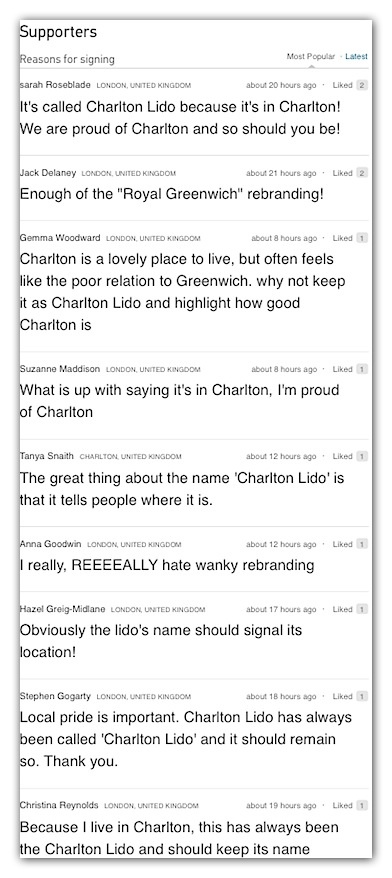
Petition Comments

Some feedback on Twitter:

Friends of Charlton Lido – time for action?

Charlton Lido - August 2012
Charlton Lido – August 2012

Following some vigorous discussion in recent posts about our lido potentially being renamed, and closing early for winter, the idea of forming a ‘Friends of Charlton Lido’ group has been mentioned and seems worthy of further investigation.

I thought it was worth floating the idea here first as a way of finding out if there’s sufficient interest; if there is, we’ll move things on and set up a public meeting to discuss it further.

A quick look at the website of Brockwell Lido Users Group shows what’s happening elsewhere – and highlights what’s not happening at Charlton at the moment.

Some questions to think about:

  • How would a Friends group engage with GLL and the council?
  • What are the overall aims and objectives for the Friends group?
  • Which of the other London lidos have successful Friends groups (and do we have any contacts there)?
  • How do we get started?

Some possible Friends group objectives for discussion:

  • to provide a forum to give GLL user feedback
  • to represent the interests of users of the lido and related facilities
  • to help build links between GLL and the local community
  • to campaign to secure the long term future of the lido in the interests of swimmers.

At the very least a Friends group could exist to gather feedback which would help GLL understand users’ likes and dislikes.

While a Friends group would sit independently of the Charlton Champion, it’s anticipated that the Champion would be a good platform to publicise it.

So what next?

A useful start would be a virtual show of hands: let us know in the comments below, on Twitter or by email (at neilclasper [at] gmail.com) if you think this is a good idea (don’t worry, this doesn’t amount to a commitment to get involved – though any willing volunteers would be extremely welcome!). And if you have ideas, advice, experience, or similar, then we’d love to hear from you. If there’s sufficient interest, we’ll draft some outline aims and objectives, follow up contacts at other lidos’ groups, then set up a public meeting to discuss the whole thing further.

Charlton House, Open House

Charlton House
Charlton House

There’s only one SE7 property in this year’s Open House London event: Charlton House will be opening its doors for tours on Sunday 22nd September. Areas open to the public will include the Minstrel Hall, Long Gallery, Grand Salon, White Room, Newton, Prince Henry & Dutch Rooms, Old Library, and the grounds. It will be open 10am-4pm, and entry is free.

Full information (including a detailed factsheet about Charlton House’s history and features) is on the Open House London website here.

UPDATE St. Luke’s Church will also be open 10am-4pm on Saturday and Sunday.

‘Year-round’ Charlton Lido to close for winter

Charlton Lido, 9 August

Lower-than-expected take-up of membership means Charlton Lido will close for the winter on Sunday November 3rd. In an email to Better Swim members, GLL explains that to-date it only has 144 members, where the equivalent scheme for London Fields Lido has 1,200 members. The lack of revenue from this scheme, plus the expectation that the “dryside” facilities will not start making a financial contribution until into 2014, mean they face “a significant financial problem keeping the pool open through the winter“.

Members will have the choice of suspending their membership until the pool reopens, or keeping it running for the other pools run by GLL.

The email lays out some of the costs of running the lido (£200-£500 a day to heat the pool in winter; 1000+ members required to make winter opening viable), and stresses the investment GLL has in making it a success: “We are hopeful that with the whole new complex ‘Royal Greenwich Lido, Charlton’ [sic] up and running next year we will be able to attract the necessary numbers to stay open all year round. GLL will have invested £4m of our money and £1m of Partners money by the time the scheme is finished, so we do need to make it work!”.

(As an aside, if you’ve not had your say on the renaming of the lido yet, you can vote here).

While the lido has clearly been much busier this year than last (thanks, presumably, to the improved weather, plus increased awareness of the pool), it would be interesting to know why take up of the membership has been so low. Are you a member? Have you considered it but decided against? Let us know why in the comments below.

(2nd aside: the lido is now closing at 7pm on weekdays, rather than 8pm as it was through July and August).

Charlton Community Gardens – September at the Station

ccg

An update and some dates for your diary from Charlton Community Gardens:

Autumn is just around the corner and our plans are turning to the next stage of the Charlton Station garden. In September we will have two clearing Sundays, followed by installation and planting of two more raised beds and planting a wildlife friendly area.

We look forward to gardening with many of our waterers and gardeners on the next two clearance days:

  • Sunday 1 September at 2 pm 
  • Sunday 8 September at 10 am

Please wear stout shoes, bring gardening gloves and garden forks, spades and loppers, if you have them. Don’t hesitate to come along without gloves and tools, though – as we have some to lend.

More news to follow on the raised beds and planting session(s).

Charlton history: The story of High Combe

High Combe

Ever wondered why there’s a blue plaque on the stately-looking house next to Our Lady of Grace School? Charlton Champion historian Peter Bone tells the tale of High Combe, which stands on Charlton Road…

In the 19th century, Charlton Road, between the Village and the Standard was lined with grand houses, mansions and villas. Most were demolished in the late 19th century to make way for new streets, homes and a growing population. The names of some of these lost houses – Eastcombe House, Little Combe, Bramhope Lodge, Springfield and Mascalls – were used to name the new streets that replaced them.

One of these grand houses, originally called High Combe, has survived. It’s now known as 145 Charlton Road, between church and school of Our Lady of Grace, and is now the church’s presbytery,

High Combe was built around 1825 in the fashionable Regency style. It’s a Grade 2 listed building, thanks to the pairs of rounded bay windows at both front and back, the central Doric porch and the original double door with rounded panels and fanlight above. You can read the full details on English Heritage’s website.

The house now looks a little overshadowed and cramped between the church and school, but a map from 1870 shows a grand sweeping drive in front of the house with entrances approximately where the church and school now stand.

There are plans to rebuild the school over the next few years, so let’s hope that the new school will improve the setting of this fine historic house.

The history of High Combe and the people who lived there reflect some of Britain’s economic and military history through the nineteenth century.

One of High Combe’s first residents was General Sir William Congreve (1772 – 1828). Congreve succeeded his father (also called Sir William) as Comptroller of the Royal Military Laboratories at Woolwich where he was responsible for developing new weapons for the British army and navy.

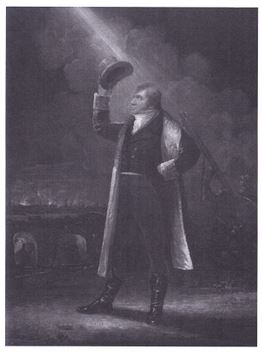
William CongrieveIt was a period when Britain was a dominant military power and had acquired a large empire. As Congreve (pictured right) himself said “England is at war with one half of the world, and has the other half to defend”.
He is best known for inventing the “Congreve Rocket”; rocket powered explosive shells. These were used by British: against the French in the Napoleonic wars, in suppressing a rebellion against British rule of India, and against the USA in the Anglo American war of 1812 – 1814. The line in the American national anthem “And the rockets’ red glare, bombs bursting in air” describes an attack onan American fort by the British navy using Congreve’s rockets.

Congreve was also an MP for Plymouth, banker, entrepreneur, and prolific inventor of mechanical devices. He was a friend of the King George III (mad George) and equerry to the king’s son George, the Prince Regent (think of George in Blackadder III, but much more unpleasant).

Things started to go badly wrong for Congreve in 1826, soon after he married and moved into High Combe. In a time when capitalism was rampant and unregulated, he was accused of fraud in management of one of the many investment companies he formed. Difficult meetings with shareholders and questions in parliament followed and Congreve’s health deteriorated. He died in 1828 in France. He may have been convalescing from his illness, but many claim he was fleeing from angry shareholders. Congreve’s wife re married in 1835 and subsequently lived in the City.

It’s not clear who was at High Combe immediately after Congreve, but by 1851 General Sir George Whitmore (1775 – 1862) and his wife Cordelia were living there. Whitmore was born into an aristocratic family and joined the Army Royal Engineers at the age of 14. His postings over the next 30 years, to Gibraltar, Malta, Corfu and the Caribbean, reflect Britian’s military rivalry with France, Spain and America.

In 1840 Whitmore was appointed Commandant of Royal Military Academy at Woolwich and the lived near the Academy at Woolwich Common. I think it’s likely that Whitmore moved to High Combe when he retired. Cordelia Whitmore died in Charlton in 1857 at the age of 70; George died in 1862 aged 84.

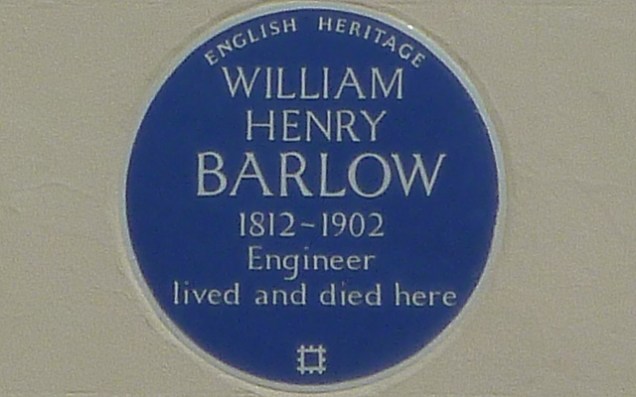
An English Heritage blue plaque on the front of the High Combe commemorates its next resident, the eminent civil engineer William Henry Barlow (1812 – 1902). William Barlow was born in Woolwich. His father, Peter Barlow, was Professor of mathematics at the Royal Military Academy, and his older brother Peter Barlow junior (1809 – 1885) was also a civil engineer best known for developing tunnelling technology that was important in building London’s early Underground.

WIlliam Barlow's blue plaque

William Barlow was famous for the design and construction of railways, bridges and iron and steel structures during the golden age of railway building. From 1838 he worked on the Manchester and Birmingham Railway, and became Chief Engineer for the Midland Railway in 1844. He advised Joseph Paxton, designer of the Crystal Palace about the iron fame of the Palace. Between 1862 and 1869 he oversaw the building of the Midland railway from Bedford to London and designed the layout and construction of St Pancras Station (but not the ornate hotel in front of the station ). He served on the court of enquiry into the 1859 Tay Bridge Disaster, and designed the replacement bridge.

William Barlow retired in 1896 but continued to live in some style at High Coombe. The 1901 census lists 7 house servants living there as well as a coachman and a groom living in at stables in the grounds. The histories of the dozens of servants who worked at High Combe would tell a less glorious story about Britain in the nineteenth century.

William Barlow died at High Combe in November 1902 and his wife Selina Crawford Barlow died there a few months later. High Combe was purchased by a French Catholic Community of Sisters from Bordeaux: the Oblates of Assumption. A small chapel was established in the house, but the population of the area was growing rapidly and congregations grew.

The building of Our Lady Grace church in the grounds of High Combe began in 1905 and was completed in 1911. The sisters started a school in the High Combe stables. Plans were made to build a new school, but these were delayed by World War I, and a new school building opened in 1927.