Would you cycle up Frances Street after riding through Kent and Essex? Daisy and Anatoliy did
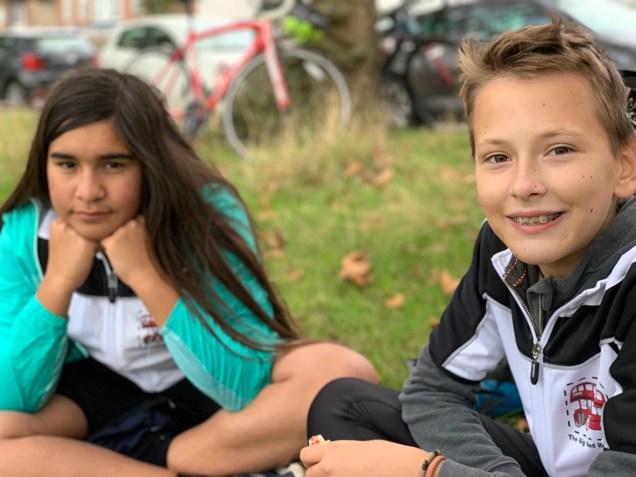
Two local 12-year-olds cycled 100 kilometres through London, Kent and Essex at the weekend to raise money for The Big Red Bus Club, the family wellbeing charity based in Charlton Park.
Daisy and Anatoliy, who met as three-year olds at one of the club’s free family stay and play sessions, cycled solidly for almost eight hours – and were inspired to take on the challenge after supporting adult cyclists who have completed the same charity ride in previous years.
They cycled for eight hours on Saturday, beginning and ending at the Big Red Bus Club, including the hills and crossing the river at the Woolwich and Tilbury ferries. Daisy and Anatoliy are trying to raise £1,750 for the charity.
Daisy and Anatoliy both almost a decade ago and were inspired to take on the mammoth cycle challenge after supporting the adult cyclists who have completed this charity ride in previous years.
Daisy said: “The best moment was the feeling of getting up Frances Street, the very last hill, and knowing at the top I was going onto the home stretch and I was going to do it. The worst moments were going up hills when I got a feeling in my legs that I couldn’t keep going, but I am so happy that I kept on and competed the whole ride.
“The Big Red Bus Club has been a part of my life since I was so little, I love walking past and seeing the new little children playing.”
Anatoliy said: “The best bit of the day was at 20 miles sitting down and having a hot chocolate on the Tilbury ferry. I can’t wait for next year.”
The Big Red Bus Club is open weekday afternoons for free stay-and-play for under-fives, run by volunteers.
The crossing is one of a number in Greenwich borough
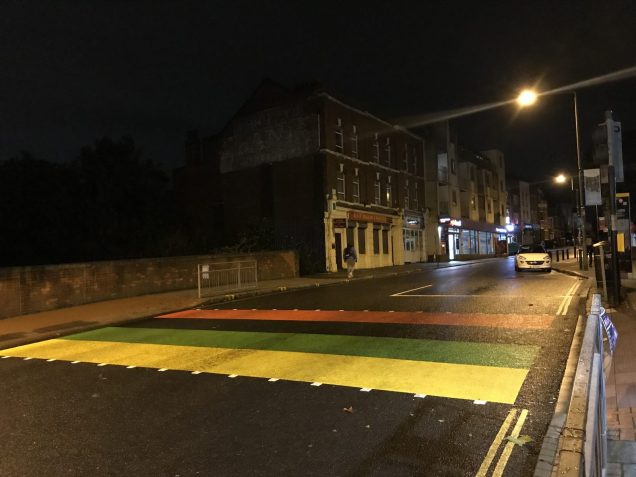
The pedestrian crossing at Charlton station has been given a new, colourful look to mark Black History Month. The crossing is one of four in Greenwich borough to have been painted in the pan-African colours of red, gold, green and black for October, and follows crossings in Greenwich, Woolwich and Plumstead being given a rainbow hue to mark Pride in London month during the summer.
Sponsors have covered the cost of the work – they include the developer U+I, which is redeveloping the former Siemens factory site by the Thames; and the housing association Peabody, which owns Charlton Triangle Housing. The other backers are Berkeley Homes, the Old Royal Naval College and Greenwich Hospital, the charity which owns Greenwich market.
A series of events are taking place across Greenwich borough to mark Black History Month, including a screening of Malcolm X at Charlton House on Friday 11 October and children’s workshops, also at Charlton House, on Saturday 26 October.
Going up: fans invade the pitch after the play-off semi-final win over Doncaster Rovers in May
Today marks 100 years since the first Charlton Athletic match at The Valley. The centenary will be marked at tomorrow’s match against Birmingham City, with Lee Bowyer’s side hoping to continue its excellent start to the Championship season. The first match in what was then known simply as the Charlton Enclosure, a 2-0 win for Charlton’s “A” team against Summerstown, took place in the South Suburban League – league football was still two years away.
The Addicks were founded as a boys’ team at Siemens Meadow, by the present-day Thames Barrier, in 1905. They became a senior team in 1913 – capitalising on Arsenal’s move to north London – and took over a ground at Horn Lane, east Greenwich, roughly where Ikea is now. But the club closed during the First World War, and the Angerstein Athletic Ground was requisitioned as a petrol dump. After the war, a reborn club played friendlies at Charlton Park and the Rectory Field while the club’s board prepared for its future.
In case you've not visited the museum before here's a colour map we lent the comms team for the 100th birthday of the Valley. We're in the top left hand corner : – ) Lots more museum content and articles in the special #cafc programme tomorrow and we're open 11 to 1. pic.twitter.com/Fbp1rxNDoa
The earliest evidence of Charlton at The Valley is a letter found in Greenwich Council’s archives, dated January 18, 1919, asking to borrow a steam roller from the local council as the club was “engaged in laying out a sports ground in Floyd Road, Charlton”. On May 13, 1919, the club’s newly-elected president, the Conservative MP for Greenwich, Sir Ion Hamilton Benn, told a meeting at the Mission Hall in Troughton Road (now Rathmore Youth Club) that Charlton had been invited to join the Kent League and would be playing at the new ground.
Volunteers did the work of converting the Charlton Sand Pits – known locally as The Swamp – into a usable football ground. Sir Ion, whose influence greatly helped the fledgling club, offered to act as guarantor for £700 of the £1,000 needed to do the work – but all the money was raised locally.
Facilities were basic, as Jimmy Seed, the club’s legendary FA Cup-winning manager, was to write in 1958:
“What a dump it was in those days without a stand or dressing rooms. The players changed in a nearby house and took their meals in a local pub. I recall how dreary The Valley was in 1920 when I played there for the first time for the Spurs reserve team against Charlton in a friendly game… After a cold, wet and thoroughly miserable day we were unable to take a bath or a shower, but had to stroll to a nearby hut so that we could change into our dry clothes.”
The club finished fifth in the Kent League in its first season at The Valley, and went professional in 1920, joining the Southern League. The year after that, Charlton became a Football League club, when it elected ten clubs into its new Third Division South.
But the switch to League football – and the punishing cost of getting The Valley up to scratch – proved costly. An FA Cup run in 1922/23 brought in the crowds, with 41,023 squeezing in for a fourth-round match against Bolton – but fencing collapsed, injuring spectators, and the cost of compensation is said to have wiped out the profit. Crowds shrank again, and in December 1923 the directors wrote off any chance of Charlton being able to draw a decent crowd in Charlton itself – and upped sticks to The Mount, in Catford. That move was even bigger disaster, with even smaller crowds of just a thousand, and the club’s directors moved back home for the following season, tails between their legs.
In the decades to come, Charlton would rise to the First Division under Seed, and attract a record 75,031 to a 1938 match against Aston Villa. The club entered a slow decline after relegation from the top flight in the 1950s, with crowds falling away and the stadium starting to crumble – despite occasional initiatives like bringing camels to the ground…
By the 1980s, and the aftermath of the Bradford City and Heysel stadium disasters, the Greater London Council moved to close the ground’s vast East Terrace. That, and a property row, led the club to repeat its mistake of 1924 and move out of Charlton in 1985, this time to Selhurst Park, leaving The Valley derelict and overgrown.
After a lengthy fans’ campaign – first against the club, then Greenwich Council – the Addicks returned in 1992, and the rest is history. Each side of The Valley tells a particular part of the club’s recent history – the Jimmy Seed Stand, the away end, dates from the late 1970s and is the only surviving structure from the pre-1992 ground. The East Stand, completed in 1994, was the first permanent stand to be finished at the rebuilt Valley, the west stand came at the time of Charlton’s first promotion to the Premier League. The huge Covered End, finished in 2001, which faces Floyd Road, is probably the biggest reminder of the club’s spell in the top flight.
Around 2000, the club flirted with the idea of a move to the Millennium Dome site, and in the early 2010s a move to Morden Wharf on the Greenwich Peninsula was mooted by the club’s then-owners. But despite the anniversary falling under the shadow of Belgian electronics tycoon Roland Duchatelet’s eccentric ownership, there are no plans for a third move away. 100 years after the first match, it is very hard to imagine Charlton without The Valley.
Come back on Monday morning for KEVIN NOLAN’s report from the Birmingham City match. Acknowledgements: The Jimmy Seed Story by Jimmy Seed (Sportsmans Book Club, 1958); The Story of Charlton Athletic, 1905-1990 by Richard Redden (Breedon, 1990); Home and Away with Charlton Athletic 1920-2004 by Colin Cameron (Voice of The Valley, 2003)
Metro Bank is planning to open a drive-through branch in Charlton – on land designated by Greenwich Council for long-term housing development.
The bank has agreed to take over the McDonald’s branch on Bugsby’s Way, and plans to knock it down and build a new building with drive-through facilities, so customers can do their banking without the bother of having to leave their cars.
In its planning application to Greenwich Council, the bank – which already has a drive-through branch in Southall, west London – says planning law already allows it to use the existing McDonald’s building. However, this would be “a missed opportunity to significantly enhance the site”.
The Charlton Champion has contacted McDonald’s to find out the fate of its current outlet; however, the fast-food giant’s lease runs out in October 2021. This website also understands that Metro Bank has been interested in moving into Charlton for some time, and at one point was in talks about moving into the Sainsbury’s M&S development on Woolwich Road.
Now Metro, which has high street branches in Bexleyheath, Bromley and the City of London, has opted for a drive-through branch – a concept common in the US, but which failed to catch on when introduced as an experiment by British banks in the 1950s. One remained in Leicester until the late 1980s, closing shortly after a car crashed into its entrance gate.
The Charlton Riverside masterplan, published in 2017, states that the Bugsby’s Way retail strip does not conform with the council’s “policy to promote Woolwich as a metropolitan town centre”.
It adds: “There is potential for some of the retail activity to remain, potentially embedded within new neighbourhood or local centres, but with a significant change to a mixed use form of development.”
However, as many of the retail barns have recently been built, the council does not envisage development starting on this part of the riverside until 2031.
Prudential, the insurance company, bought the whole Peninsular Park [sic] retail park – which sits between Asda and the Angerstein Wharf railway line and opened in the mid-1990s – in December 2016 for £38 million. Most of the leases run out next year or in 2021; the leases for the Smyths Toys and Tapi Carpet branches last until 2028.
Metro Bank, which rather optimistically refers to the area as “North Greenwich”, says it is aiming for a 25-year lease on the site – putting a spanner in any plans to rework the site for residential use until the mid-2040s. It says it will create 25 jobs with the proposal.
A letter from council officers submitted with the plans says: “The use of the building as a bank with drive-thru facilities will maintain the attraction of the retail park to customers and continue its economic contribution.”
In its transport statement, the bank claims most customers will use public transport or walk. The council’s transport officer raises no objection, saying there is an “abundance of parking available”.
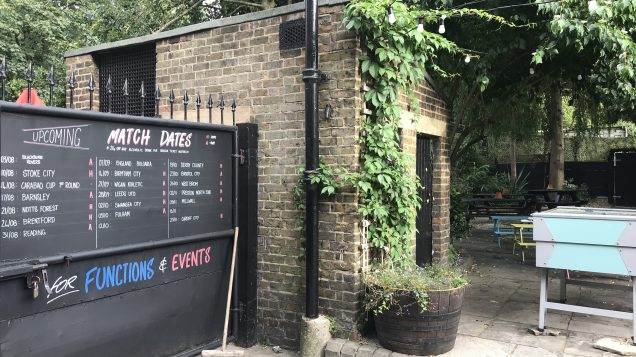
The road to the house’s bin store would run through this outbuilding and the beer garden behind
The company that owns the freehold to the White Swan pub has made its fourth application to build on land behind the pub’s beer garden – taking a strip off the pub’s beer garden in doing so.
Isle of Man-based Mendoza Ltd, which makes money through buying pubs and turning part of the land into housing, again wants to build a three-bedroom house on land behind the pub, although with a new design that takes inspiration from the Swan’s neighbour, The Bugle Horn. The plan eight months after a planning inspector threw out its last attempt.
In an application submitted to Greenwich Council, it says that planning officers are now supportive of the scheme, which would see the house face the Torrance Close service road behind The Village.
This access route would be extended to the new house
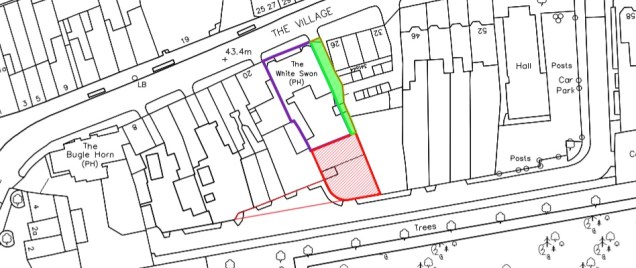
However, the new plan involves using the yard at the side of the pub – and part of the beer garden – as an access route so council bin lorries can collect refuse from the new house by driving in from The Village. Plans submitted by Mendoza show the road running through an outbuilding and the east side of the beer garden. Greenwich Council had told the developer that its bin lorries were too big to use Torrance Close.
While Torrance Close had been seen as unsuitable for new homes by many, the planning inspector who dealt with the last application did not agree, saying: “The local area to which the site belongs [Torrance Close] has an air of neglect and to my mind is capable of successfully accommodating a bespoke form of new development.
“The conservation area itself has no single unifying architectural theme and there is no obvious reason why it could not in principle readily assimilate a variety of new dwellings in terms of size and style.”
The access route to the bin store can be seen on maps submitted with the planning application
The developer says the design of the home is informed by “a visual analysis of the area”, citing the Bugle Horn and Charlton Assembly Rooms. “The immediate site context is interspersed with Victorian outhouses, chimneys, single and gable- pitched roofs, brick ornamentation, linear facades and window surrounds,” it says. “There is a sense of establishment with most buildings with specular geometries added to address function and enhance the parent form.”
The new 335 service will follow the red route to North Greenwich
Bus users who live on the western side of Charlton will get a new service to North Greenwich from October after Transport for London confirmed its new route, the 335, will run via Westcombe Hill.
The new double-deck service will run between Kidbrooke and North Greenwich every 12 minutes during Monday to Saturday daytimes and every 15 minutes during evenings and Sundays. TfL hopes to begin the service, which will provide relief to the often-overcrowded 108 route, on 26 October.
Two options were presented in a consultation, with the possibility that the route could run straight down the A102, as the current 132 service does now. TfL – backed by Greenwich Council – opted to for a route via Kidbrooke Park Road, Shooters Hill Road, Stratheden Road and Westcombe Hill, to follow the 108 to North Greenwich.
The Westcombe Society – an amenity society for the Westcombe Park area – had led objections to the route serving Westcombe Hill, which has been a bus route for over a century. According to TfL, the society said running via Westcombe Hill was “unacceptable to residents who already suffer from frequent buses on a residential road”. It claimed the area was already “well served for buses to Greenwich Peninsula and North Greenwich”.
Another group, the Westcombe Traffic Group, complained about noise and pollution and called for buses on route 132 to be given double-decker buses to serve passengers from Kidbrooke. Double-decker buses have operated route 132 for ten years. TfL plans to use hybrids on the new 335. (Read the full consultation report.)
While the new route will be of huge use to those who have struggled to squeeze onto routes 108 or 422 to North Greenwich, it remains to be seen whether buses will already be crowded by the time they reach Westcombe Hill. The service is being funded by money from Berkeley Homes, which is developing the Kidbrooke Village development; while Transport for London – which has been cutting services in recent years due to financial problems – says it is using business rates income to bring the introduction of the bus forward.
Neighbours disputed Rockwell’s images of what the scheme would look like
The developer behind plans to build 771 homes off Anchor and Hope Lane has appealed to planning inspectors to overturn Sadiq Khan’s rejection of the scheme.
Rockwell’s proposals, the first to emerge on the Charlton Riverside development area, were bitterly opposed by residents in Atlas and Derrick Gardens who feared their homes would be overlooked by the 10-storey blocks planned for the site of a trading estate.
Now Rockwell is putting its scheme’s neighbours through a third round of the fight by appealling to the Planning Inspectorate, where an inspector will decide on the development after a detailed public hearing.
Rockwell’s appeal is against Khan’s decision, not Greenwich Council’s. At the time, Khan said: “This is an underutilised, brownfield site in an opportunity area and very accessible. It is well-connected and in an area capable of accommodating growth. It is precisely the kind of site that we need to bring forward in order to create vibrant and active places, ensuring a compact and well-functioning city.
“However, I am clear that we must deliver good growth, not growth at any cost, where people have more of a say and don’t feel excluded from the process. I have listened carefully to the concerns of residents and considered the substantial amount of work done on the Charlton Riverside Masterplan. I consider that this is the wrong development for the site.”
Rockwell had hoped for approval for its development here
He urged Rockwell to “go back to the drawing board, in partnership with the community, the council and the GLA, to come up with a scheme that delivers on the strong ambitions we all share for the future of Charlton Riverside”.
But Rockwell have instead decided to challenge the decision. They may have been fortified by Greenwich’s Council’s approval of 10-storey blocks at Victoria Way – just outside the masterplan area – in January 2018 without any explanation to objectors, a decision that was later ratified by the mayor.
Rockwell’s scheme is one of five for the Charlton riverside, designated an “opportunity area” for redevelopment by City Hall. The other four are:
U+I plans 500 homes on the old Siemens glassworks site on the Charlton/Woolwich border, along with a co-working hub for local businesses and space for light industry. A planning application is also expected within weeks.






 The Charlton Champion