Organisers are planning another event on February 18 but now want a permanent licence to host them all year round
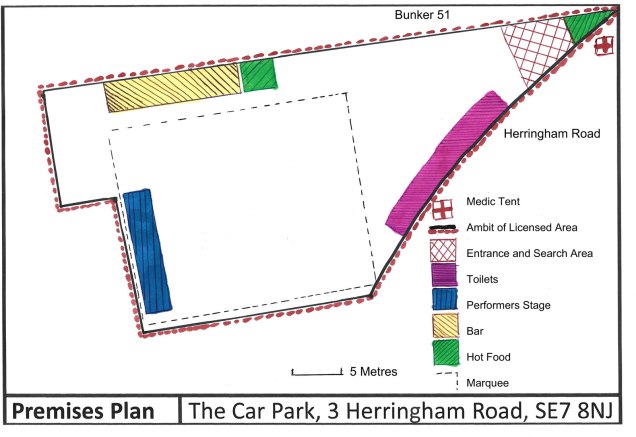
Plans have been lodged with Greenwich Council for outdoor raves to be held all year round in a car park close to the Thames Barrier.
A number of events have already been held on the site at Herringham Road, next to the Bunker 51 paintball venue, with residents complaining about noise on at least one occasion. Another event is planned for February 18.
Those events have been held with temporary licences, but now a newly-formed company wants a permanent licence to host 800 people on the site on Fridays and Saturdays, as well as Sundays during bank holiday weekends.
The application comes from Thecarparkldn Ltd, which was registered on January 15 by Andreas Millios at offices in Shoreditch, according to Companies House records.
Last year Millios had an application for an event in Morden refused by Merton Council after police objections, while a New Year’ Eve event in St Albans was also thrown out by the local council.
The nearest neighbours to the venue are actually across the Thames, in the Barrier Point and Royal Wharf developments in Silvertown, but this website is aware of noise complaints in Charlton from past events.
One objection seen by this website says that people living a kilometre away were kept up until 4am and added: “It sounded like a very loud party at the end of the road, but in fact it was an incredibly noisy party further away.”
An outline of the car park application can be downloaded here, which contains details of how to respond. All responses need to be made by February 27. To contact your local councillors, visit writetothem.com.
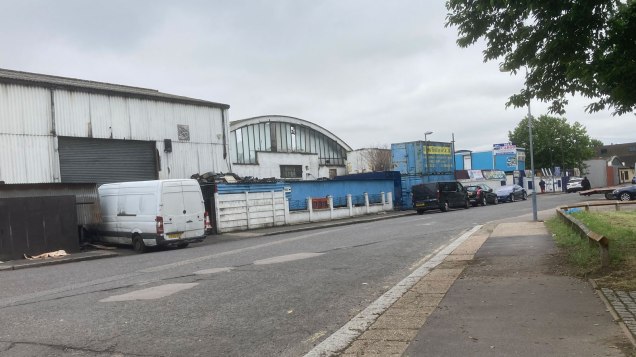
The car park is next to the Bunker 51 paintball venue
In 2018, the developer Komoto applied to build up to 500 homes on the car park site, which was home to the Johnsen & Jorgensen glass works until the early 1980s. Revised proposals were submitted in 2021, but little has happened since with the scheme, called Flint Glass Wharf.
Separate proposals for 1,200 homes on land surrounding the rave site were approved in March last year, with the area described as “horrible” by the chair of planning at the time, Stephen Brain, who approved the plans on his casting vote. Construction plans were recently submitted to the council, although a March start date for work on Herringham Quarter looks likely to be missed.
The site, behind the derelict Victoria pub, is billed as a “significant residential development opportunity” that currently generates £167,300 a year in rent, according to sales documents.
A neighbouring site, to be developed by the housing association Optivo, is unaffected by the possible sale.
There are plans to build up to 7,000 houses on the riverside, but the Aitch site is one of just three major projects to win planning permission and no work has started on any scheme so far.
Plans for a low-rise neighbourhood have been hampered by advice from the Environment Agency warnings that ground floors should not be occupied because of flood risks.
The Aitch development site as it is now, viewed from Eastmoor Sreet
There are also fears that a shortage of land for warehouses in inner London could mean that Charlton remains more valuable for industrial developers rather than homebuilders. One site once earmarked for homes – the VIP Trading Estate off Anchor & Hope Lane – has been bought by a company specialising in logistics hubs.
Representatives for Aitch and the company itself have not responded to requests for comment.
Optivo, which plans to build 67 homes for London Affordable Rent on the site next door, said: “We can confirm our plans for Evelyn House have not been affected. We’re still planning to deliver 67 homes with work due to start by the end of the year.”
But plans for a school fell through during the summer when the Department for Education pulled out of plans to buy part of an industrial estate on Anchor & Hope Lane, citing reduced demand.
The two schemes would bring 255 new homes to what is currently industrial land
A planning inspector has approved two new housing developments on the Charlton Riverside, including 107 homes for people on housing waiting lists, overturning Greenwich Council decision to refuse the schemes last year.
The twin schemes, for land behind the disused Victoria pub on Woolwich Road, are the second and third housing developments to get approval on the riverside after plans for 1,200 homes close to the Thames Barrier were approved in March.
A lobby group representing residents’ associations, Charlton Together, had objected to the Aitch scheme, but both were thrown out by Greenwich’s Labour-dominated planning committee last July for not fitting in with the masterplan drawn up for the Charlton Riverside.
Optivo’s plans for Eastmoor Street, with the Aitch scheme in white next door to it.
In that area, the masterplan suggests building three or four-storey townhouses to fit in with the Victoria and the former Lads of the Village pub – now a vets’ surgery – near by. Optivo is planning blocks of up to seven storeys, while the Aitch scheme goes up to 10 storeys.
But the planning inspector, Patrick Hanna, said that townhouses did not fit in with plans to build up to 7,000 homes on the riverside – or guidance from the Environment Agency that the lower floors could not be occupied in case of flooding.
“The townhouse typology is unlikely to be a realistic or optimal option at the appeal site, which in turn affects the ambitions for an intimate village feel in this location,” he wrote.
“As a consequence of these site constraints, it follows that when the [masterplan] is taken as a whole, and bearing in mind that it represents guidance only, its general thrust can reasonably and sensibly be taken to encourage medium rise developments.”
Having commercial units on the lower floors would be more attractive than townhouses with ground-floor garages, Hanna added.
Optivo’s site as it is now with the Aitch site to the right
Hanna also said that the council should have approved the schemes because the borough did not have a big enough supply of new housing coming up.
Despite the clear flaws in the masterplan, Labour councillors Gary Dillon and Jo van den Broek – elected last week for the new Charlton Village & Riverside ward – put it centre stage in a leaflet delivered to residents.
In a passage that may only have made sense to those involved in residents’ groups that have fought for lower-rise buildings on the riverside, they promised to “ensure that the communities’ voices are heard and that the spirit of the masterplan is respected”.
However, the inspector’s decision – and his explicit acknowledgement that aspects of the plan are flawed because they do not take into account flood risks – may now give future developers the confidence to aim higher when they submit their plans.
The development would make use of a jetty on the Thames. The Tarmac plant at Riverside Wharf is on the left
A plan to approve more than 1,200 homes by the Thames Barrier was approved by Greenwich Council last night on the casting vote of its controversial chair of planning, Stephen Brain.
The Labour councillor, who is standing down after the elections in May, goaded objectors by inviting them to send abusive emails as he broke a 4-4 tie by approving the project from the housing association Hyde.
“Start tapping now and I’ll read them in the morning,” he said.
Some of the future residents in the Herringham Quarter development in Charlton will face living in homes where they will not be able to open their windows because of concerns over air quality from an asphalt plant next door at Riverside Wharf.
The development site as it is now, as seen on Google Streetview
A representative of Tarmac, which operates the plant, said that the business would be under threat because the new blocks would tower over the plant’s chimney, and residents would be subjected to nauseating smells.
A string of residents’ lobby groups also complained that the development was too dense. But their complaints were dismissed by Brain, meaning the first major development on the Charlton Riverside – earmarked for up to 8,000 homes in a City Hall blueprint – has been given the go-ahead.
Hyde plans to build 718 homes along with commercial units at Herringham Road and New Lydenburg Street, close to the Thames Barrier, in blocks of up to 10 storeys. The first residents could move in by 2026. Hyde was also given outline permission for a further 494 homes, and will return with more detailed plans in the future.
The land concerned – Plots A and C could be finished by 2026. Plot B is the Tarmac plant. Detailed plans for plots D and E will follow
Of the first phase, 263 homes for London Affordable Rent, about half market rent and available to people on housing waiting lists, comprising 37 per cent of the total number of homes. Another 133 homes (18 per cent) will be for shared ownership, with the remainder going on private sale.
There will be more private homes in the later stage, taking the proportion down to 40 per cent “affordable” housing across the site.
Some of the blocks will be built on the site of Maybanks Wharf, currently a recycling yard for Westminster Waste, but the Tarmac yard will remain.
Tito Arowobusoye, a planning consultant representing Tarmac and other local wharf operators, said a third of London’s construction aggregates were processed in the local area – a local industry that could be put at risk if new neighbours were not protected from air quality and pollution.
An air quality expert, Gordon Allison, said the Tarmac plant would be eventually be hemmed in on two sides, with Hyde’s block just 60 metres from the chimney. “In my 25 years in the industry I’ve never seen a proposal where the building will be hit by a plume from an industrial chimney stack,” he said.
Herringham Road, close to the development site, in 2020: Planning chair Stephen Brain said the area was “not pleasant”
“It’s not a sensible proposal – when the wind blows, it will hit the nearest building. Chimneys should be taller than the buildings nearby.”
Allison warned that odours from the plant could also be an issue. “I find it nauseating, even though I’ve worked in the industry my whole career,” he said.
The solution – to fit affected flats with sealed windows and mechanical ventilation – was “unproven”, he added. “There is a genuine risk of nuisance complaints that hasn’t been recognised.”
Asked by Brain if he thought development by the Tarmac plant was impossible, he said that it was not – but that the buildings should be set further back, or the developer should pay to make the chimney taller.
A view from the Thames, with the Tarmac plant on the left
Trevor Curson of Buro Happold, an environmental consultant to Hyde, said that the developer had planned for a worst-case scenario of the plant operating 24 hours a day, 7 days a week – something it does not do.
After hearing of complaints from residents of Greenwich Millennium Village whose homes back onto the Murphy’s Wharf aggregate depot, said that future residents would be better protected from noise than in other nearby developments. One 10-storey block was to shield residents from the noise of the Tarmac plant, the committee heard.
Representatives of several overlapping lobby groups in the Charlton area criticised the scale of the development. Jodie Coughlan, speaking for the Derrick and Atlas Gardens residents’ association – the only group actually based on the riverside – saying it was an “unreasonable and untenable level of deviation” from the local masterplan, which sets maximum heights of three to five storeys for much of the area.
While Hyde said that their blocks, which would step down to six storeys at street level, were at a human scale, the groups disagreed, with the Charlton Central Residents Association’s David Gayther calling it “monolithic in nature”.
Maybank Wharf has been used for waste paper processing since the 1960s – but will soon see new housing
Hyde’s Jaime Buckley said that the housing association had “a limited window” in which to build the scheme because it depended on a £22.5 million grant from City Hall – £60,000 for each affordable-rent home.
Promising the scheme would be a “catalyst” for redeveloping the rest of the riverside, she urged councillors to balance “not just what is desirable, but what is achievable”.
While Hyde will be paying towards new bus services and new roads, Charlton councillor Gary Dillon voiced concerns about the effect of the development on local infrastructure.
Pointing out that the Charlton Riverside masterplan was created with up to 5,000 new residents in mind, but now City Hall was expecting up to 8,000, he said: “Those people who live between Greenwich and Woolwich Dockyard know how fragile the infrastructure is. We’re sometimes waiting for two hours to move five minutes up the road.
”My concern is that developers are looking at this [City Hall] aspiration taking at gospel, but it has no support – there’s no infrastructure development plans or TfL budget to develop new links, and there’s the possibility of extra traffic from the Silvertown Tunnel.”
Hyde’s vision of Herringham Road in the future
Conservative councillor Nigel Fletcher also said he would turn down the scheme, saying that the whole point of the Charlton masterplan was to create somewhere distinct from the towers of Greenwich Peninsula and Woolwich: “It’s really frustrating that when we want to see regeneration here, we’re presented with things we can’t accept because they’re inconsistent with the masterplan.”
Of the three women on the committee on International Women’s Day, none gave their views, while four of the five men did.
Brain said: “I know this area very, very well, how many objectors live near this site? Not many. I see one hand out of all the speakers. It is not residential, it is not pleasant, I’ve had my car serviced there for 30 years.
“The area is horrible, this provides an opportunity to improve the area. If we turn this down, how do any of the applications for the riverside go forward?
“I wouldn’t like to be on the doorsteps saying I’d turned down a great big chunk of social housing. We’d be turning down the futures of many of our residents.”
Brain was joined by fellow Labour councillors Sandra Bauer, Clare Burke-McDonald and Averil Lekau in supporting the scheme, but Labour’s Dillon and Fahy voted to turn it down, along with Fletcher and Geoff Brighty for the Conservatives.
The development would make use of a jetty on the Thames. The Tarmac plant at Riverside Wharf is on the left
Plans to turn the Charlton riverside into a residential district could take a giant step forward next week if councillors approve over 1,200 new homes on what is currently industrial land.
But some residents face living in homes where they will not be able to open their windows because of concerns over air quality from an asphalt plant next door.
The Port of London Authority and the operators of nearby wharves have submitted objections to the Herringham Quarter project, saying that residents’ complaints about air quality, noise and smell could threaten their businesses.
The land concerned (not the blocks) – Plots A and C could be finished by 2026. Plot B is the Tarmac plant. Detailed plans for plots D and E will follow
Hyde housing association is asking for detailed permission to build 718 homes along with commercial units at Herringham Road and New Lydenburg Street, close to the Thames Barrier, in blocks of up to 10 storeys. It also wants outline permission for a further 494 homes, which could follow in the future.
Councillors are due to make a decision on the scheme next Tuesday, at a meeting of Greenwich’s planning board, the committee that deals with the biggest developments in the borough.
The blocks would be up to 10 storeys high, with some to be built on the site of Maybanks Wharf, currently a recycling yard for Westminster Waste.
The Tarmac asphalt depot next door would remain in place. The first homes could be ready by 2026.
Hyde’s application is the biggest Charlton Riverside scheme to reach councillors since the notorious Rockwell scheme for land off Anchor and Hope Lane, which has now been abandoned after Greenwich Council, City Hall and the government all rejected proposals for 771 homes there. The site is now to be used as a “last mile” logistics depot.
So far just one home – a flat at the derelict Victoria pub, which is to be turned into a pizza takeaway – has been given approval out of a potential 8,000 new homes in the area.
The proposals have changed since the scheme was first unveiled in 2019, with “affordable” housing now making up 55 per cent of the total in the first phase of the scheme.
Hyde’s plans include 263 homes for London Affordable Rent, about half market rent and available to people on housing waiting lists, comprising 37 per cent of the total number of homes. Another 133 homes (18 per cent) will be for shared ownership, with the remainder going on private sale.
The second phase of the scheme will include more private housing, taking the “affordable” total down to 40 per cent across the project.
However, the quality of life for people who move into the homes has been questioned by the operators of Murphy’s, Angerstein and Riverside wharves, who say that complaining residents could put their noisy businesses at risk of closure.
Hyde’s vision of Herringham Road in the future
They also warn that the introduction of residents living so close to the trajectory of the chimney stack emissions will make it unlawful for Tarmac to operate the asphalt plant at Riverside Wharf under its current permit.
The Port of London Authority has also objected, saying that Riverside Wharf needs to be able to operate 24 hours a day because of tidal movements.
In response, the developer is proposing that people living in affected properties will have “sealed units with no openable windows which will be fitted with mechanical ventilation”.
Council planners say that this mitigation is “considered to be acceptable such that undesirable conflict with the uses at the wharves will be avoided”.
A view from the Thames, with the Tarmac plant on the left
Just 90 car parking spaces will be provided, with Hyde expected to pay for a new bus route to serve the site – expected to be an extension of the 301 service to zone 4 Woolwich station rather than a route to zone 3 Charlton or zone 2 North Greenwich.
Developers in the area will be expected to pay £3,000 per home to Greenwich Council for new roads, and £2,800 to TfL for new bus services.
The council is also looking for a site to place a new primary school, after concluding that a planned school on Anchor & Hope Lane would provide insufficient spaces as it would also be serving the Greenwich Peninsula. Hyde will have to pay £915,000 towards that.
The local NHS is to get £1.1m in extra funding for GP services as the commercial units on the site are too small to include a health centre; the council’s GLLaB job brokerage will collect almost £1.3 million from the scheme.
One factor that will weigh heavily on the developer’s side is that Greenwich only has a three-year supply of new housing on the way – it should, by law, have five. This is enough to get a refusal overturned on appeal – putting pressure on councillors to back the scheme.
Rockwell had hoped for approval for its development here
Controversial plans for 771 homes off Anchor & Hope Lane have finally been scrapped after the site was sold to a company promising to revamp it as a logistics hub.
Rockwell’s proposal for the VIP Trading Estate was the first to come forward as part of plans to transform the Charlton riverside to provide up to 8,000 new homes. The scheme was fiercely opposed by residents of Atlas and Derrick Gardens, whose homes would have been in the shadow of the proposed blocks, as well as community groups, councillors and local MP Matt Pennycook.
Rockwell’s proposals were rejected three times
The scheme was rejected by Greenwich councillors in 2018, with Sarah Merrill, the chair of planning at the time, saying it was “reminiscent of Stalingrad”. The decision was called in for scrutiny by Sadiq Khan, who rejected it himself. Rockwell then appealed to a planning inspector, but the scheme was rejected a third time.
Greenwich Council officers had originally recommended approving the 11-block development.
After Rockwell lost its appeal, the site was sold by its owner, the property investment company Zenprop, to another property company, Falconbrook. An industry website, React News, reported that Falconbrook had talked to Greenwich Council about building homes on the land.
The VIP Trading Estate will now become a logistics hub
GLI, which has already snapped up sites in Park Royal, Mitcham and Croydon as part of a push into London, said the revamped hub “will be highly energy efficient and redeveloped on a net zero carbon basis”,
The sale will be a setback to Greenwich and City Hall’s plans for new housing on the Charlton riverside, which have so far yielded just one new home – a flat at the Victoria pub, which is being redeveloped into a pizza outlet – after two other schemes were also refused.
The developer Aitch Group and the housing association Optivo are appealing against the refusal of their plans for new housing off Eastmoor Street, near the Thames Barrier, which together would have provided 255 homes, including 107 for affordable rent. Aitch has also submitted a new application for 149 homes on its site, with just 11 for affordable rent.
Despite the bus, this is the view from Westmoor Street
Local people waiting for housing could lose out after a developer submitted a new plan for homes on the Charlton Riverside, just a few months after Greenwich councillors threw out their first scheme.
Last year, Aitch Group’s plans for 188 homes on land between Eastmoor Street and Westmoor Street, close to the Thames Barrier, along with shops, workspace and a new green space were thrown out by Labour and Conservative councillors who objected to its height. It comprised two blocks of five to nine storeys.
The Coopers Yard development would have included 40 homes for London Affordable Rent – available to people on Greenwich borough’s 23,000-strong housing waiting list – and 10 for shared ownership, making a total of 30 per cent “affordable” housing.
Aitch says its scheme mostly conforms with the masterplan
Aitch has now appealed against that decision, but has now returned with a new application to build 149 homes in blocks of up to eight storeys as well as retail and business space.
In the new scheme, just 11 homes would be for affordable rent, and four for shared ownership with the new application – making just 11 per cent “affordable” housing.
A view of the new proposals, looking towards Woolwich Road
Local lobby groups, including the Charlton Society and the Charlton Central Residents Association, were enraged by the original plans for buildings of up to nine storeys, believing this broke the terms of a masterplan they were closely involved in writing.
However, they are unlikely to be won over by the new plan, which is just one storey shorter.
Eastmoor Street as it is now. The flats would overlook Barrier Gardens on the right
A four-year-old masterplan for the Charlton Riverside – which both Greenwich Council and City Hall have long earmarked for thousands of new homes – suggests a maximum height of ten storeys for buildings, with guidelines of three to five storeys in that particular area.
The situation is complicated by the Environment Agency objecting to ground-floor housing close to the Thames Barrier because of the risk of flooding – an objection which calls parts of the masterplan into question.
Similar concerns also led to a second scheme on a site next door, from the housing association Optivo, also being rejected, with councillors voting down 67 affordable-rent flats. Optivo has also launched an appeal.
This site could be transformed if Aitch gets its way
Apart from the lower heights and lack of “affordable” housing, the revised Aitch scheme is largely the same as the one rejected last year, with a “green link” to Barrier Gardens between the two blocks of housing, and an eight-storey tower on the corner of Mirfield Street and Westmoor Street.
The entire area is currently industrial land at present. With the exception of a single flat behind the derelict Victoria pub, no proposals for the Charlton Riverside have been approved since the masterplan was approved in 2018. Plans for a second flat are awaiting a decision.











 The Charlton Champion