The plant sale usually take place at Charlton station
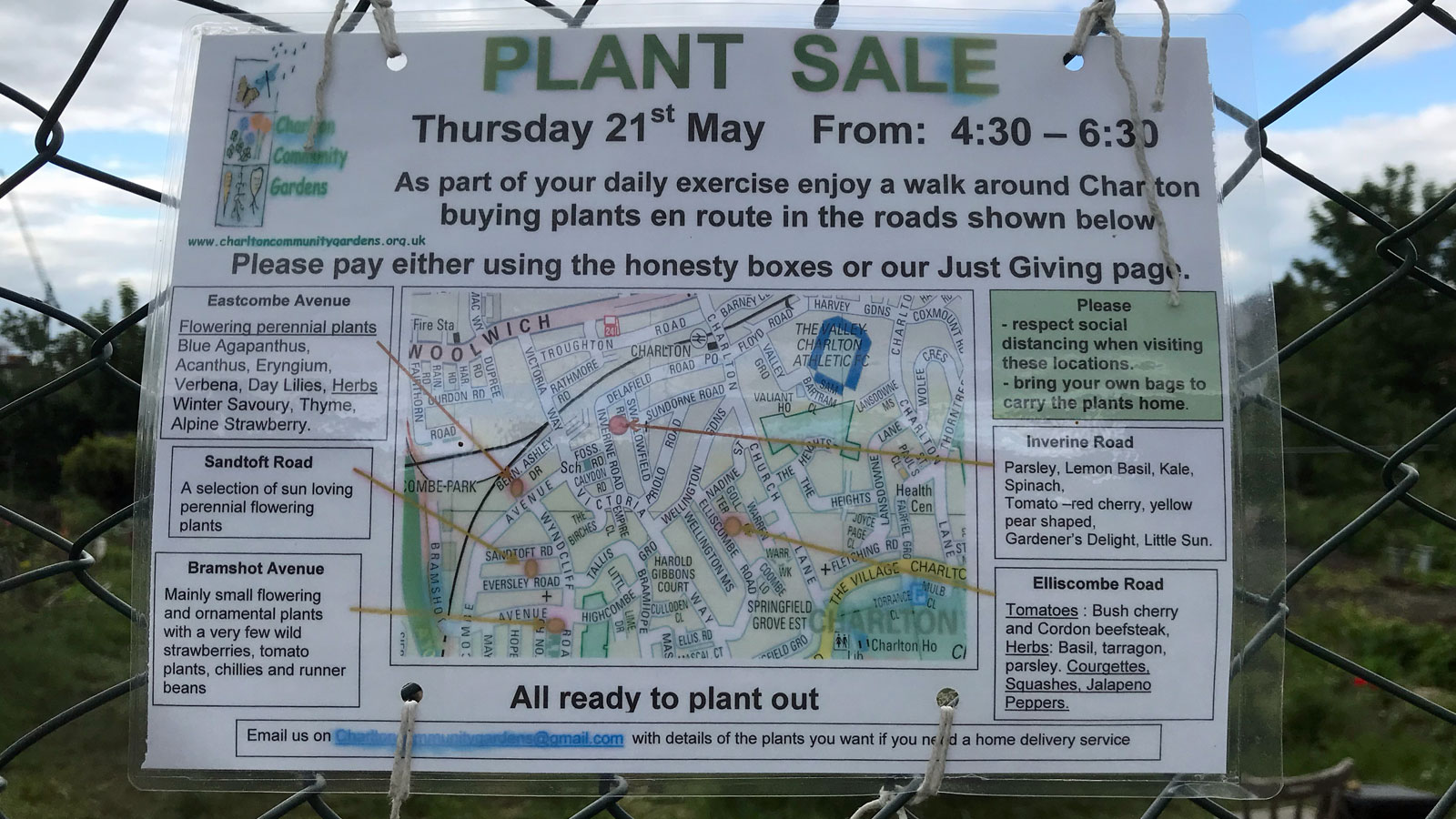
Every year, Charlton Community Gardens holds a plant sale at Charlton station. Then the coronavirus struck and put paid to that.
So this year, the group is having a socially-distant plant sale on Thursday 21 May between 4.30pm and 6.30pm – you’ll be able to buy from local front gardens in Eastcombe Avenue, Sandtoft Road, Bramshot Avenue, Elliscombe Road and Inverine Road. You can pay online or through honesty boxes.
It’ll be better than the queue for B&Q and you can get some exercise into the bargain.
Valley House in March: There wasn’t a lot happening two months ago…
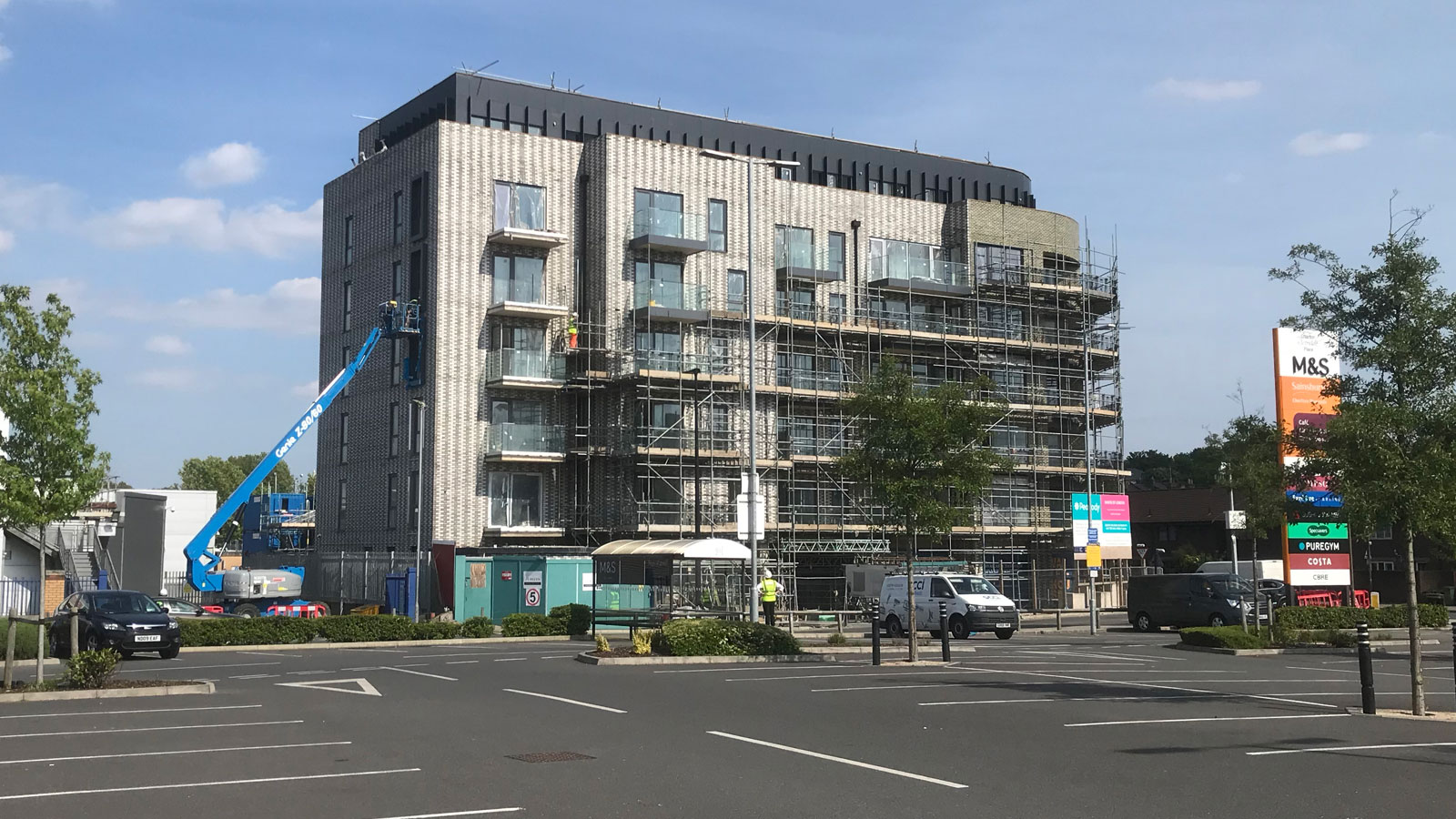
It’s been the most puzzling development in Charlton since the last puzzling development. What on earth happened with the big building site next to Sainsbury’s?
At the time, the development was largely private. Work on 73 flats – 62 private, four for shared ownership and seven for social rent – began more than three years ago. They included 22 studio flats, 3 1-bed flats, 37 2-bed flats and 11 3-bedroom flats. Progress since then has been sluggish. Commuters who use Charlton station have, however, lost the view of Canary Wharf from Delafield Road.
“The queue to Sainsbury’s is only back to the bus stop, shall I get some milk?”
The housing association Peabody has taken over the scheme from developer London Green. Two months ago, just before lockdown – in fact, at the last planning meeting before everything ground to a halt – Greenwich Council gave permission for the scheme to be reconfigured. The biggest change was that the scheme was now becoming 100% “affordable” – in reality, this means there will be 54 flats for shared ownership and 19 flats for social rent. The 22 studio flats would become proper 1-bed flats, although a lift would be removed, the concierge would go, and the Breeam rating (a measure of energy use and sustainability) was downgraded from “excellent” to “very good”.
Scaffolding has come down in recent weeks
Since then, work has been going on – at a distance, of course. And this weekend, Peabody is launching the scheme to buyers. “So much to see. So much to do. So much to come. That’s what we love about Charlton. An area experiencing regeneration but already well served by shops and transport.” Oh heavens. “In the age of Uber Eats it might be all too tempting to order in to your sleek new pad, but you don’t have to stray far if you’d rather a night out. Within a few minutes walk dependable chains like Frankie & Benny’s and Nando’s rub shoulders with local favourites such as seafood restaurant Winkles, the riverside Chef House Kitchen and tempting Thai joint Cattleya.”
Winkles, the van outside the Anchor and Hope, will no doubt be delighted it’s been upgraded to “restaurant”.
Anyhow, should you fancy somewhere “located in Greenwich” (nope) or “located close by North Greenwich station” (good luck with that), you can check it out on the Peabody website.
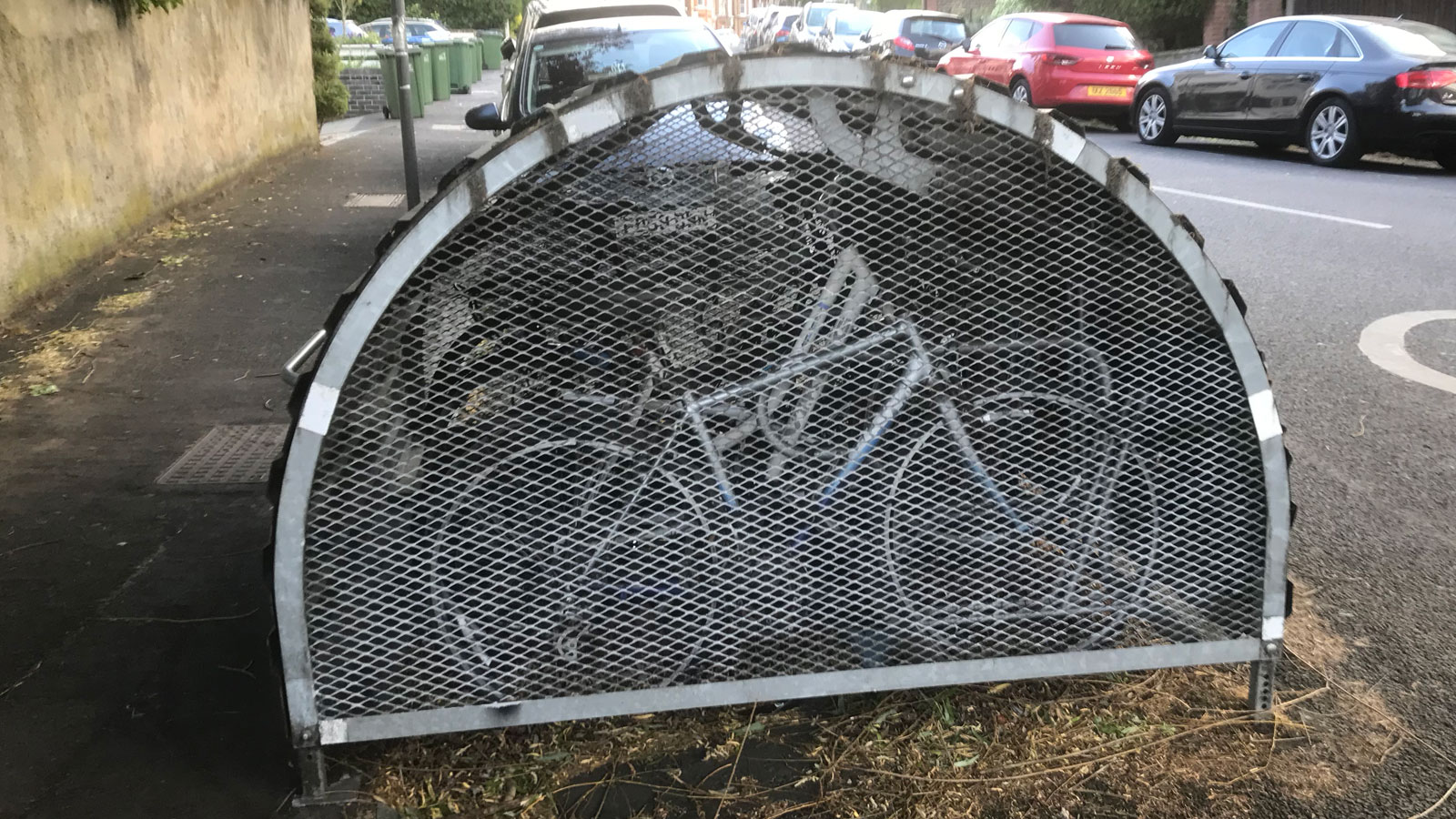
Residents in Eastcombe Avenue and Sandtoft Road are to get secure cycle parking spaces after residents asked Greenwich Council to install them.
The town hall is putting the lockable cycle hangars in place after it won £120,000 in funding from Transport for London last year. In total, 13 different locations around the borough – mostly in Greenwich itself – will get the hangars, while new cycle racks will be installed in Greenwich South Street in place of car parking.
Nine residents wrote to Greenwich Council to complain about the proposal, stating that neither they nor their neighbours cycled. Other residents complained about a lack of car parking space in general. However, the council received 28 separate requests for secure cycle parking in the area.
The hangars will take up the space of half a parking bay.
Residents who would like secure cycle parking on their street should contact Greenwich Council – its officers usually act when three separate households have asked for a hangar.
Another cycle hangar in Coleraine Road, Blackheath, close to Westcombe Park station
Meanwhile, residents are still waiting to see what action Greenwich Council will take to make cycling and walking easier during the coronavirus crisis. At the weekend, council leader Danny Thorpe insisted that plans were in hand to open up streets to people on two wheels and two feet and close roads to rat-runners – however, it remains to be seen whether any of the schemes will tackle notorious trouble spots in Charlton such as Eastcombe Avenue and Victoria Way.
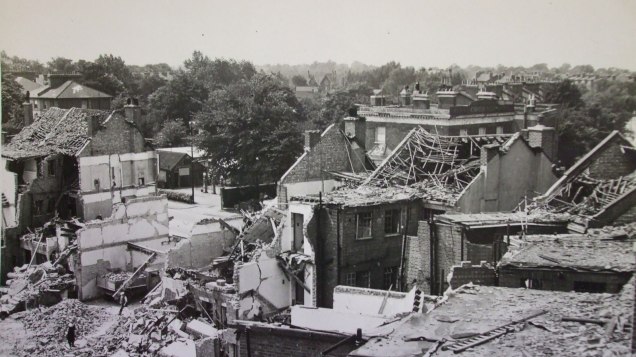
The damage to Stratheden Parade, opposite the Royal Standard in Blackheath
As we mark the 75th anniversary of VE Day, still under lockdown, there are still plenty of reminders of our wartime past in the area. Many of them are hiding in plain sight. Historian STEVE HUNNISETT takes us on a Second World War trail to show you what there is to discover in and around Charlton.
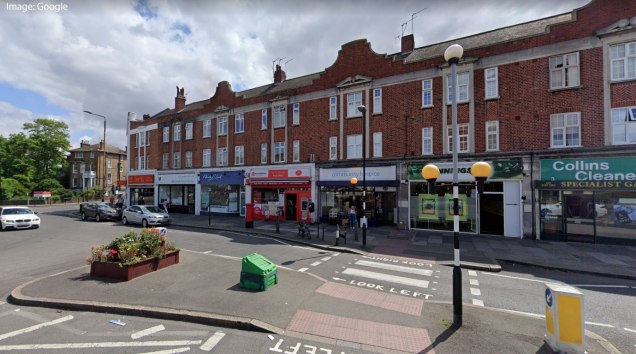
We start our walk adjacent to the Royal Standard pub. Take a look at the arcade of shops that we know as Stratheden Parade. These were rebuilt after the war, replacing those destroyed in a V-1 flying bomb incident on 21 June 1944.
Stratheden Parade in 2019 (image: Google)
The photo at the top of this tour below shows the scene immediately afterwards. You can just see the top of the Royal Standard peering above the ruins in the right middle distance.
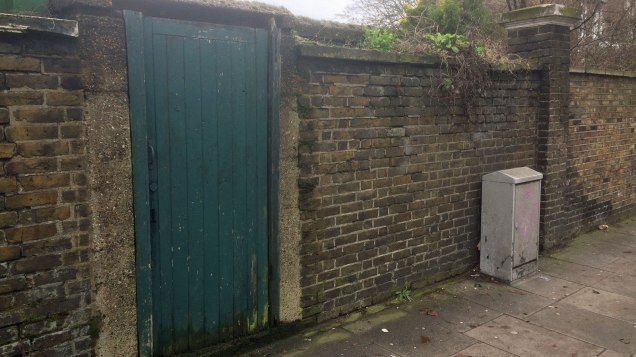
As we set off along Charlton Road, heading towards SE7, you can see an innocuous-looking wooden door by the bus stop.
An innocuous-looking door on Charlton Road…
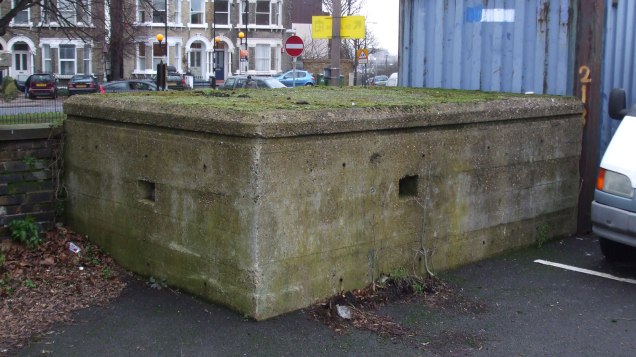
Step back slightly, and you will see a concrete slab roof. If you venture into the car park of Bernard’s Club (Combe Lodge), you will see a concrete structure that looks to be at a slightly odd height. This is due to the car park level having been built up over the years.
…what’s behind the wall
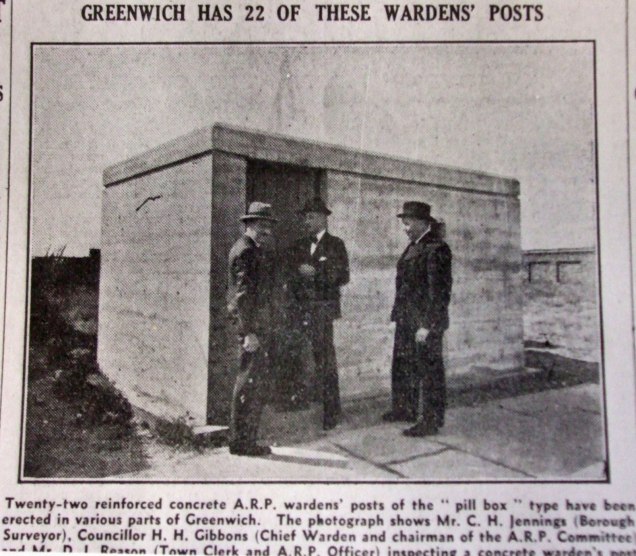
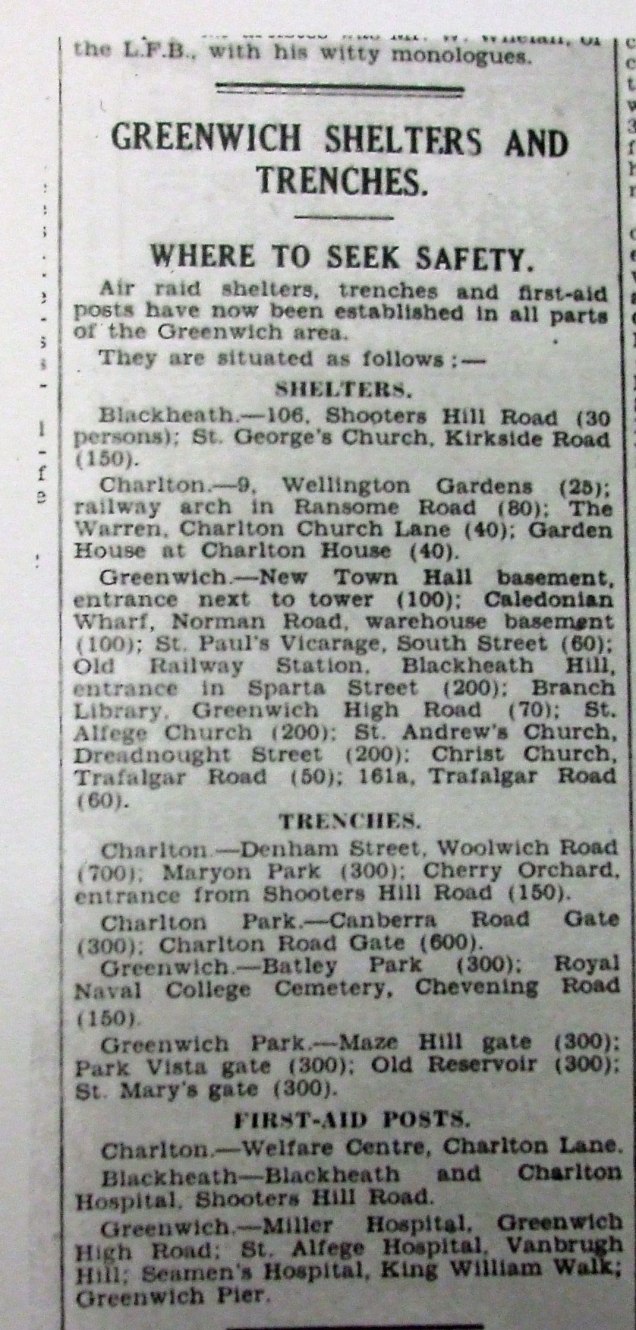
This is the former air raid precautions (ARP) wardens’ Post “Park 20” of the Metropolitan Borough of Greenwich. These were a standard design, as the contemporary newspaper article shows us. This post was one of a network across the borough that housed the air raid wardens who patrolled a local beat during air raids, acting as incident officers to co-ordinate the response to individual bomb incidents.
“Is that a light?”
During “all clear” periods they would continue their patrols, and would be on the lookout for infringements of the blackout – no doubt telling local residents in true Dad’s Army style to “put that light out!”
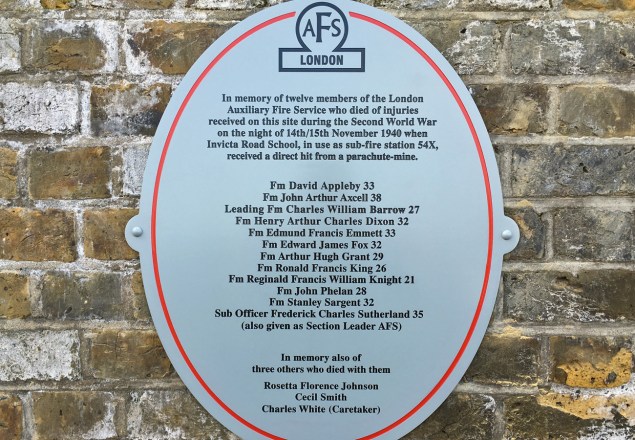
If you cross the road and take a brief detour into Invicta Road, it might be possible to catch a glimpse of a commemorative plaque in the school playground, fixed to one of the surviving walls of the original school building.
The plaque was erected in 2017
The plaque tells us that the school, whose wartime pupils had been evacuated to the safety of the countryside, was in use as Station 54X of the Auxiliary Fire Service. On 13 September 1940, one of the firemen based there, Arthur Grant, had been awarded the George Medal for his bravery in removing a 50kg bomb that had fallen through the roof of the school without exploding. He had carried it into the playground and covered it with sandbags to reduce the effects of any subsequent explosion. When the bomb did eventually explode, the damage caused to the buildings was minimal.
Sadly though, on the 14 November 1940, a parachute mine exploded which devastated the school buildings and killed 12 of the firefighters based there, as well as three civilians, including the school caretaker. Arthur Grant’s George Medal had been announced two days previously and he died without having the chance to have it awarded to him.
The damage to Invicta Road School
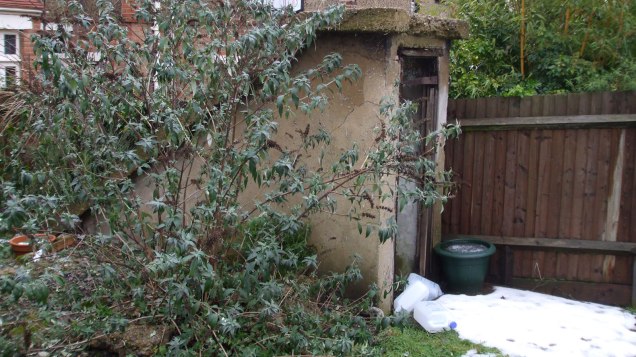
We’ll resume our walk along Charlton Road, but pause by the entrance to the Rectory Field. If you peer through the fence of the adjacent dental surgery, you can see a concrete structure in the garden. This is the entrance to a substantial air raid shelter. The reason that the house had this in the garden, rather than the standard Anderson shelter is that the house and the one next door to it had been requisitioned by the Army to house some of the guns’ crews for the anti-aircraft guns that were on the sports fields. (The shelter is usually filled with surplus furniture from the dental surgery, so cannot be accessed at present, although I will keep trying!)
The shelter behind Charlton Dental Surgery
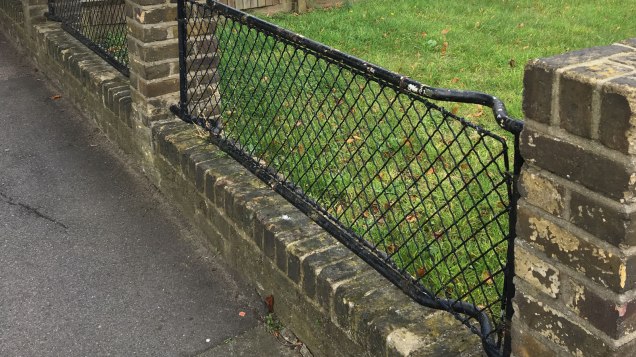
As we continue our walk, we swing right into Marlborough Lane. About halfway along on the right-hand side, we can see some examples of wartime “stretcher fences”. These were originally manufactured by the hundreds of thousands and were known as ARP stretchers, for use by the Air Raid Precautions service to deal with the expected mass casualties from any enemy air attacks.
Stretcher fences in Marlborough Lane
Fortunately, casualties were far lighter than expected and the vast majority of these stretchers were never used in anger. With the coming of peace, in an early example of recycling, the stretchers were used as railings, in many cases replacing wrought iron railings that had been sacrificed for the war effort in the production of steel.
From here, continue a short distance along Marlborough Lane, turn left into Sutlej Road and right into Canberra Road, before turning left into Hornfair Road. You will soon see the magnificent Charlton House on your right. Completed in 1612 for Sir Adam Newton, it subsequently became the home of the Spencer-Maryon-Wilson family.
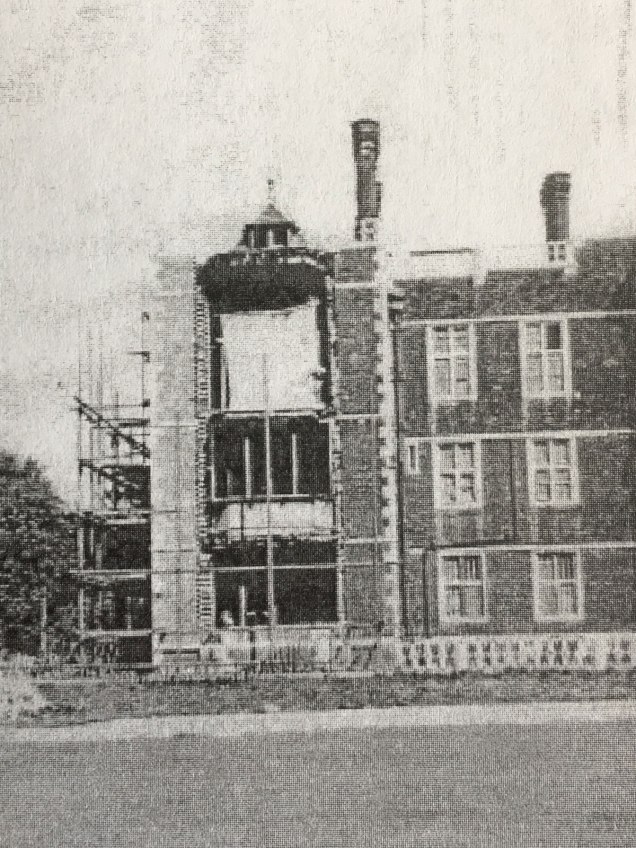
The wrecked wing of Charlton House
During the Great War of 1914-1918, it had been requisitioned for use as a military hospital and following the war, was purchased outright by the Metropolitan Borough of Greenwich for use as a library and as the borough museum. During the Second World War, the basement was used as an air raid wardens’ post. On 25 January 1945, the house was “near missed” by a V-2 rocket, the blast from which demolished much of the Chapel Wing. Repairs were made after the war but shortages of materials meant that non-matching bricks of a different size and colour had to be used, which today gives us a vital clue as to which part of the building was destroyed and which is the original.
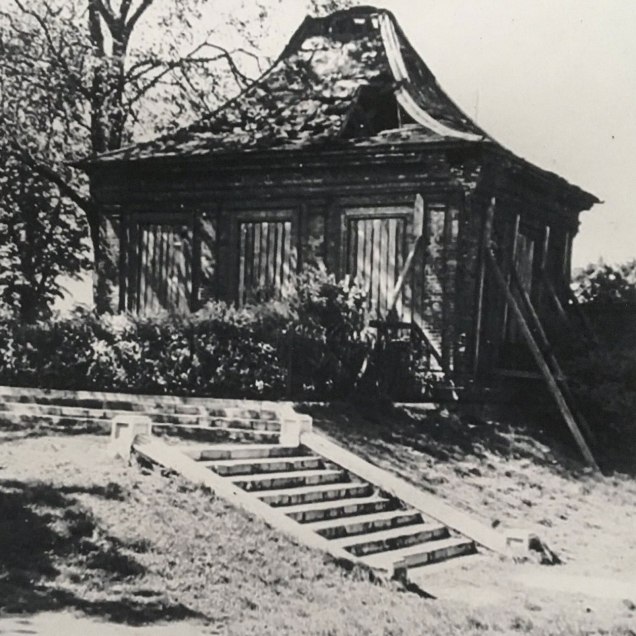
The summer house following the bomb
If we cast our eyes towards the attractive summer house, we can compare views with the building as it is now but also immediately following the V-2 blast, which left it in a state of near-collapse.
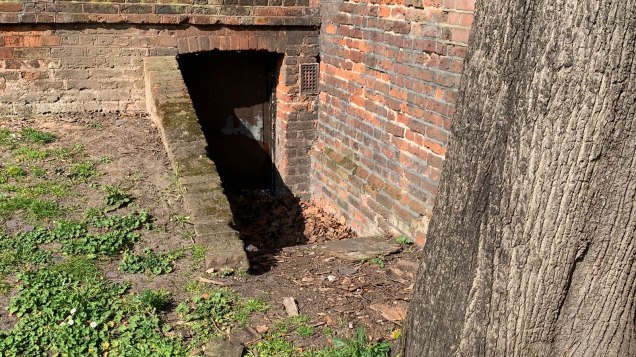
The entrance to the old Charlton summer house shelter
At the bottom right of the summer house, visible behind the fence that rings off the mulberry tree, can be seen a slightly obscured entrance. This was earmarked for use as an air raid shelter in 1939 and appears in the list published in the Kentish Independent at the outbreak of war. It was allegedly capable of housing 40 people but it is unclear whether it was ever actually used as such and it was certainly out of use by the time of the V-2 attack in 1944.
As we exit the park and turn right heading into The Village, we see opposite us St Luke’s Church and the War Memorial, in the shape of the Sir Reginald Blomfield-designed Cross of Sacrifice. The present St Luke’s dates from 1630 and the tower, which could be seen from the Thames, was once used as a navigational aid to ships using the river. As the church is entitled to fly the pre-1800 Naval Ensign on St Luke’s and St George’s Days.
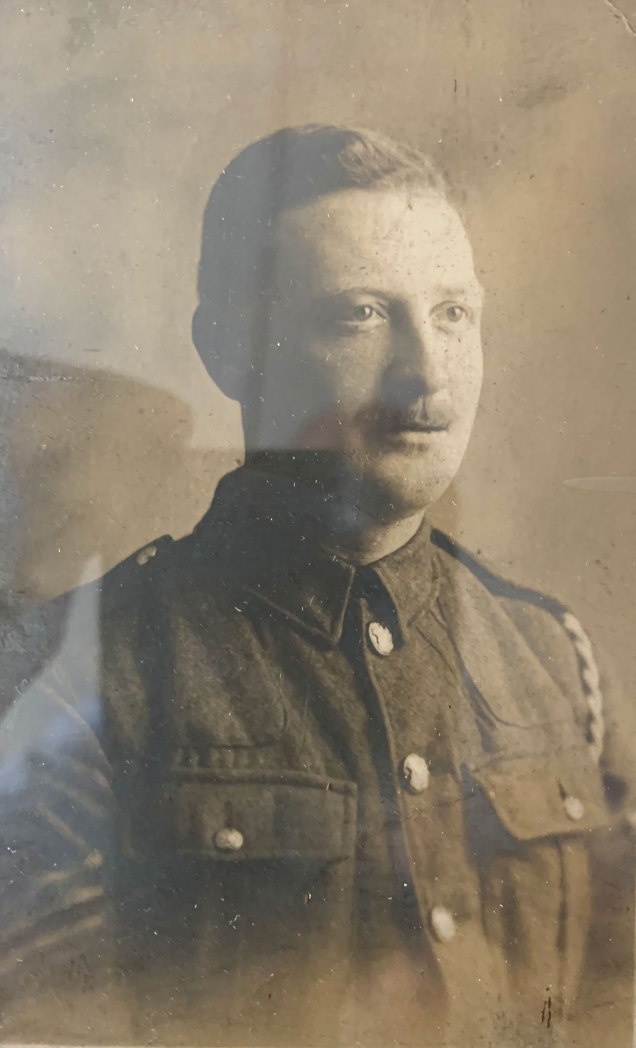
The tower was also used for firewatching duties during the Blitz and my grandfather, William Henry Beresford (seen here in his Army days), a local air raid warden, was frequently stationed here at that time.
William Henry Beresford, Steve’s grandfather
As you continue in to The Village, pause opposite the White Swan pub, now sadly closed since just before the lockdown began and the future of which remains uncertain. If you compare the pub in as-built form and how it appears today, you can see that it has a slightly truncated look to it. This was a result of events on the night of 17 October 1940, when a high-explosive bomb destroyed the Siemens Social Club, which once occupied the site now occupied by the more modern arcade of shops. The blast from this bomb also rendered the once-ornate top part of the pub unusable and in danger of collapse, leaving the pub with its present appearance.
The original White Swan with ornate upper floor and Siemens Social Club next door. Meridian Sports Club in Charlton Park Lane is the successor to the Siemens club
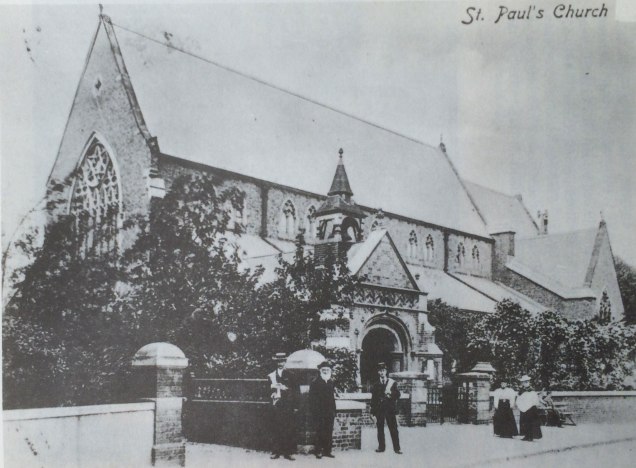
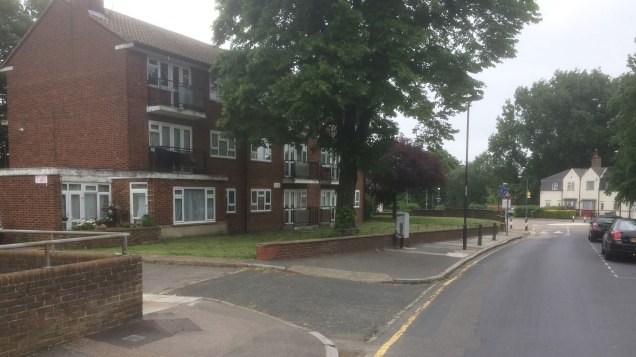
Now turn left from The Village into Fairfield Grove and pause at the junction with Charlton Lane. Today this is the site of an unassuming apartment block named St Paul’s Close. On this site once stood St Paul’s Church, which dated from 1867 but which has the sad distinction of being the first church in London to have been destroyed by enemy action during the Second World War.
St Paul’s Church as it was St Paul’s Close today
This came on 4 September 1940, before the “official” start of the Blitz when at 21:40 a single aircraft dropped a bomb at low level which hit the church, almost completely destroying it. There were no casualties but the church was deemed to be beyond repair. The following day, large crowds came to view the ruins but the novelty of such sights was soon to wear off. Some artefacts from the ruined church were salvaged and are now in St Luke’s Church, but the only remaining clue here lays in the name of the apartment block.
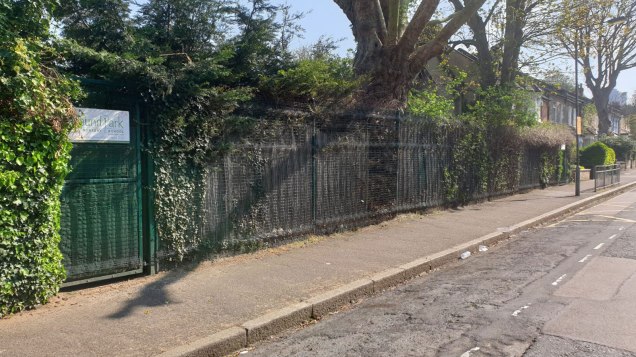
The site of the bombed houses on Charlton Lane
Continue down Charlton Lane but before you turn left into Harvey Gardens, pause and look into the near distance on the opposite side of the road, before the junction with Pound Park Road. This area is now part of the garden for the school, but in 1940 this was the site of a row of five houses. On the night of 8 December a high-explosive bomb demolished the houses, trapping five people inside.
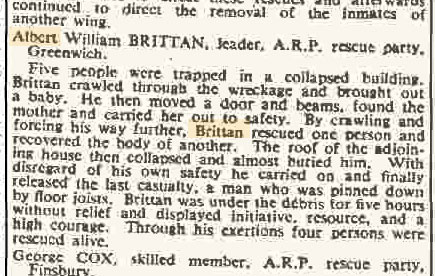
A rescue squad under the command of Albert Brittan soon arrived. Brittan decided to enter the ruins. Crawling through the rubble, he soon found a baby and brought it to safety. He went back in and found the baby’s mother, freed her and brought her to safety also. Going back into the ruins a third time, he rescued a third person and recovered the body of a fourth. Whilst he was doing this, the roof of one of the buildings collapsed and almost buried him. Undeterred, he carried on his work and freed another man who was pinned down. Brittan spent almost five hours in the ruined building and continued working with no regard for his own safety.
For this act of incredible bravery Brittan, who lived in Deptford and who had been a bus conductor before the war, was awarded a George Medal, as this extract from The Times of 26 April 1941 informs us.
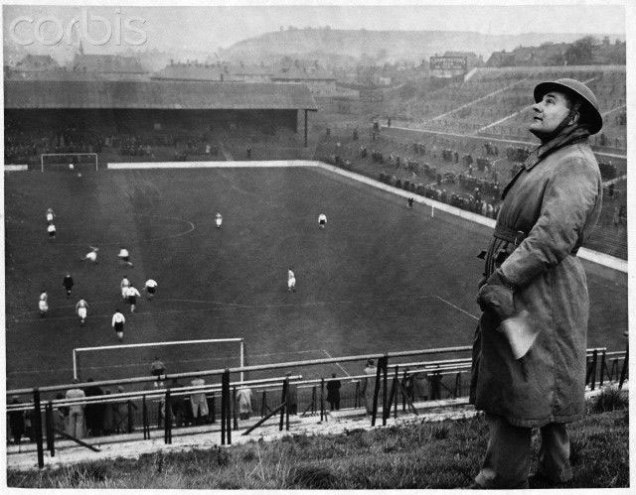
As you head into into Harvey Gardens, you will walk behind the Covered End of The Valley, which was hit on 16 October 1940 leaving a hole in the roof of the stand. The repairs to this were visible right up to when the stand was replaced with the present structure in the early 2000s. The photograph taken at the opposite end of the ground shows the arrangements that were in place for wartime football, with a “spotter” stationed high on the terraces; his job was to alert the referee using his large flag, in the event of enemy aircraft being seen approaching. The match would then be abandoned whilst the fans took cover in local shelters.
This famous image of wartime football was taken at The Valley
One shelter that was nearby was located at the railway arches at Ransom Road. These were extended with a brick and concrete structure so as to be able to accommodate eighty people. However, this type of shelter was not popular with the public, for the dual reasons of safety and sanitation, or the lack thereof.
The Ransom Road shelter was built out to the right of the bridge
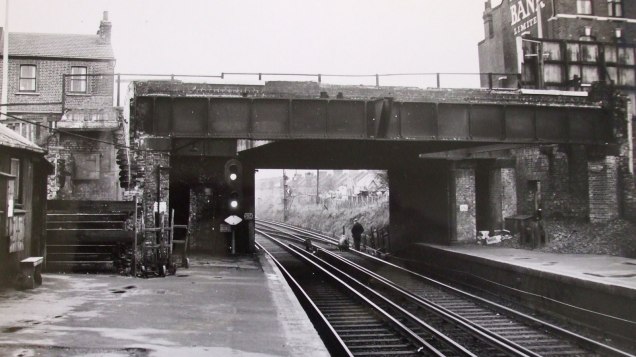
Continue along Floyd Road and turn right into Charlton Church Lane for our final port of call, which is outside Charlton station. Today it is an uninspiring late 1960s structure, built in the former British Railways’ “Clasp” style of construction. Older residents might remember the shambolic appearance of the station before the present buildings were constructed, which resembled a collection of wooden and corrugated iron huts.
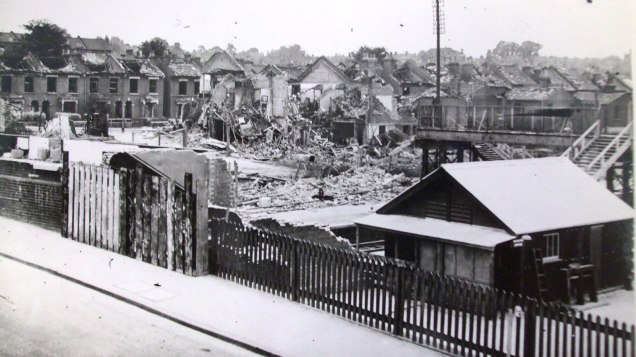
Charlton station a few weeks after the bomb
This was the legacy of a devastating V-1 flying bomb attack on 23 June 1944, when the station buildings were completely destroyed by a direct hit. Considering that the missile hit the station during the afternoon, it is perhaps surprising that only four people lost their lives in this incident, including Mrs Newick, the wife of the station master. Another 30 people were seriously injured in the incident, which left surrounding houses severely damaged by the blast.
Charlton station still bore its war scars until well the late 1960s – this picture was taken in 1961
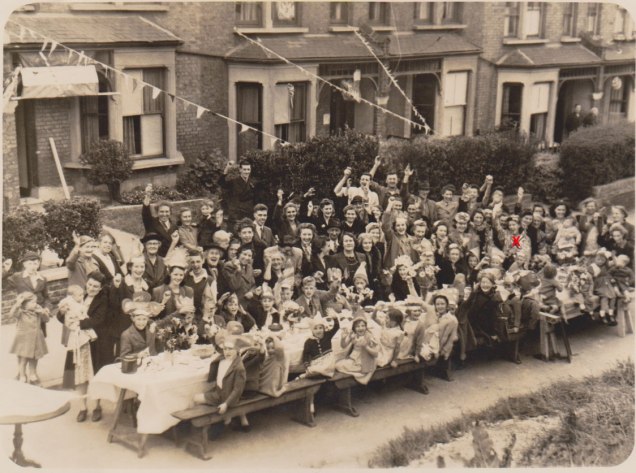
Victory was hard earned but when it came, street parties erupted all across London, including in our own neighbourhood. To conclude, it seems fitting to return almost to where we began and to observe the street party held in Invicta Road on either the 8th or 9th May 1945 – I wonder if any of those small people enjoying the newly-found peace are still with us?
Aitch’s plans, looking south: Barrier Gardens is to the left, with the Beaumont Beds (Optivo Homes) site behind and Mirfield Street at the front
Developer Aitch Group has launched a consultation into plans for 230 new homes between Eastmoor Street and Westmoor Street on the Charlton Riverside.
With the coronavirus lockdown, it has launched a virtual exhibition of its plans, which would see 10-storey blocks built on a plot behind the current Beaumont Beds warehouse and to the west of Barrier Gardens.
It is the latest in a number of proposals for the riverside, all at varying stages in the planning process. None have yet been approved, never mind built, making imagining what these developments will be like somewhat tricky. While Aitch says 35 per cent of the homes would be “affordable”, this would be a mix of “affordable rent” and the much less affordable shared ownership. 30 car parking spaces are planned. More details can be found at www.eastmoorstreet.co.uk.
In January, the housing association Optivo Homes held a very short-notice consultation about a development on the Beaumont Beds site.
Elsewhere on the riverside, five major schemes are still in the works:
Christine Grice with Eltham MP Clive Efford opening a refurbished Co-op store in her ward (photo: twitter.com/GriceChristine)
Colleagues from across Greenwich Council are mourning the death of Christine Grice, the councillor for Kidbrooke with Hornfair, after she was diagnosed with an aggressive form of stomach cancer.
Grice, 68, who had represented the ward for Labour since 2014 and was also the cabinet member for finance, was an enormously popular figure in the town hall. She was presented with flowers at January’s council meeting to mark her being given the all-clear after 18 months of treatment for breast cancer.
However, she fell ill again two weeks ago and was readmitted to hospital. She died earlier this week in the Greenwich and Bexley Community Hospice.
Her Labour colleagues had elected her deputy leader of their group and of the council last month. She had been due to take up the position in May, but Grice was made deputy leader last Monday after council leader Danny Thorpe, deputy leader David Gardner and chief whip Angela Cornforth agreed to invoke a rule in the council’s constitution to bring forward Grice’s appointment.
A former council officer in neighbouring Lewisham’s children and young people’s division, Grice’s four years as the councillor in charge of the borough’s finances were praised by both parties in a town hall placed under pressure by government austerity. She implemented Conservative suggestions for funding council services – such as setting a dedicated fund for parks – as well as those from her own party.
Her appointment was the first time in many years that the council had handed control of its finances to a dedicated cabinet member. Past leaders had taken the post themselves, but when Thorpe was elected leader he gave the job to his close ally.
At January’s full council meeting, Thorpe gave Grice flowers to mark her recovery from breast cancer to applause from all councillors.
“I do’t think I’ve ever been so inspired by watching someone be so resilient, so brave and so courageous,” he said.
“She came to me a couple of weeks ago and said ‘good news, my treatment has finished, let’s talk about the medium term financial strategy,’ I said, ‘Christine, hang on… did you ring the bell?”,” Thorpe said.
She had not, and so she was also presented with a bell to ring in the council chamber. “You’re just amazing,” he told her.
“The one thing I would say to everyone watching this – do take up the screening opportunities the NHS provides,” Grice said. “I know I’ve been incredibly lucky and that’s because of the mammogram programme. I can’t recommend that enough.”
‘Champion of improving lives’
Thorpe said today: “I am devasted. Christine was a force of nature and someone I’ve had the privilege of working alongside in her role as ward councillor for Kidbrooke with Hornfair, and also in her cabinet member role dedicated to finance and resources.
She was a champion of improving people’s lives and a champion for equality. Very early on after being elected as a councillor she worked tirelessly with Cllr Linda Bird to develop a fairness commission here in Greenwich.”
Greenwich has recently decided to take its poorest residents out of council tax, and Thorpe added: “Only a few weeks ago, Christine and myself met a number of residents who were affected by the introduction of Universal Credit and who were going to benefit from the introduction of this scheme. It was a very moving meeting and one that moved Christine very much, hearing so tangibly the difference this policy would be making. I can think of no better legacy for Christine than this moment.”
“Christine was being cared for at the Greenwich and Bexley Hospice and I would like to pay my respects to this incredible organisation. We are so fortunate to have them here in our borough,” he continued.
“Our thoughts and prayers are with all of Christine’s family at this sad time.”
The leader of the opposition, Conservative councillor Matt Hartley, said: “The whole council is devastated by this news. Christine achieved so much in her life and was a wonderful person. She was always thinking of others. It was a privilege to know her, and all of our thoughts are with Christine’s family at this difficult time.
“We at the town hall have lost a friend, and Greenwich has lost a dedicated public servant and community leader who never stopped working for our borough. Christine’s contribution will not be forgotten.”
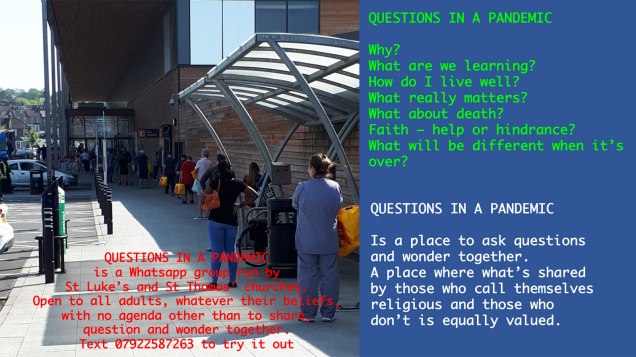
Charlton’s two Anglican churches have closed their doors during the lockdown, but they are exploring new ways of communicating with their community. The rector of the benefice of Charlton, the Rev Liz Newman, says…
We are starting a WhatsApp group open to people who call themselves religious and those who don’t to share together the reflections that arise out of the time we’re living through. It occurs to us there may be people who have nowhere to share some of the big questions that the health crisis is provoking and we hope to provide a welcoming and non-judgemental platform where they can be aired, shared and wondered about together.
You can get in touch with the group on 07922 587 263.









 The Charlton Champion