We’re still waiting for news from Greenwich Council on its detailed plans to redevelop the Charlton Riverside – a consultation on a new masterplan was due earlier this year, is apparently due this month, but that’s what they’ve said before.
In general, we know from the previous masterplan and a recent land use consultation that the plan is to sweep away much of the area’s industry (and ultimately, some of the retail barns) and replace it with housing – completely changing the shape of the area in which we live.
Developers aren’t waiting – they probably know what’s going on anyway. So a consultation begins this weekend on a 15-acre site off Anchor & Hope Lane and behind Atlas Gardens and Derrick Gardens. The developer here is Rockwell – which is also involved in the highly controversial cruise liner terminal at Enderby Wharf, east Greenwich.
With exciting new plans for this neglected riverside area now well underway, it’s time for sensitive and visionary planning that will benefit residents and visitors. Part of Greenwich’s new economic and environmental strategy, the new urban community at Charlton Riverside will include new green landscaping plans, while improving access to the waterfront area and its stunning views.
The development of a new Barrier Park link to Maryon Wilson Park will be key in opening up new views of the river and its striking silver defences, while making cycling and walking in the area much easier and safer, improving access to river transport links, opening up choice for local residents and helping to attract visitors.
Those who live at Charlton Riverside will enjoy direct links to exciting new developments already underway at Greenwich Peninsula and Woolwich town centre. This focus on helping to build a community in harmony with its urban surroundings is a key focus for Rockwell.
The plans for Anchor & Hope Lane include a new public park as well as new homes. There’s an exhibition taking place over the next week, and a special website, Charlton Conversations.
Unfortunately, the exhibition isn’t actually in Charlton itself – it’s at Greenwich Yacht Club, at the end of Peartree Way in Greenwich.
You can see it tomorrow (Saturday 24 September) from 10am-4pm; Wednesday 28 September from 6.30pm-9pm; and Thursday 29th September from 4pm to 8pm.
Ripe for development: Charlton’s riverside at the Thames Barrier
One of the developers behind the redevelopment of Charlton’s riverside is promising “affordable homesteads for ordinary people alongside the river Thames” as part of a plan to create 5,000 new homes on what is currently industrial land.
Richard Upton, deputy chief executive of U+I, says the company will soon be in control of enough land to create a “small town” by the Thames.
Upton’s statement pre-empts a Greenwich Council consultation on a new masterplan for the riverside, which has been postponed until after the mayoral election.
His comments appear in Historic England’s Conservation Bulletin (see pages 26-28), in a special edition devoted to the challenges London’s next mayor will face.
Under U+I’s previous name of Cathedral, the company was responsible for the Movement development next to Greenwich station as well as the redevelopment of the Eltham Coronet cinema site. U+I is also behind Deptford Market Yard, next to Deptford station, and owns the Morden Wharf site to the west of the Greenwich Peninsula.
It’s the first official confirmation that U+I is involved in the plans for Charlton.
Upton writes: “In Charlton, U+I will soon control sufficient land to create a small town spanning 6 million square feet and providing 5,000 homes. The site is brownfield and light industrial in nature, but we’ve delved into its past and from this, we’ll create a future that makes it unique. The grimy industrial routes actually reflect the patterns of paths and hedgerows from the 17th century. Lovely. I promise you we will bring history and parochial distinction alive.
“Charlton will once again provide affordable homesteads for ordinary people alongside the river Thames.”
It also looks like architectural practice Farrells is also involved in the scheme. The article also features a timeline of the Charlton riverside’s history which is credited to Farrells.
This looks very like Anchor & Hope Lane… (picture: Farrells)
Earlier this year, founder Terry Farrell told the Evening Standard he wanted to see a series of low-rise lift bridges for pedestrians and cyclists across the Thames at locations including Rotherhithe, Greenwich Peninsula, Charlton and Woolwich.
The story was illustrated by a mock-up of such a bridge – which appears to be at the end of Anchor and Hope Lane in Charlton. Last year, TfL identified Charlton as a site for a potential crossing in a speculative list of 13 possible or planned links across the Thames, although it said the idea was merely “conceptual”.
Separately, plans to create a secondary school on the riverside could come to fruition much earlier than planned, with proposals for the two-year-old Royal Greenwich University Technical College to become an 11-18 school, after the college had trouble recruiting students at age 14. A little-publicised consultation took place earlier this year.
Charlton Asda: This site could be zoned for housing under a Greenwich Council plan
The area around Charlton’s Asda superstore could be earmarked for housing under plans being consulted on by Greenwich Council.
We’re still waiting to hear what the council has up its sleeve for redeveloping Charlton’s riverside – plans to reveal a new Charlton Riverside Masterplan have been postponed until the spring.
But you can find a few clues about what’s going on in the snappily titled Greenwich Local Plan Site Allocations consultation. It’s not being very well publicised, but it’s happening now and will have a bearing on the future development of Charlton and the wider borough of Greenwich.
This is about allocating particular sites in the borough for particular uses. For example, the unbuilt plots at Greenwich Millennium Village are allocated for housing.
Much of the focus is on Charlton’s riverside area – and that includes the possibility of converting much of SE7’s retail space into housing and community uses.
The Asda site, together with the retail parks and industrial premises that surround it, are part of one area suggested for “residential, non-retail commercial/employment uses, community infrastructure including open space, and an area of search for schools”.
“Current uses are out of-town retail, threatening growth of retail development in other centres,” the consultation says – a not-very-subtle way of saying Woolwich’s development as a shopping centre is being throttled by Charlton’s retail parks.
The effect of Charlton’s retail parks on Woolwich has been a running sore with Greenwich Council for decades. Big box retail first came to Charlton in the 1970s when Makro – aimed at business customers – opened on the site of the old greyhound stadium.
In the early 1980s, Greenwich Council originally refused permission for Asda to open its Charlton store, but was overruled by a planning inspector. Local newspapers at the time reported that plans for a new Co-op store, which would have been the centrepiece of a redeveloped Woolwich town centre, would be axed if Asda went ahead. It’s pretty much undeniable that Woolwich entered a long period of decline from about that time.
Since those early days, retail parks have opened across the Charlton riverside area – with the council’s blessing. The latest – an extension to the misleadingly-named Greenwich Shopping Park – is under construction.
It now appears the council is trying to turn back the tide. The plans don’t affect the retail parks’ ability to trade from their existing sites. But expansion or replacement could be more difficult – and selling up for housing could be more lucrative.
Charlton’s riverside has changed since this photo was taken, and is set for more changes
There’s a useful interactive map on the Greenwich Council website – here’s the plans as they affect Charlton and immediately adjacent areas.
Charlton Riverside West (Asda, Ramac industrial estate, surrounding retail parks): “Residential and area of search for schools.”
Charlton Riverside North West Industrial (north of Makro): “Industrial uses compatible with PIL (SIL) and area of search for Waste facility to include a Vacuum Waste Collection Centre and a Reuse and Recycling Centre.”
Charlton Riverside Central (Makro, Stone Lake Retail Park, Stones Foundries, Penhall Road) “Residential, small scale retail, employment use. Seconday and primary school area of search. To include bus and cycle east-west route and transport interchange at the south western corner of the site opposite Charlton Church Lane.”
Thames Barrier approach and Eastmoor Street (car breakers’ yards, etc): “Community open space to include playing pitch which could be dedicated for school use, replacing playing pitch north of UTC building if the existing playing pitch is needed for school expansion.” (A neighbouring zone, Charlton Educational, covers Windrush Primary School and the Greenwich University Technical College.)
Land to the south of Thames Barrier: “Safeguarding for Flood Defences, only a use compatible with this is to be considered, such as Community Open Space.”
Harrington Way (area around Second Floor Arts): “Existing historic buildings to be retained and used for B1, offices , creative uses, studios in accordance with IBP designation.”
Westminster Industrial Estate (immediately to east of Thames Barrier site): “Existing historic buildings to be retained and used for B1, offices , creative uses, studios.”
Morris Walk, Maryon Grove estates:“Redevelopment for improved quality and intensification of residential uses” – which looks like this little-publicised 13-storey tower planned for the site of the Albion pub on the Woolwich side of Morris Walk.
Maryon Road estates: “Redevelopment for improved quality.” No tower blocks, then.
40 Victoria Way (the one remaining warehouse from the old Thorn Lighting site): “Housing.” No surprise there.
This last one’s interesting – the Angerstein Triangle is an old railway yard (there’s still a set of steps linking it to Westcombe Park station) that was once proposed as the terminal for what became the Jubilee Line extension. Perhaps this is still sitting in planners’ minds. Charlton Champion reader Stephen Baycroft suggests it “should instead be rezoned into parkland and/or community facilities” to ease the pressure of lorries coming down residential streets.
Finally, both The Valley and the Rectory Field remain zoned as community open space under the proposals.
Naturally for a set of council proposals that directly affect Charlton, none of the roadshows for the scheme are taking place here.
Instead, you can talk to planners at the Greenwich Centre on Saturday 27 February from 2pm-5pm, and at the Woolwich Centre on Thursday 3 March from 4pm-7pm. More details on the Greenwich Council website.
These images form part of developer LXB‘s application to Greenwich Council. A planning board will then decide whether to approve or reject these plans – likely to be some time in June.
View of M&S and coffee shop from Woolwich Road
There’s several elements to this application including an impact assessment on retail in much of south-east London. A thorough report by consultants WYG states that:
“The enhancement of the retail facilities at Bugsby’s Way will not affect Woolwich’s status as a Major Centre, nor its prospects of being re-designated as a Metropolitan centre in the long term.”
Their reasoning behind this are the new developments in Woolwich, such as the Tesco, that WYS believes will regenerate the SE18 area, keeping shoppers from getting into their cars or straying onto a bus and travelling over to Charlton.
Another talking point recently has been the downgrade of the western end of Woolwich Road (from Charlton station to the flyover) and how these new developments will impact on the near 24,000 vehicles that use the road on an average weekday.
This website understands the developer LXB have been told by TfL and the council’s highways department that alterations to plans won’t be considered until the road has actually been downgraded.
Meaning, the proposed reshaping of Woolwich Road for deliveries and customer access (including current work being undertaken for the Travelodge) don’t take this downgrade into account.
Would it be outrageous for me to suggest that a coherent plan for Woolwich Road, using a bit of foresight, might save a lot of time, money and upheaval in the future?
Two different diagrams highlighting proposed changes to Woolwich Road
The old retail barns that currently occupy this site lay dormant, aside from the odd illegal rave. Wickes is the last store still operating and is believed to be moving into its new home next to Matalan in the next two weeks.
If approved by the council’s planning board the new Sainsbury’s and Marks & Spencer would be looking to open before the end of 2014.
3) A mention of a green bridge as one option for a crossing at the eastern section of Woolwich Road.
4) A nod towards enhancing Charlton railway station and improving its connections with other modes of transport.
5) The idea for a marina has changed to “leisure activities on the waterfront” due to concerns from the Port of London Authority that it would interfere with other river uses.
6) There’s a sentence added that calls for a limiting of retail uses in Charlton “to support the aspirations of Woolwich becoming a metropolitan centre”, which possibly came after pressure from investment vehicle Powis Street Estates who own buildings in the heart of the town. A council officer at the meeting stated that any new planning applications for the retail park would have to fulfill impact assessments so as not to take trade away from Woolwich.
Residents also addressed the cabinet at the meeting. Some representing local groups such as CRAG, the Charlton Society and the Westcombe Society. Each underlined the main themes from their formal responses. There were calls for Charlton to be seen as a whole and for residents and businesses to be involved as much as possible. The traversing of Woolwich Road was highlighted as key as well as improving our streetscapes.
Charlton Champion reader Ashleigh Marsh also raised the point that blogs (like this one) should form part of the consultation process, or at least noted.
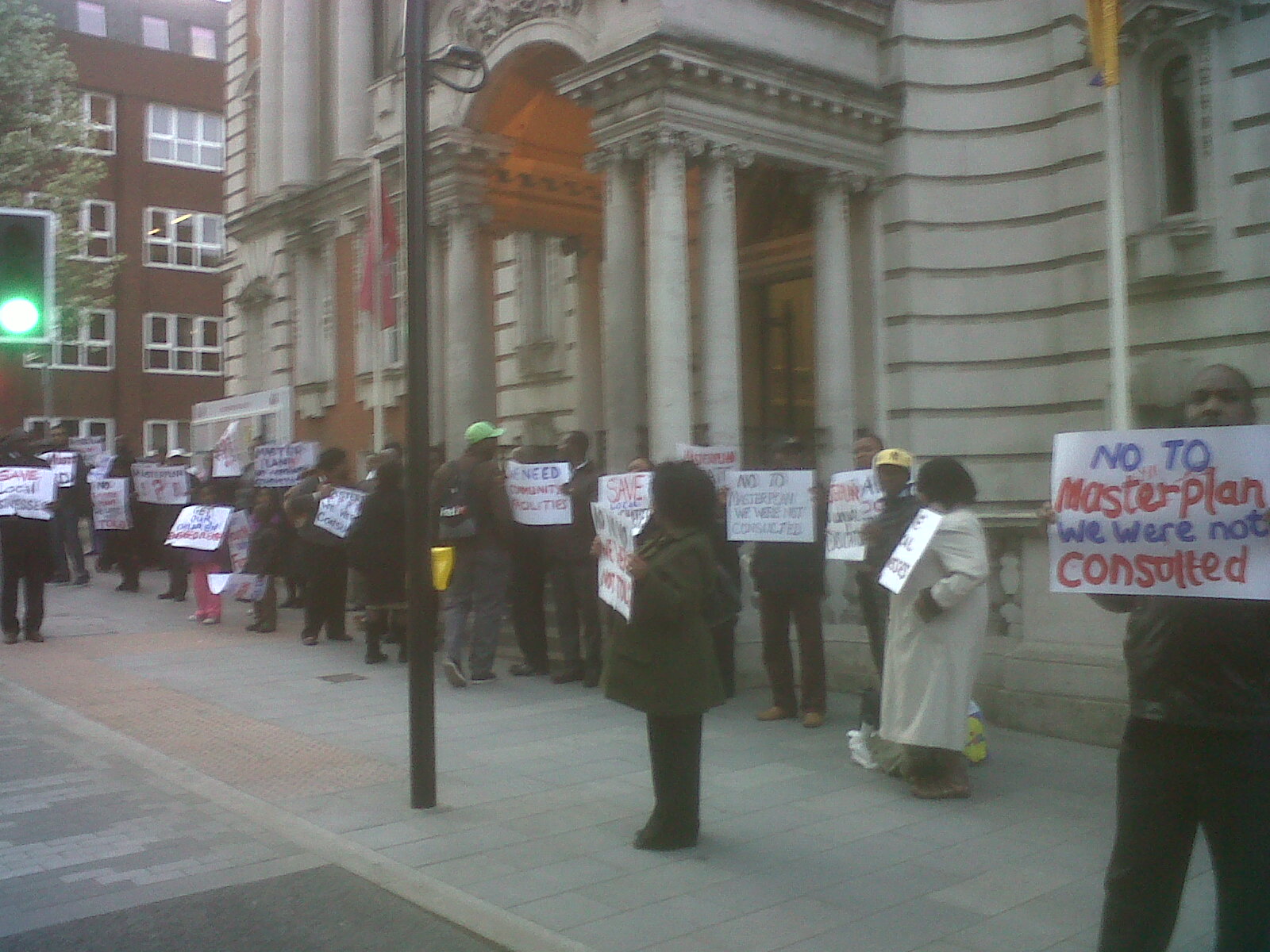
Before the meeting a crowd had gathered outside Woolwich Town Hall protesting at the potential loss of businesses and the poor consultation. On further investigation it’s believed that this lobby group were actually the Christ Faith Tabernacle Church. They’ve recently been in the news with their battle to take over the former Gala Bingo building in Woolwich – something Woolwich’s masterplan conflicts directly with. Why they weren’t more up front with their intentions is beyond me, but it might have something to do with council statistics showing only 10% of these objectors live within the borough.
It’s probably best not to get too carried away and come back to what a supplementary planning document actually is. My own knowledge tells me that it will complement the overall plan for the borough. It will add to a “core strategy” and will be taken into consideration in future planning applications.
This point was reiterated by councillors and officers on Monday night. Council leader Chris Roberts added:
“Changes won’t necessarily happen overnight, next week or next year. This is a think-through as to what might happen when traditional industry moves on.”


 The Charlton Champion
