The new Southeastern franchise begins in April 2019
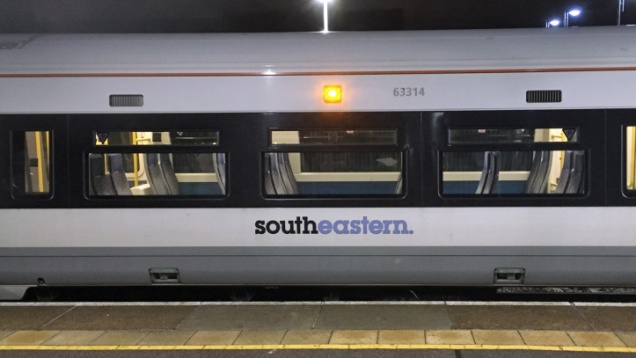
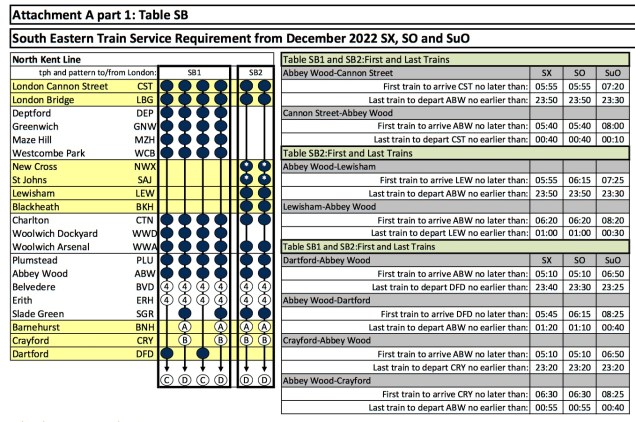
Charlton and Woolwich Arsenal stations will lose direct trains to Charing Cross from December 2022, according to the Department for Transport’s plans for the new Southeastern franchise, which have been published today.
The invitation to tender sets out what the Government expects of the firm which wins the new franchise, which due to begin in April 2019. It sets out the basic service the winning operator is expected to provide.
Currently, six trains per hour run from Charlton to Cannon Street via Greenwich, with two running to Charing Cross via Lewisham.
But from 2022, those Charing Cross services would be rerouted to Cannon Street, calling additionally at New Cross and St John’s. Passengers who want Waterloo East and Charing Cross will have to change at London Bridge.
Looking in the other direction, there is also an option given for bidders to extend one set of Greenwich line trains to Maidstone West, while Belvedere and Erith may see a cut in services, with bidders asked to provide only a minimum of four trains per hour. The planned Thameslink trains are not set to call at those stops.
Arthur asked The Charlton Champion what was going on. So we asked Network Rail.
A very nice spokesperson told us: “The footbridge at Charlton Lane has been taken away for major refurbishment and re-painting. We aim to get it back in position before Spring 2018 and in the meantime if people could use the level crossing we would appreciate their patience and understanding.”
A bit inconvenient if you come at a time when there are multiple trains coming, but hopefully a brighter and less creaky bridge will be back in place soon.
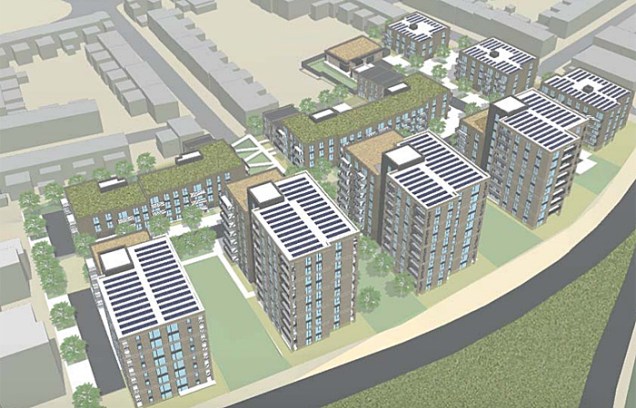
The plan includes two 10-storey blocks next to the railway line
Plans for new homes on the remainder of the old Thorn Lighting site on Victoria Way have been revised, cutting the number of dwellings from 341 to 330.
But developer Fairview New Homes still plans to build 10-storey blocks on the site, which has caused anxiety among residents who live close to the proposed scheme.
Fairview submitted the plans back in June, but has now changed its proposals following discussions with Greenwich Council planning department.
It says 35% of the new homes will be “affordable”, while a nursery and business space have also been added to the scheme.
The changes are, according to the planning documents:
330 new dwellings, including 35% affordable homes – tenures and mix as previously ‘agreed’ with RBG Planning Policy, namely 77 rented (including 29 family rented units) plus 37 intermediate /shared ownership.
New D1 Nursery building at approx. 439m2, with a potential child capacity of 125 children depending on ages and up to 22 staff / jobs – based on DfE / OFSTED requirements.
A new dedicated B1 employment building – building ‘A’ at 999m2 (GIA) of open-plan flexible floor-space, suitable for SME workspace, with a capacity of approximately 85 FTE roles. A combined potential employment offering of approximately 107 jobs.
Design improvements to the ground floor layout and elevations along Victoria Way and the internal ‘Avenue’
Increase provision of 3-bed family units to 89, bringing the percentage to 27%.
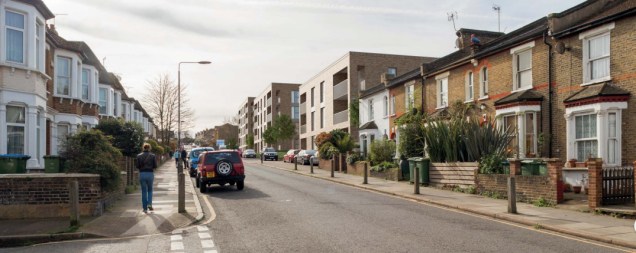
View up Victoria Way taken from the original applicationView from Gurdon Road, taken from the original applicationThe tall block can be seen in this view from Fossdene School
Each year between and March, St Thomas’ Church in Charlton is one of a group in Greenwich borough who collaborate on the Greenwich Winter Night Shelter project.
St Thomas’ opens its doors for one night each week, providing up to 15 homeless people with a hot shower, an evening meal, a warm place to sleep and breakfast, as well as a packed lunch to take away.
Other churches in Greenwich borough pitch in so a volunteer-run service is provided all through the week.
Here’s a video showing what happens in the church on Fridays when it hosts the shelter…
All this costs money to provide, and to help raise funds, there’ll be a concert at the church at 7.30pm on Friday 1 December, featuring popular classics for cello, voice and piano. For more information about the concert or the shelter, call 07989 740 252 or 020 8854 0841.
Charlton House’s former summer house, which is now being restored, has been on the register for some years, but whole conservation areas can also be added to the list.
Bowes’ shoe shop closed at Christmas 2015
The village has long been disfigured by empty and neglected shop units. Number 33, the former Bowes shoe shop, has sat empty since it closed nearly two years ago. Land Registry documents indicate it has been owned since 1989 by Kamil Ahmet of Clapton, east London.
This unit was left open to the elements during the summer
Number 11, the former Sol Property Services, has had a front door panel left open to the elements for weeks earlier this year. It is owned by Maqbool and Nadeem Chaudry of Birmingham, according to the Land Registry.
While the recent revamp of the White Swan and the arrival of the Kasturi Indian restaurant have given the village a bit of a lift, it has struggled to attract other new businesses that would keep these properties in good condition and start restoring The Village to its former glory.
Two years ago, this site published one resident’s musings on how the area needs a regeneration plan. Who will make the first move to sort Charlton Village’s problems out – residents, or Greenwich Council? Your thoughts would be appreciated.
February 2017: Parents’ parking causing problems outside Our Lady of Grace school
Last month, schools in Charlton and across the borough of Greenwich took part in the STARS Car-Free Day, which saw roads closed outside schools. It’s an attempt to highlight the problems caused by parents driving their children to school – and to persuade them that leaving the car at home makes life easier for everyone. Local father Nathan Hughes says this should be more than a one-off token gesture.
“My lungs feel better already,” was my note to Ben Murphy, traffic officer for Greenwich Council. I said the same to local councillors, who were on show, along with our supportive local MP as he passed by.
Of course, you need the reason why. Whilst checking my son’s school bag one evening I found a short note titled ‘STARS project’, which informed my wife and I that Friday was a walking to school day and that the roads surrounding his particular primary school and a number of others in the borough were to be closed for a period of time throughout the day and afternoon.
We set off for school as normal that morning and found an obvious reduction in both traffic and the sometimes overlooked noise.
There were children playing games in the roads which the schools had organised (cycling, rowing machines, hopscotch, and more) and a noticeable excitement in the body language of the children. The headteachers thanked us for walking – a statement which really made me laugh.
As many parents know, the catchment areas of schools these days – and probably always have been – can be summed up as “if you you don’t live within walking distance to the school, you won’t get in”.
With this being the case, why is that so many parents or carers decide to continually drive their young to school on a daily basis?
I would suggest the investment in our public transport these days has become exceptional. It is frequent and reliable – although many would choose to dispute that – and the added benefit of tracking it through smartphone apps mean we are constantly updated.
I put the driving to school down to laziness rather than a necessity.
Possible reasons why:
Moving further out as soon as the child has been allocated a school place, taking advantage of maximised property prices
“I need to make other drop-offs”
“I won’t get to work on time”
On the first point, this means some families are denying children living in close proximity to their closest school a place, thus making them travel further afield and having a detrimental impact on the immediate community. This just isn’t right.
Our borough’s primary education system has an abundance of excellent, enthusiastic, passionate teachers that have turned our schools into arguably some of the best in the country, making the options ever more attractive.
Positive impact and suggestions/ideas:
Local retired residents might like to get involved by supporting/marshalling the school roads
Local businesses. There’s an opportunity here to grow our community, as some of the local shops might find a way to promote their businesses through pop-up shops before and after school.
We all like to think we have an interest in the environment. But we choose to ignore the easiest thing to do and one that would make a huge difference. School run traffic has been chaotic and at times unsustainable for local residents, some of whom adjust their schedules around the inconvenience of the double parking.
Let’s start making a real difference to those little lungs. It could also help the older ones too. School by school, class by class, year by year, we could make a positive change – just like the one our teachers have made to an increasingly popular borough.
It shouldn’t just be be a one-off poster to stick to the school gates, it needs to be embraced and properly implemented.
What do you think? Could you help make car-free days a regular occurrence? Leave a comment below.
The proposed development on Fletching Road, with Charlton Church Lane to the left
Plans for 37 new council homes to replace a 1980s sheltered housing block behind Charlton Village were backed by Greenwich Council’s main planning committee last night.
The council’s Planning Board endorsed the scheme by three votes to one, with two abstentions, after concerns were raised about the way the council had gone about consulting people who live next to Fred Styles House, which faces demolition.
The block will be replaced by three 1-bedroom and five 2-bedroom flats, along with 16 one-bedroom, seven 2-bedroom and six 3-bedroom houses, all for social rent.
While the current block only allows access to Charlton Church Lane through a gate, the new scheme will see two pedestrian walkways linking it with Fletching Road, which runs behind The Village.
Residents of the homes that surround Fred Styles House have voiced concerns that turning their area into a pedestrian thoroughfare will lead to an increase in crime.
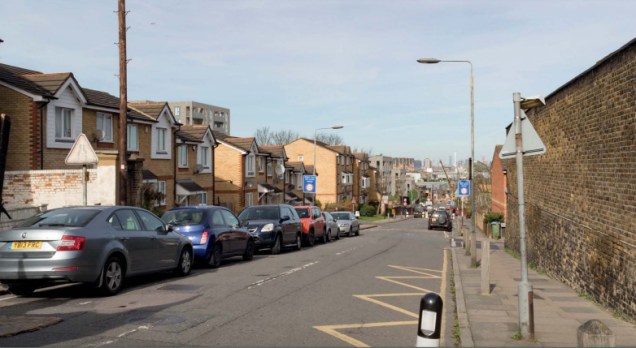
Fred Styles House as seen from Charlton Church LaneThe current building has 42 bedsits and closed in October 2013
One resident, who lives next door to the proposed development, told councillors she only found out last week that the development would come right up against the side of her house – building over a path she uses to access her front garden, particularly when emptying bins.
Another complained that construction of three one-bedroom flats would block out daylight and lead to two homes being “enclosed like caves”, while one objector said residents’ questions had been met with “stock answers, don’t knows or ‘we’ll get back to you'”.
Many of the upset neighbours’ homes have this view of the current Fred Styles House
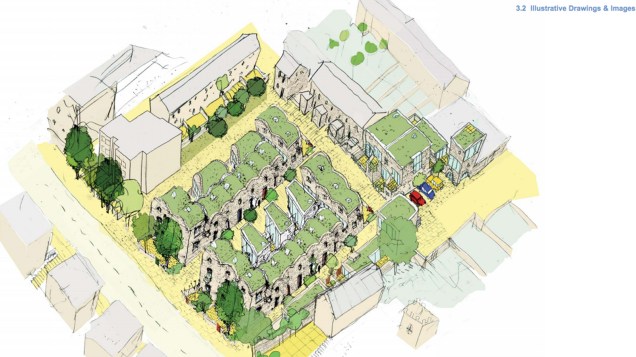
One of the architects behind the new development told the meeting that he wanted the site to feel “much more villagey” with a “traditional approach to housing”. His aim was to create “a little neighbourhood”.
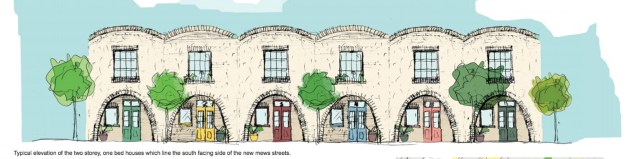
How the new homes will look
Several councillors indicated they were unhappy with the way the residents had been consulted. Council deputy leader Danny Thorpe said there was “potential for an off-line discussion” about giving existing residents communal bins to ease the problems caused by losing space near their homes. Kidbrooke with Hornfair councillor Norman Adams voiced concerns about the homes having flat roofs so close to a conservation area.
Planning chair Mark James said he backed the scheme but wanted the applicant – the council – to “engage further” with residents, adding that open walkways actually reduced the risk of crime.
A 3D view of the development
The council was spared the embarrassment of seeing its own housing proposal thrown out, with three councillors – James, Thorpe, and Mark Elliott – backing the scheme to one – Clive Mardner – against. Two – Adams and Geoff Brighty – abstained.










 The Charlton Champion