What’s more, many people’s Easter plans will be in tatters with a holiday weekend spent in lockdown rather than visiting friends and family.
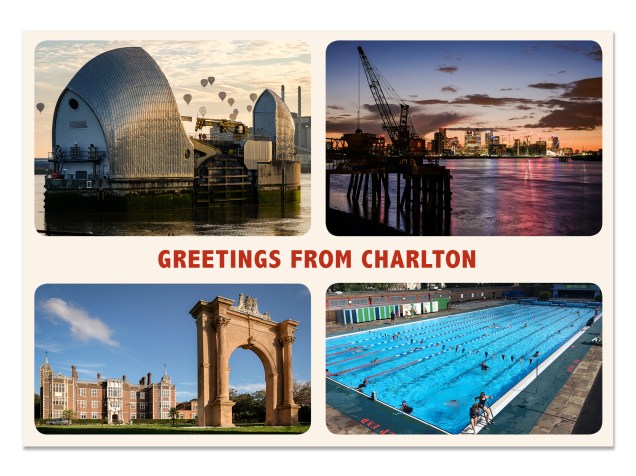
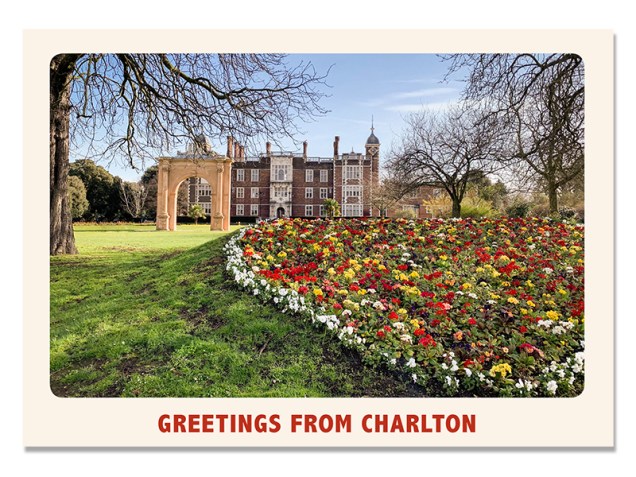
If you want to send your loved ones something special for Easter to show you haven’t forgotten them – or just want to tell chums you’re okay – we still have stocks of our popular Greetings from Charlton postcards available.
All you need to do is visit our online shop, and we’ll deliver as quickly as we can (combining it with daily exercise, of course). All proceeds go towards the running costs of this website.
Times may be tough, but at least you can tell everyone you’re having a staycation in SE7 with one of our cards.
If you’re looking to take a local stroll over the next few days, you could do it along the Charlton riverside – before it changes forever. Greenwich University landscape architecture student MEREDITH WILL takes us for a walk from the Greenwich Peninsula to the Thames Barrier.
Charlton Riverside is a unique area within London, and it is about to change dramatically. While Charlton residents will probably be aware of the local master plan and large-scale development proposals, the history of the riverfront in Charlton is less well known, and in need of celebrating.
An easterly amble down the two-mile stretch of the Thames Path from Greenwich Peninsula Ecology Park to the Thames Barrier provides a fascinating mix of active industry and remnants of the past along the river.
At the ecology park, you can step back in time to experience the river as it was before the 1800s. The wetland habitats have been reconstructed to emulate the environment that although now almost forgotten, once covered the entire Charlton Riverside area. There you can see the kinds of water birds and insects that would have been common before industry took hold. Now a watery urban oasis, visitors can search for snipes, reed warblers, swifts and the many butterflies and dragonflies that thrive in the wildflower meadow.
Following along the Thames Path, around the Greenwich Yacht Club, you come towards Angerstein and Murphy’s Wharves. Angersteim was the first wharf to be developed to the east of Greenwich, opening up the area for all future industry.
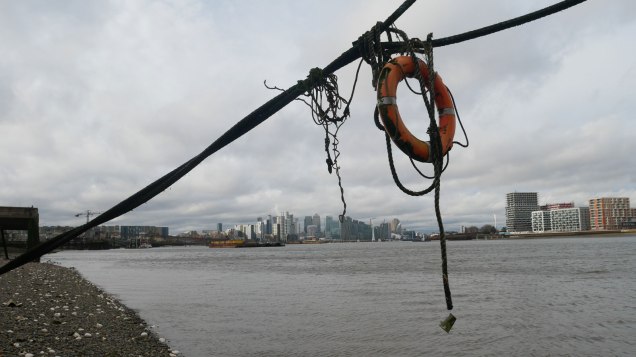
Looking back up the Thames from Riverside Wharf
It was built in the 1850s by John Angerstein, originally born in Russia to a Germany family, who later settled in Greenwich. Angerstein, like many others at the time, made his fortune in the slave trade, profiteering off the trading of enslaved people in Grenada. Angerstein’s extensive art collection became the basis of The National Gallery. Over time the wharf has been involved in dredging, metal works, glassworks, and aggregates industries.
For the last 30 years both Angerstein and Murphy’s wharves have been home to Day Group Ltd, loading and unloading sea-dredged aggregates and supplying material for London’s ever-expanding construction projects. The works are unmissable as you pass by; the many conveyer belts, corrugated irons shacks and mountains of tarmac are like walking onto the set of Mad Max.
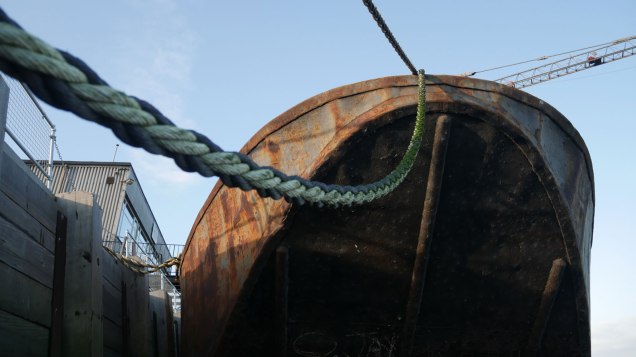
A barge being repaired at Cory Environmental
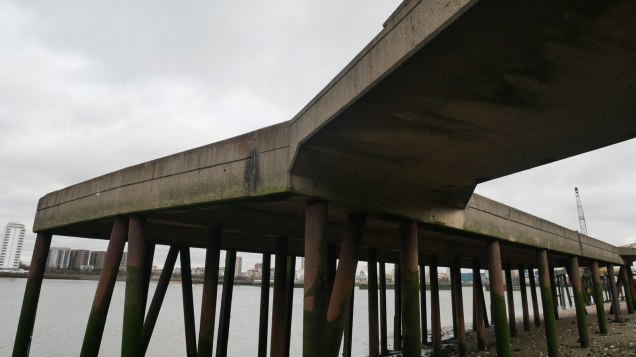
Murphy’s Wharf – originally known as Christie’s Wharf – was built alongside Angerstein in the 1920s for the import and treatment of timber. It was famous for having a concrete pier, instead of the older wooden structures lined along the banks and for the quick unloading time of the dockers who worked there. The pier and cranes remain largely as they were built, but now stand unused and mossy – monuments to the workers and their industry. For the keen eye, the train track linking these wharves to the rail network can still be seen from the line between Charlton and Westcombe Park.
Beyond this lies Cory’s Barge Works. Now Cory Environmental, the company still operates on site, building, maintaining and repairing barges that take domestic waste out of central London. This is probably the only continually-operating boat repair company that has been working on the same site since 1873. Some of the timber sheds may be even older than Cory’s.
Durham Wharf from the Anchor & Hope beer garden
Further downstream is Durham Wharf, built in the early 1900s, which once transferred coal and sand into the city along the narrow gauge railway line which can be seen across the yard. Cory’s last used it in the 1970s and since then it has remained untouched.
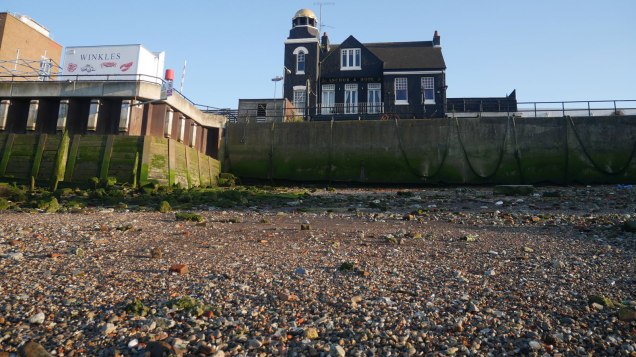
Next you’ll reach the jewel in the crown, one of London’s best public houses, and a welcome sight for many a sailor, the Anchor and Hope pub, where the community of workmen have been served since Tudor times. The current building was built in 1898, and is a very popular stop-off point for people attempting to cover the whole Thames Path. A winkle shack is just next door if you fancy a salty snack.
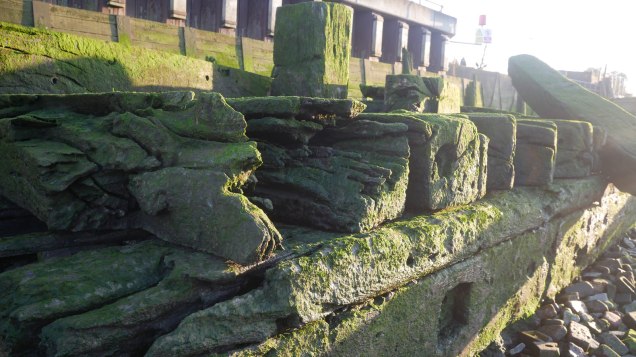
The remains of Castle’s shipbreaking works
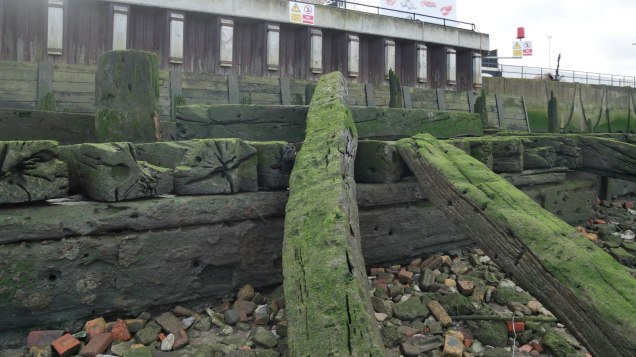
If you’ve timed your journey with the low tide, brave the mud and explore the foreshore by going down the steps by the pub. You’ll be rewarded with one of the most important maritime archaeological sites in the country – the remnants of huge Victorian battle ships which were broken up on the foreshore for parts. People have been able to identify what these timbers were used for and which ships they came from. The most famous of these ships was the HMS Duke of Wellington, a first-rate triple-decker flagship, powered by both sail and steam.
Down on the foreshore
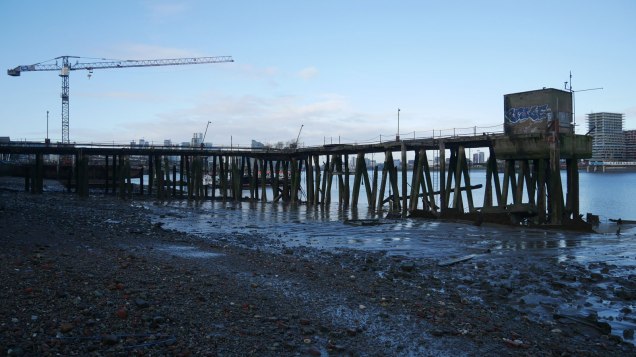
A short distance away is the youngest wharf along this stretch, Maybank Wharf, occupied by Westminster Waste. Built in 1966 for transporting paper from it nearby factory, it is no longer in use but is in near-perfect condition. A development from Hyde Housing is set to replace the current buildings with flats and a public park on the jetty.
The Maybank jetty
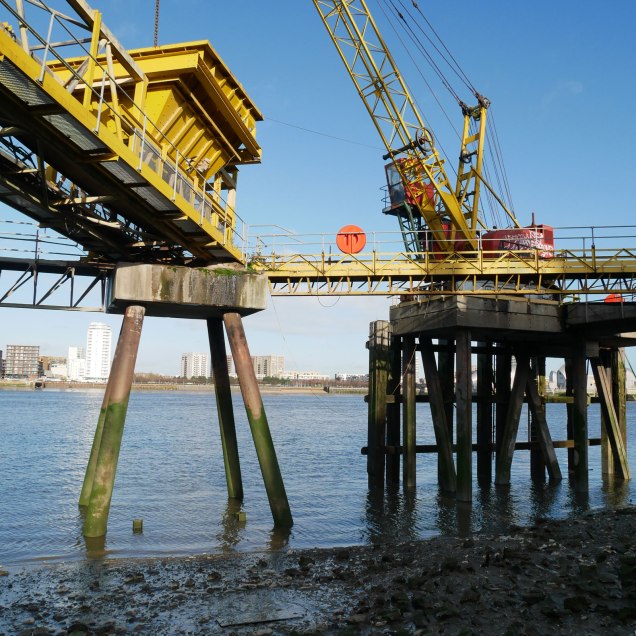
Next you will come across Riverside Wharf, a striking yellow and red structure which stretches over the Thames Path. This Tarmac plant, as well as Angerstein and Murphy’s wharves, is safeguarded, meaning it has been given special protection by the Mayor of London to prevent their redevelopment.
The final wharf along this walk is the Flint Glass Jetty and Thames Wharf, erected in 1920 by Johnsen and Jorgensen, Swedish cod liver and polar bear traders, for their glass works business. The factory was one of the world’s leading glass works, importing bottles to be made into thermometers and other glass equipment.
Riverside Wharf at high tide
Although just short of two miles long, this amble along Charlton Riverside allows walkers to traverse across 200 years of history, from misty marshland through waves of 19th and 20th century industry and into the next chapter of redevelopment. While the developments will inevitably change the industrial character of this area, there’s hope that Charlton’s unique history will not be lost or forgotten. The redevelopment offers an opportunity to re-engage with this history and ensure its legacy is respected.
A group of students from the University of Greenwich are conducting a project on Charlton and the Thames. If you have any stories relating to the Charlton foreshore, industry past or present or anecdotes and memories, please get in touch with us at CharltonForeshoreStories[at]gmail.com.
We’d like to show our appreciation to staff at Queen Elizabeth Hospital and Lewisham Hospital as they help local people with coronavirus
Just across the river, the new NHS Nightingale Hospital created inside the Excel centre will take its first coronavirus patients this week. But in Woolwich and Lewisham, the fight goes on to treat people who have been laid low by the Covid-19 pandemic.
Today, The Charlton Champion is launching an appeal to help the staff at Queen Elizabeth Hospital in Woolwich as well as Lewisham Hospital as they toil day and night on the front line against the greatest threat many of us will have known in our lives.
Last week, thousands of south-east Londoners stood to applaud the staff of the National Health Service for their efforts in treating coronavirus patients. But with patient numbers set to rise much further, their greatest battles are yet to come.
We would like to show our appreciation for their efforts by raising £2,000£5,000 for the Lewisham and Greenwich NHS Trust Charitable Fund. Money donated to the fund will go towards making the lives of our local NHS staff easier.
We’d like to help fund temporary accommodation for staff at the two hospitals who have household members in quarantine. Your money will also go towards morale-boosting supplies, such as coffee machines and care packages.
The fund also provides vital equipment that can be used in the hospitals.
We know that by choosing to read this website, you care about what happens in your local area. We also believe that local media has a responsibility to rally round those who care for us when times are hard. So if you can spare something, even just the cost of a cup of coffee, it would be hugely appreciated. Thank you.
9.40pm update: We’re delighted to say we broke our original £2,000 target within five hours of this appeal going live. Let’s see how close to £5,000 we can get…
Thanks to the team at Lewisham & Greenwich NHS Trust for supplying the photos for this appeal.
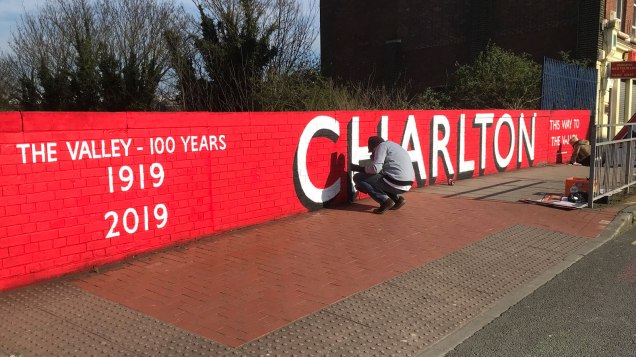
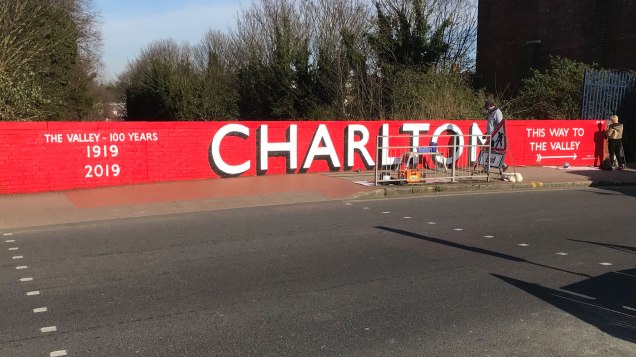
The drab bridge over the railway line at Charlton station has been brightened up by a colourful new mural marking 100 years since Charlton Athletic first played at The Valley.
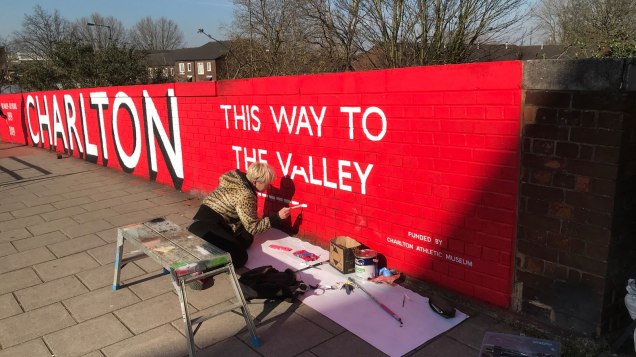
Artist Lionel Stanhope, whose creations have livened up drab corners all over south-east London, has spent two days working on the mural on Charlton Church Lane along with fellow artist and sculptor Zara Gaze. The project has been paid for by the Charlton Athletic Museum, an independent charity which seeks to preserve and celebrate the football club’s distinguished heritage.
Network Rail has supported the project, which sees Charlton join Brockley, Hither Green, Lee, Forest Hill and Plumstead as neighbourhoods with a Stanhope mural.
Only the undercoat was visible on Wednesday
Charlton Athletic first played at The Valley on September 13, 1919. The first match in what was then known simply as the Charlton Enclosure, was a 2-0 win for Charlton’s “A” team against Summerstown. It took place in the South Suburban League – league football was still two years away.
Volunteers had converted the old sand pits – then known locally as The Swamp – into a usable football ground after an appeal from the local MP, Sir Ion Hamilton Benn, at a public meeting at the Mission Hall in Troughton Road a few months before.
The mural marks 100 years since Charlton first played at The ValleyThe mural took two days to create
Stanhope, who used graffiti-resistant materials to create the mural, told The Charlton Champion: “It’s a nice one to do. The colours are really going to brighten up this little stretch outside the station.”
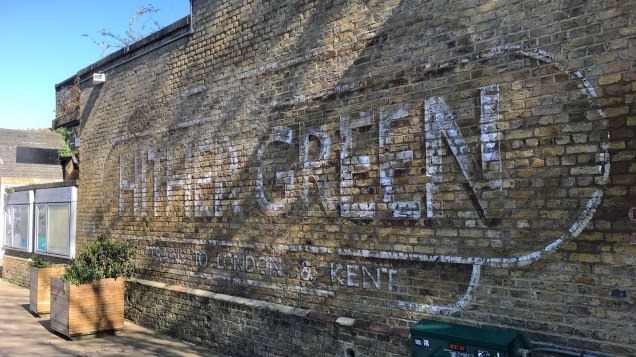
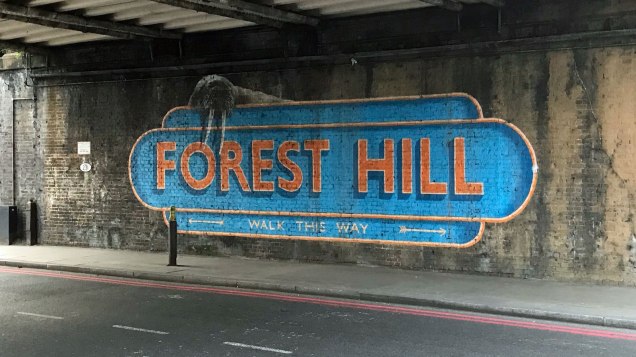
Stanhope’s other work includes this deliberately-faded sign at Hither GreenStanhope’s mural at Forest Hill features the Horniman Museum walrus
He has completed over 25 murals – mostly large creations under bridges, but a few, like Charlton’s, are smaller works on overbridges. His work is now spreading to railway land outside London, including Kent and Sussex and as far afield as Wales.
Ben Hayes, a trustee of the Charlton Athletic Museum, said: “As a museum we wanted to do something to mark the centenary of The Valley but at the same time brighten up the area. I drink in the Radical Club in Plumstead before games, so always see Lionel’s work by Plumstead station and thought it would work perfectly at Charlton, Eddie Burton at Network Rail was really helpful and Lionel was keen from the start.
“The Valley has a special place in Charlton fans’ hearts for many reasons. Nearly all fans love their own stadium but what makes The Valley special is that it was dug out in 1919 by fans, one of whom was Bob Sims, my great-uncle, and players.
“And then in the 1980s and 90s when we were forced to leave the fans, along with Roger Alwen and the other directors, fought to bring us home. The Valley is Charlton and Charlton is the Valley.”
It was paid for by the independent Charlton Athletic MuseumIt directs visitors to The Valley
Hayes added: “We hope it helps local people take pride in their area. It certainly brightens up what was a bit of a drab railway bridge. The football club played a major part in reviving the local community just after World War One when the Valley opened and the sign is one way of that.”
Fellow museum trustee Clive Harris said: “’Now more than ever our community is important. Charlton Athletic is so intrinsically entwined with the local community that to us, as a museum, it seemed the perfect way to commemorate the centenary of our beloved Valley. We hope it becomes an integral local landmark for generations to come.”
The mural includes a tribute to Charlton fan Seb Lewis, who died this week
‘Seb 1076’
The mural also includes a small tribute to Seb Lewis, a 38-year-old Charlton fan who died from Covid-19 this week. A familiar and much-loved figure at The Valley, Lewis had attended 1,076 consecutive matches since 1998 before being admitted to hospital earlier this month. Stanhope was asked to add “Seb 1076” to the mural this morning, a couple of hours after fans heard about the news.
“I just heard about it this morning – it’s a nice touch to add his name and the number of games he’d been to,” Stanhope said.
Seb Lewis went to 1,076 consecutive matches, home and away, before he was taken to hospital this month
Hayes said: “When adding ‘Seb 1076’ was suggested, we thought it was a brilliant idea. It makes the design extra special for everyone connected to the club. Seb was a regular visitor to the museum so we’re grateful to have a way to commemorate him in a small way.”
Museum is for local people too
The museum has been open for five years and has generated interest from other clubs, as well as holding events like last summer’s Blitz walk of the area with local historian Steve Hunnisett. Hayes said: “We’ve had visits and enquires for other English clubs such as Wimbledon, Luton and Exeter who have plans for new stadiums or stands that will include museum rooms. We also had a visit from the museums of Benfica of Portugal and Boca Juniors of Argentina.
The mural is opposite Charlton station
“We hope that local people, whether they are Addicks fans or not will find something of interest. The way the club was founded in the streets near what is now the Thames Barrier by 14 and 15 year old boys is very much a local story. We’ve had plenty of non-Charlton fans visit and they have all found something that engages them. It might be the old rattles people used or the photos of local people stood on the packed Valley terraces.”
Should this wall be next for a mural?
Now Hayes and others are thinking about a bigger idea – decorating the blank wall on the corner of Floyd Road for a wider celebration of the local area.
“There is a big blank wall on the corner of Charlton Church Lane and Floyd Road that is ripe for a mural showing the history of Charlton from the Horn Fair, Spencer Perceval, Siemens, the Thames Barrier and, obviously, Charlton Athletic. It’s something we’d love to work on with local residents’ and history groups,” he said.
If you like the mural and want to help chip in towards the museum’s costs, you can send via PayPal to cafchistorian[at]gmail.com, or contact the museum on the same email address for bank details.
If you’re as interested in doing something with the Floyd Road wall as we are, get in touch with us at The Charlton Champion and we can start investigating ideas and how to get it funded.
If you’d like Lionel Stanhope to brighten up railway land near you, email eddie.burton[at]networkrail.co.uk.
Shops across London have been selling masks and sanitiser (Photo: Duncan C via Creative Commons)
Greenwich Council has warned of rogue traders selling face masks and hand sanitisers during the coronavirus crisis – and reminded residents that there is no evidence that masks will protect from Covid-19.
Trading standards officers visited two shops last week selling disposable face masks which had been split into separate packages, interfering with the product’s integrity, according to the council. Officers also found a number of “potentially irregular” hand sanitisers for sale.
The council said all the products were immediately withdrawn from sale.
A spokesperson said the masks had limited use outside of medical settings and urged the public to continue keeping two metres apart from each other and to keep washing their hands thoroughly.
“Face masks play a very important role in clinical settings such as hospitals but there’s very little evidence of widespread benefit from their use outside of these clinical settings,” the spokesperson said.
“The best defence is to wash our hands for at least 20 seconds, using soap and hot water, or hand sanitiser if soap and hot water is not available. As well as always carrying tissues and using them to catch coughs and sneezes, then putting the tissue in a bin. Please note that a hand sanitiser must contain more than 60 per cent alcohol to be effective.”
Residents with concerns about local retailers in Greenwich borough should email tradingstandards[at]royalgreenwich.gov.uk, while concerns about national retailers should be reported to the Competition and Markets Authority.
With many traders hiking prices of hand sanitisers and other cleaning products to cash in on the epidemic, the prime minister said yesterday that there may be legislation to tackle the price gougers.
During prime minister’s questions, he said: “I think that profiteering is something that we should be looking at from a legislative point of view in this House as has happened before in this country.”
Lachlan Leeming is the Local Democracy Reporter for Greenwich. The Local Democracy Reporter Scheme is a BBC-funded initiative to ensure councils are covered properly in local media. See more about how The Charlton Champion uses LDRS content.
A Saturday slow dance to Adele is on offer from Equality Dance
Equality Dance is a dance school that holds classes at Charlton House. It’s a bit hard to dance with a partner while taking part in social distancing, so its teacher Peter Meager is holding a session via Facebook…
We’d loved you to join us for an Equality Dance FREE online Rumba class for everyone from beginners upwards. Pete Meager will be delivering a 20-30 minute session on Saturday 21st March at 12 noon right from his very home during isolation – but you can change that by dancing with him in your very own living rooms.
If you’re doing something special to help local communities in Charlton get through the Covid-19 crisis, drop us an email and we’ll try to feature it on the site.
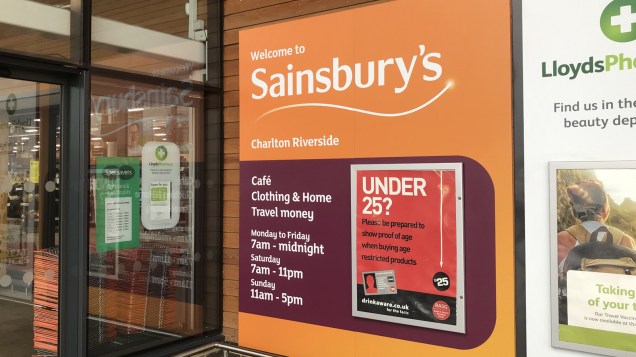
Sainsbury’s promised an hour exclusively for older shoppers – but it did not happen at its Charlton Riverside store
Sainsbury’s says it is “listening to feedback after its Charlton Riverside branch did not reserve its first hour of opening for older shoppers to help them stock up during the Covid-19 pandemic, as promised by the supermarket giant’s chief executive.
In a statement to the media yesterday, Mike Coupe said “we will set aside the first hour in every supermarket this Thursday, 19th March, for elderly and vulnerable customers”.
However, one Charlton Champion reader, Joy Brown, told this website that the store’s manager simply let all customers in when the doors opened at 7am.
“He refused to allow even a ten minute window and said everyone must take their chance before disappearing into his hidey-hole. You can imagine what happened when everyone was let in at the same time and the disadvantaged were jostled and shoved by the younger customers,” she said.
Brown’s experience was backed up by social media users. “Queues are longer than the aisles, elderly forced to wait alongside the rest of the general public,” wrote Joey Brown.
Sandra Smith wrote: “Unless 60 percent of them had had a recent face-lift, you did not deliver your promise. My 90 year mum went for three items, toilet paper, Oats and Kitchen roll. Got none!”
Greenwich and Woolwich MP Matt Pennycook said he had also heard about issues at the Sainsbury’s store and that he was concerned that the government was complacent about the pandemic’s outbreak on food supplies. “From the large number of reports I’m receiving, many local supermarkets are either not taking action to limit overbuying or are struggling to enforce such a policy and more worryingly are failing to ensure older people have dedicated shopping hours to secure essential supplies,” he said.
A Sainsbury’s spokesperson told The Charlton Champion: “A Sainsbury’s spokesperson said, “We asked our customers to respect our decision to dedicate an hour in our supermarkets this morning to serving the elderly and vulnerable and work with us as we try our best to help those that need it the most. We’re listening to feedback from our customers and colleagues and understand some stores faced challenges supporting the hour.”
If you’re doing something special to help local communities get through the Covid-19 crisis, drop us an email and we’ll try to feature it on the site.






 Lachlan Leeming is the Local Democracy Reporter for Greenwich. The Local Democracy Reporter Scheme is a BBC-funded initiative to ensure councils are covered properly in local media.
 The Charlton Champion