Pollution in SE7: Silvertown Tunnel public meeting tomorrow

Silvertown Tunnel public meeting, 16 October
You may have heard about London mayor Boris Johnson’s proposals to build a new Silvertown Tunnel – effectively a third Blackwall Tunnel – between Greenwich Peninsula and the Royal Docks. It’s likely this would attract more traffic to the area, making Charlton’s roads even more polluted.

During the summer, a couple of the Charlton Champion’s contributors took part in an air pollution monitoring study. The results are worrying – with EU air quality limits being broken on both Woolwich Road and Charlton Road, and with levels at Fossdene School only just under the limit.

There’s a public meeting tomorrow at 7pm at the Forum at Greenwich, Trafalgar Road, London SE10 9EQ. Speakers are transport consultant John Elliott, the Campaign for Better Transport’s Sian Berry, King’s College London air quality expert Dr Ian Mudway and Clean Air London’s Simon Birkett. If you can, please come along and find out why the tunnel’s a bad idea for drivers, and a bad idea for Charlton reisidents.

There’s more about the study on the No to Silvertown Tunnel website, and extra details and opinion over at 853.

Charlton history: The story of High Combe

High Combe

Ever wondered why there’s a blue plaque on the stately-looking house next to Our Lady of Grace School? Charlton Champion historian Peter Bone tells the tale of High Combe, which stands on Charlton Road…

In the 19th century, Charlton Road, between the Village and the Standard was lined with grand houses, mansions and villas. Most were demolished in the late 19th century to make way for new streets, homes and a growing population. The names of some of these lost houses – Eastcombe House, Little Combe, Bramhope Lodge, Springfield and Mascalls – were used to name the new streets that replaced them.

One of these grand houses, originally called High Combe, has survived. It’s now known as 145 Charlton Road, between church and school of Our Lady of Grace, and is now the church’s presbytery,

High Combe was built around 1825 in the fashionable Regency style. It’s a Grade 2 listed building, thanks to the pairs of rounded bay windows at both front and back, the central Doric porch and the original double door with rounded panels and fanlight above. You can read the full details on English Heritage’s website.

The house now looks a little overshadowed and cramped between the church and school, but a map from 1870 shows a grand sweeping drive in front of the house with entrances approximately where the church and school now stand.

There are plans to rebuild the school over the next few years, so let’s hope that the new school will improve the setting of this fine historic house.

The history of High Combe and the people who lived there reflect some of Britain’s economic and military history through the nineteenth century.

One of High Combe’s first residents was General Sir William Congreve (1772 – 1828). Congreve succeeded his father (also called Sir William) as Comptroller of the Royal Military Laboratories at Woolwich where he was responsible for developing new weapons for the British army and navy.
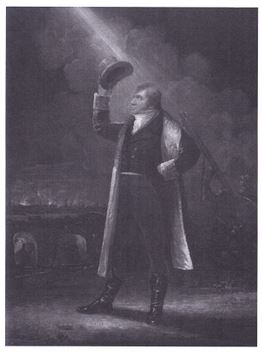
William CongrieveIt was a period when Britain was a dominant military power and had acquired a large empire. As Congreve (pictured right) himself said “England is at war with one half of the world, and has the other half to defend”.

He is best known for inventing the “Congreve Rocket”; rocket powered explosive shells. These were used by British: against the French in the Napoleonic wars, in suppressing a rebellion against British rule of India, and against the USA in the Anglo American war of 1812 – 1814. The line in the American national anthem “And the rockets’ red glare, bombs bursting in air” describes an attack onan American fort by the British navy using Congreve’s rockets.

Congreve was also an MP for Plymouth, banker, entrepreneur, and prolific inventor of mechanical devices. He was a friend of the King George III (mad George) and equerry to the king’s son George, the Prince Regent (think of George in Blackadder III, but much more unpleasant).

Things started to go badly wrong for Congreve in 1826, soon after he married and moved into High Combe. In a time when capitalism was rampant and unregulated, he was accused of fraud in management of one of the many investment companies he formed. Difficult meetings with shareholders and questions in parliament followed and Congreve’s health deteriorated. He died in 1828 in France. He may have been convalescing from his illness, but many claim he was fleeing from angry shareholders. Congreve’s wife re married in 1835 and subsequently lived in the City.

It’s not clear who was at High Combe immediately after Congreve, but by 1851 General Sir George Whitmore (1775 – 1862) and his wife Cordelia were living there. Whitmore was born into an aristocratic family and joined the Army Royal Engineers at the age of 14. His postings over the next 30 years, to Gibraltar, Malta, Corfu and the Caribbean, reflect Britian’s military rivalry with France, Spain and America.

In 1840 Whitmore was appointed Commandant of Royal Military Academy at Woolwich and the lived near the Academy at Woolwich Common. I think it’s likely that Whitmore moved to High Combe when he retired. Cordelia Whitmore died in Charlton in 1857 at the age of 70; George died in 1862 aged 84.

An English Heritage blue plaque on the front of the High Combe commemorates its next resident, the eminent civil engineer William Henry Barlow (1812 – 1902). William Barlow was born in Woolwich. His father, Peter Barlow, was Professor of mathematics at the Royal Military Academy, and his older brother Peter Barlow junior (1809 – 1885) was also a civil engineer best known for developing tunnelling technology that was important in building London’s early Underground.
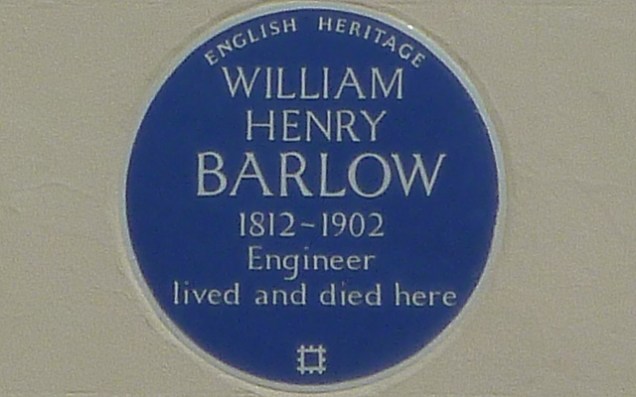
WIlliam Barlow's blue plaque

William Barlow was famous for the design and construction of railways, bridges and iron and steel structures during the golden age of railway building. From 1838 he worked on the Manchester and Birmingham Railway, and became Chief Engineer for the Midland Railway in 1844. He advised Joseph Paxton, designer of the Crystal Palace about the iron fame of the Palace. Between 1862 and 1869 he oversaw the building of the Midland railway from Bedford to London and designed the layout and construction of St Pancras Station (but not the ornate hotel in front of the station ). He served on the court of enquiry into the 1859 Tay Bridge Disaster, and designed the replacement bridge.

William Barlow retired in 1896 but continued to live in some style at High Coombe. The 1901 census lists 7 house servants living there as well as a coachman and a groom living in at stables in the grounds. The histories of the dozens of servants who worked at High Combe would tell a less glorious story about Britain in the nineteenth century.

William Barlow died at High Combe in November 1902 and his wife Selina Crawford Barlow died there a few months later. High Combe was purchased by a French Catholic Community of Sisters from Bordeaux: the Oblates of Assumption. A small chapel was established in the house, but the population of the area was growing rapidly and congregations grew.

The building of Our Lady Grace church in the grounds of High Combe began in 1905 and was completed in 1911. The sisters started a school in the High Combe stables. Plans were made to build a new school, but these were delayed by World War I, and a new school building opened in 1927.

Will Charlton road changes give you the hump?

Greenwich Council 20mph zone map

Big changes are on their way to a big chunk of Charlton’s back streets – if they affect you, what do you think of them?

Hundreds of homes were sent consultation packs last week about making the area between the A102, Charlton Road, Charlton Church Lane and Woolwich Road into a 20mph zone. If you got one and it came as a surprise, you weren’t the only one – it’s understood local councillors weren’t aware of the plans, either. (If you haven’t had one, call the council on 020 8921 3804.)

“The Victoria Way area has been identified as a priority,” says the accompanying letter, citing 21 accidents in three years, one causing a serious injury.

Furthermore, work is planned for the railway bridge on Victoria Way to protect the narrow, weak footway from vehicles mounting the pavement.

The documentation is supposed to be on the council website, but – surprise, surprise – it’s not on there. I’ve asked when it’ll be uploaded and will link to it when it is.

Here’s what’s planned for the Victoria Way 20mph Zone

Speed humps on nearly all roads within the area (apart from the no-through roads and those that already have them).
– Installing 20mph roundels at key points, and removing existing road hump warning signs since they won’t be needed.
Repainting faded road markings.
– Giving northbound traffic priority on the Victoria Way railway bridge, adding a new 7-foot width restriction south of the bridge, introducing a 3-tonne weight limit (it’s currently 6 tonnes) and installing guard rails and raised kerbs between the roadway and the pavement.

20mph zones are slowly being adopted by London boroughs – indeed, streets around Charlton Lane, as well as in Blackheath and east Greenwich were made 20mph zones some years back. More recently, Greenwich Council has become keener on the idea and plans gradually to make all residential roads 20mph zones. The key reason’s safety – if you’re hit at 20mph, you’ve a better chance of surviving. But 20mph zones tend not to be actively enforced by police, who say the surrounding measures mean they tend to be “self-enforcing”.

Another concern is the speed humps themselves. Humps with shallower rises are promised, providing a smoother ride for both motorists and cyclists. But with the humps also affecting streets on the 380 bus route, has Transport for London been consulted? (Existing humps on the bus route section of Victoria Way are more like raised tables.) And will residents have to put up with the scrape of speeding cars’ exhausts as they bash against the humps?

On the other hand, is this just too weak a solution? You could dispense with speed humps and cut rat-running by closing off short sections of each road to all except pedestrians, buses and bicycles – something that’s been done successfully in the borough of Hackney.

As for the works on the railway bridge – would a guard rail add to clutter?

Lots of questions, and I suspect there’ll be a variety of answers. What do you think?

Is the 380 bus getting a little too close for comfort?

380 bus

The 380 bus route, wiggling its way through the back streets of Charlton, is a lifeline for many residents. But for some, it’s been getting a bit too close for comfort. A couple of weeks ago, Clare dropped me a line to ask…

“A parked car was hit by a 380 bus this afternoon outside my house on Woodland Terrace, the back bumper was taken off the car and there is red paint all over the side of the car. The bus driver didnt stop so having spoken to the police its unlikely that they will be pursuing it any further.

“This is the third incident of a 380 hitting a parked car along my road so just thought it might be interesting to hear if other residents have had similar issues?”

Longer buses have been used on the route in recent years, including the five hybrids which now ply the route – but are some corners just too tight for them?

Fancy a green-fingered trip to Hatfield House?

Hatfield House

Free on Wednesday? Want to visit one of the country’s most impressive gardens? Here’s Aeron Allen with an offer you might be interested in…

I understand that some of your readers are probably interested in horticulture. With that in mind, I am chairman of a social group in Charlton Triangle Homes.

Because of a clerical mix-up, we have a number of spare tickets for a coach trip to Hatfield House & Gardens. The price includes entry & coach for £10. This trip leaves Marlborough Lane at 9am on 31st July, leaving Hatfield House at 4.30pm. If anyone is interested, please contact me – sorry, no children.

If you’re interested, give Aeron a call on 0789 110 0514.

Charlton fans act to protect The Valley – but what else in SE7 needs looking after?

Newspaper front page from The Royal Oak

The Charlton Athletic Supporters Trust has launched a petition to officially designate The Valley as an “asset of community value” to protect the historic ground from being sold for development.

There’s no suggestion that the stadium is in any immediate danger of being sold, and relations between the relatively new trust and the club are good.

Instead, it recognises the fact that almost every club in England outside the Premier League is in permanent financial peril – and given Charlton’s unhappy history of ground moves, it makes sense to safeguard the ground in case any new owners plan to sell up.

Even if Charlton are successful, this isn’t a totally unlikely scenario – Greenwich Council planning masterplans show a possible stadium on the west side of the Greenwich Peninsula, and it’s felt by some that this would be an option if the club were to return to the Premier League, given the natural restrictions on developing what used to be the biggest ground in the League.

Charlton moved to share Crystal Palace’s Selhurst Park ground in 1985, returning in 1992 via a short spell at West Ham. Even earlier in the club’s history, it spent a disastrous year at a ground in Catford called The Mount (now Mountsfield Park) in the 1920s.

So what is an asset of community value? Quite simply, every council is now required to keep a register of places which are deemed valuable to their local communities. If the council approves this application, then if the property is ever sold, then a six-month block is placed on the sale to enable local community groups to bid. Nominations have to come from community groups, rather than individuals. Assets can include community centres, libraries, pubs, open spaces and more.

At present, Greenwich Council does not have an register of assets, but Lewisham has registered the Baring Hall Hotel pub in Grove Park and an artists’ studio in New Cross. So it’s easy to see where The Valley fits in – indeed, Manchester United fans are making similar moves to protect Old Trafford.

So, what else locally should be on this register? The Place Station allows anyone to list places they think could or should be on the list – in Charlton, I added the old St Austin’s sports field in Highcombe, and the summer house (ex-public toilets) outside Charlton House. That said, it’s possible neither would qualify because they’ve been out of use for so long, but just outside SE7, I added East Greenwich Library (due to be sold by the council) and Hervey Road Playing Field too.

But what else could go on there? The biggie’s Charlton House – itself due to be moved to a heritage trust soon. But where else? Charlton Assembly Rooms? The pet cemetery in Hornfair Park? The Old Cottage Cafe in Charlton Park?

These are just suggestions – where else do you think could benefit from special protection? Share it here – and The Place Station would also like to know, too.