
The first plans to build housing on the Charlton Riverside could finally get the go-ahead from councillors next week – replacing warehouses and industrial units on Eastmoor Street with 255 flats.
City Hall wants to see thousands of homes built on the riverfront around the Thames Barrier in the coming years, with a number of schemes in the pipeline. Plans for 771 homes off Anchor and Hope from the developer Rockwell were thrown out by a planning inspector a year ago after being rejected by both Greenwich Council and London mayor Sadiq Khan on grounds of both height and density.
A masterplan for the area calls for lower-rise housing – a maximum of 10 storeys – in an attempt to differentiate it from the Greenwich Peninsula and Woolwich’s Royal Arsenal, while Greenwich Council’s housing policy demands that 35 per cent of homes must be “affordable”.

Now two smaller plans have come forward for land behind the old Victoria pub, which could finally start the transformation of the area – but will also provide an insight into the trade-offs and compromises involved in creating what will eventually become a new neighbourhood. In one scheme, objections to taller buildings have been followed by a cut in the amount of “affordable” housing at a time when there are 23,000 people on Greenwich Council’s waiting list.
Planning officers are recommending that the schemes get the green light – but councillors on Greenwich’s planning board will have the final say at a meeting on Monday 28 June.


The first – and most controversial – scheme is from the developer Aitch Group, for land behind the current Beaumont Beds warehouse and to the west of Barrier Gardens. Aitch originally planned 230 homes with 10-storey blocks – after objections these have been cut down to 188 homes with blocks of up to nine storeys, with commercial units on the ground floor and play space for children.
Before the objections, the plan had 35 per cent “affordable” housing; now only 29.7 per cent of the homes would be “affordable”, with the developer saying it cannot afford to build more. Of the total, 21.2 per cent would be for London Affordable Rent – half market rents, available to people on the housing waiting list but more expensive than standard council rents – and 8.5 per cent would be for shared ownership.
The scheme has drawn objections from resident groups. The Charlton Society says the blocks are too tall, as the masterplan suggests heights of three to six storeys at this site, adding that it “would be a waste of time commenting on any other features of the design”.

The Charlton Central Residents Association – whose patch is some way from Eastmoor Street – also objects, saying the scheme would “not exactly providing good quality living accommodation” while the Derrick and Atlas Gardens Residents Association, which represents the only residential streets currently on the riverside, calls the height, density and massing “extreme”.
Charlton Together, an umbrella group representing residents’ organisations, says: “We continue to be faced with plans for dormitories that could be anywhere.”
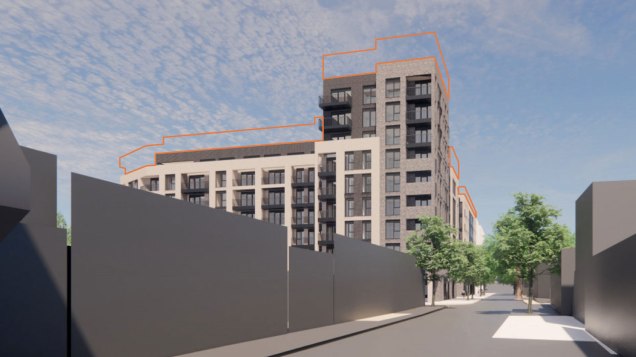
In their report, planning officers say that the heights in the masterplan are simply guidance, and that traditional houses would not be allowed in a flood risk area.
“The scheme is characterised by a six-storey main parapet and which is considered appropriate to the intended mid-rise character of this part of Charlton Riverside,” they say.
Overall, there were 28 objections, with 34 comments in support.

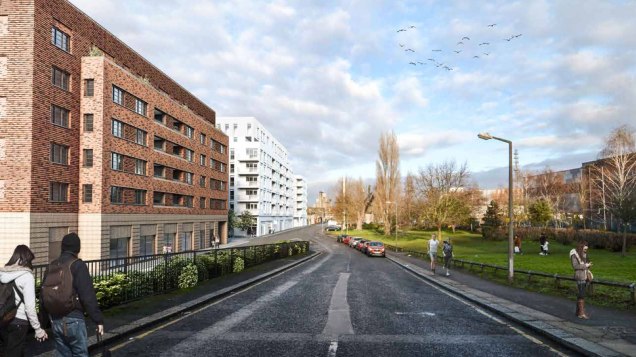
Less controversial are plans for 67 flats on the site of the Beaumont Beds warehouse. These would be from the Optivo housing association – which held a very short-notice consultation in January 2020, meaning it snuck under the radar for many – and would all be for London Affordable Rent.
These would be in blocks of up to seven storeys, with two ground-floor commercial units.

However, there are still objections on the grounds of height from the Charlton Society and the Greenwich Planning Alliance, with worries expressed about a lack of play space – with Maryon Park across the busy Woolwich Road from the development. Other residents’ groups did not comment.
The major challenge to both developments is a lack of infrastructure. While new healthcare facilities are planned for the riverside, the NHS London Healthy Urban Development Unit calls for money from both developments to be spent on existing GP surgeries in the meantime – a request refused by council planners who say the developments are not big enough. Councillors could revisit the issue if they take enough interest in it.
Developers will also have to pay a £3,000 council levy on each flat to contribute towards the major infrastructure needed – new roads, including what will effectively be an extension of Bugsby’s Way; improvements to Woolwich Road and Anchor & Hope Lane; a new secondary school; one or two primary schools; ten nurseries; the health centre; Thames Path upgrades; improved public realm and a new park.
Network Rail has raised the issue of pressure on local trains, while Transport for London is charging a £2,812 levy on each flat to pay for new bus services through the riverside area – an extended 301 bus service from Woolwich is expected to be introduced as an interim measure.
If approved, other major schemes are likely to follow soon with developers understood to be impatient to start work on their projects.
They are:
- U+I plans 380 homes on the old Siemens factory site on the Charlton/Woolwich border, along with a co-working hub for local businesses and space for light industry. The scheme, Faraday Works, was recently altered because one of the Siemens buildings was given a Grade II listing – resulting in a cut to the “affordable” housing on the site.
- Hyde housing association wants to build nearly 1,300 new homes at what it calls Herringham Quarter, using a number of sites including Maybanks Wharf.
- 500 homes are planned by developer Komoto at what it calls Flint Glass Wharf, the former Johnsen and Jorgensen glassworks which closed in 1981, between the Tarmac works and the Thames Barrier;
- 1,500 homes from developer Montreaux on the industrial estate containing the former Stone Foundries plant behind the Stone Lake retail park. The land was sold in 2018 and the scheme has not yet entered planning.
- The infamous Rockwell development for 771 homes off Anchor and Hope Lane, thrown out by a planning inspector last year. Current status: unknown, and the site has disappeared from Rockwell’s website
One small scheme has already been approved for the riverside area – the conversion of the crumbling Victoria pub with the addition of a single flat next to it. However, the developer has already applied to split the single flat into two.
Close to the riverside, building works have begun on the Antigallican pub after permission was granted for a 60-room hotel there two years ago. There has been no decision on plans to change this to a 49-room co-living space.
PLEASE SUPPORT THE CHARLTON CHAMPION
We tell the SE7 stories you won’t read elsewhere. And we’ll do the others better than anyone else. We can’t do it without your help.
– Please tell us about your news and events
– Become a monthly supporter at presspatron.com/charltonchampion
– Donate to our running costs at paypal.me/charltonchampion
 The Charlton Champion
2 thoughts on “Charlton Riverside: First 255 new homes could get council go-ahead next week”
Comments are closed.