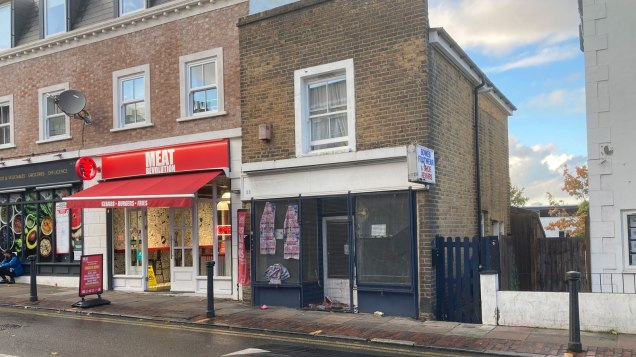
A developer wanted to build a new shop on the ground floor with two 2-bedroom flats and two studio flats to match the parade of shops next door. “The property is in a bad condition thus demolition will be more suitable,” planning documents submitted to Greenwich Council said.
But Greenwich’s planning officers threw out the plan, saying the “development would result in the demolition of a building which positively contributes to the character of the Charlton Village Conservation Area”.
The Charlton Society did not lodge a comment on the application, although one individual wrote in to observe that “the view of Docklands enjoyed by 34-44 The Village would be lost”, without making an objection.
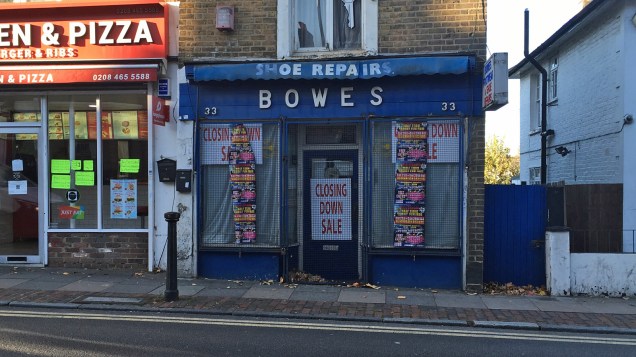
Bowes was one of the last remaining traditional shops
The council’s conservation officer said that: “The significance of the building lies in its historic contribution to the understanding of the development of the area; and its architectural/aesthetic contribution to the character and appearance of the Charlton Village Conservation Area.
“The building’s diminutive scale and proportions; its traditional shopfront; and its overall appearance make a positive contribution to the character and appearance of the area, which retains a real village identity. The latter is in danger of being eroded by new development.”
There were also concerns about the effect on neighbouring properties, whether the new flats would have sufficient light, and about car parking.
Since the shop closed it has mostly remained empty, although it did briefly trade as a gift shop in the run-up to Christmas. The council issued its rejection in December, but the decision has only recently come to light.
One of Charlton Village’s best-loved shops could be demolished if plans to extend the block next door are given the go-ahead.
The Victorian building at 33 The Village has been empty since the Bowes shoe shop closed nearly seven years ago. Now a developer – whose name is given only as Mr Boyraz – wants to knock it down to expand the row of shops to the west, which themselves have recently undergone redevelopment.
Boyraz wants to build a new shop on the ground floor with two 2-bedroom flats and two studio flats to match the block next door. “The property is in a bad condition thus demolition will be more suitable,” planning documents submitted to Greenwich Council say, adding that it is significantly smaller than its neighbours.
Bowes was one of the last remaining traditional shops
“The proposed new building will be stepped back thus in line with no 25-31 and it will carry on the architectural elements and materials of said building,” it adds. “The result will be a continuous design and a better proportioned building to fill the gap between no 31 and 35.”
Bowes was one of the last remaining traditional shops in The Village but closed its doors for the last time at Christmas 2015. The building was bought for £265,000 in April this year, according to the Land Registry.
A disused shop unit in Charlton Village could become a coffee shop – if a developer is as good as their word.
The former ironmongers at 7a The Village, which has a two-storey flat on top, has been closed for seven years, but a developer wants to build an extension so it can accommodate two flats, and divide the downstairs unit so it can incorporate a coffee shop.
A planning document submitted to Greenwich Council reads: “At ground floor, the shop front will be restored and refurbished, with provisions made for future use as a coffee shop or similar. The area has struggled to compete with larger centres such as Woolwich and Blackheath, as well as with out-of-town retail parks of Charlton Riverside.
“This is a factor that may have led to the closure of several shops in The Village in recent years, according to the Charlton Village Conservation Area Character Appraisal.
“We hope that by restoring the shop it will provide much needed footfall to the local high street. There is also strong demand for coffee shops in the area, according to a local estate agent. At ground floor, behind the shopfront will include two offices for use to carry out general administrative tasks, plus a training/presentation room.”
It adds: “[The development will] e of great benefit to The Village high street and the Charlton Village Conservation Area. Restoring the disused and vacant shopfront is critical to enhancing the relevance of the high street in Charlton Village, which is currently falling away to become instead a through road to Woolwich and Greenwich. This refurbishment alone won’t solve the issues facing The Village high street, but it is a positive step in the right direction.”
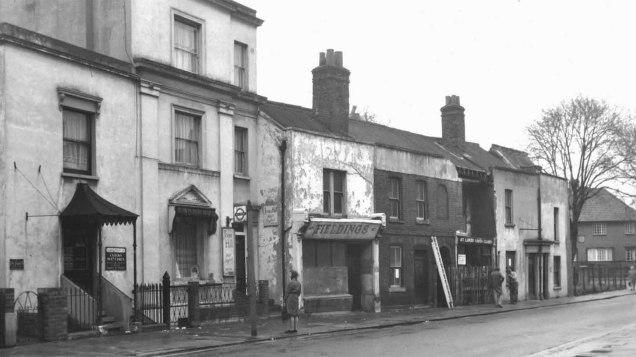
Charlton Village in 1970. “The watchmaker, hairdresser and Fieldings before the cottages were demolished, the tree to the right still stands in Fairfield Grove”
From Saturday, the Charlton Society is hosting a street exhibition in The Village, with displays on 17 shops showing engravings and photographs of the village since 1775. If you can’t make Saturday, the exhibition will last until 27 November.
In addition, if you can spare time on a Friday afternoon, the society is hosting an open day on 30 October from 2pm to 4pm: “Members of The Charlton Society Committee will be in the Village outside The Village Green Grocers where they will hand out copies of a commemorative Year Book and a facsimile of Charlton Village and its Parks Walk, originally printed in 1984. We hope that Charlton Society members and residents will take the opportunity to walk around the Village and view the exhibition.”
A view from 1775, with St Luke’s Church on the left and the spire of Charlton House on the right
The society adds: “The Charlton Society has been operating virtually since the beginning of the Covid-19 lockdown and have produced this exhibition to highlight Charlton Village as a unique London village, thank our traders for supporting the community throughout the lockdown and demonstrate some of the activities that The Charlton Society has engaged in during its 50 years.
“The Charlton Society has been operating since 1969 in response to a growing concern at the level of modernisation that could threaten the special character of the Village. Never an enemy of necessary development The Charlton Society was established to awake interest in the special character of Charlton Village, to assess new developments with a view to bring the best to Charlton as a whole, to protect the neighbourhood from the excesses of development but support good design and improvement.”
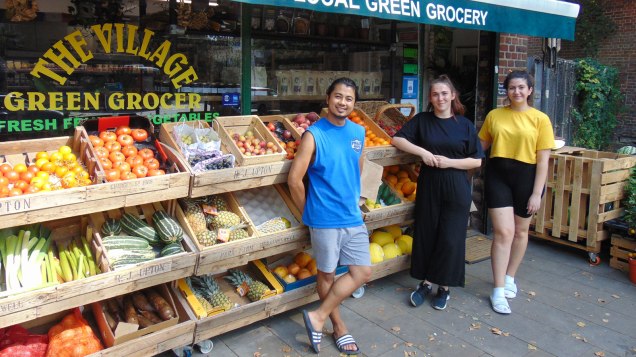
Bardan Pradhan took over the greengrocers three years ago
The coronavirus lockdown turned life upside down for many small businesses. The Village Greengrocers, which featured on our lockdown shopping list six months ago, prospered. LANCE BOHL found out why.
Originally from Kathmandu, Bardan Pradhan gained an MA in business administration before taking jobs as diverse as a smartphone area development manager for a Japanese conglomerate and as a tutor in economics. He also co-owned Philly Boys Cheese Steaks, which sold fast food at Camden Market, London Zoo and music festivals. “Although I worked with red meat for about six years I’ve never really eaten it myself,” he says.
“I always knew that I wanted to do something on my own, and decided that I wanted to make a definite move away from that area and focus on enabling people to eat healthily and sustainably. And that’s how I came to be involved with the shop.”
When The Village Greengrocers came up for sale in 2017, Bardan jumped at the chance. Although it was a traditional greengrocer, its main focus was supplying pubs and restaurants with the shop run very much as a sideline. The first thing he did was to reposition it as an organic grocery store with not just fresh vegetables but also bread, dried fruits and honey. “I started selling only good quality, sustainable, foods from local suppliers. If air miles had to be involved, I wanted them as low as possible.”
Although 2019 was a very difficult year, lockdown actually helped the shop not just grow, but thrive. It was the first shop in Charlton Village to introduce a distanced queuing system and also restrict the number of people in-store, before lockdown came into effect.
“This made our customers – and staff – feel much safer and more comfortable when shopping during lockdown,” Bardan says. “The personal service my customers received made a huge difference to them. There was a definite shift away from large supermarkets in the retail parks, which had huge queues and staff who could be quite rude to people.”
People suddenly found their choice of places to shop had reduced dramatically. The vast majority of stores were closed and The Village Greengrocers was one of only two shops in Charlton Village which were open. People still needed to buy food, but had fewer places to buy it from.
“Our customer numbers increased hugely and, because we only sell food, it meant our queues were relatively short – so the shop was more convenient to use. Plus we opened regularly from 9am until 3pm every day of lockdown, whereas other shops varied their hours significantly, with no notice.”
The Village Greengrocers is trying to move away from plastic packaging
People started to stockpile – not just toilet roll, but even fruit and vegetables, sometimes buying as much as two or three weeks’ supply at once. This meant that staples, such as potatoes and carrots, became very hard to source at a supplier level. “My main problem suddenly became getting hold of enough stock for the shop. Luckily, I’d built up a good reputation over the years with traders and porters at the wholesale market which stood me in good stead. But it was a difficult time.”
Before lockdown, almost half Bardan’s stock came from major organic suppliers. After March, these suppliers experienced vastly increased demand from their larger customers and smaller independent shops such as The Village Greengrocers were unable to get deliveries. “I quickly found local producers who were more than happy to supply me with fine quality artisan bread, pastas, cheese, poultry and dairy, Kentish eggs as well as fruit and vegetables. What’s more, I trust them and they’re reliable. These relationships work really well and the shop’s now got a whole new network of local suppliers.”
A government small business grant and council rent relief meant the shop could invest in more stock and hire a fourth full-time staff member, helping Bardan concentrate on getting stock in.
Home deliveries of fruit and vegetable boxes have helped keep vulnerable people going while shielding. Many were unable to get a delivery slot from the major supermarkets, and this personal service has been rewarded by customers staying loyal to the shop. “I’m expanding our delivery service with locally-produced bread, milk and eggs,” says Bardan. “The next step is to finalise and launch the online store. Our customers will be able to select from a range of pre-set boxes, which they can customise if they want. At the moment they create a list and send it by email, which is quite time-consuming.”
The Village Greengrocers team are now looking to the future
Bardan also plans to cut the shop’s impact on the environment by making 30 currently pre-packed goods – including rice, greens, dried goods, coffee and pastas – available loose from dispensers. He is passionate about the idea. “By dispensing with the individual packaging, customers will be able to bring their own bags and get the same quality but at a much lower price and in a more environmentally friendly way.”
Publicity including coverage in Metro and American Express’s Shop Small campaign has also helped, with the shop regularly updating its social media accounts.
“I think lockdown has completely changed people’s eating habits,” says Bardan. “Fast food chains were closed for a long time and this, along with home working, meant people started to prepare and cook food themselves. Also, they are focused on building up their immune system and the demand for fresh fruit and vegetables is now much greater than ever before.
“I really think the four of us make a great team. We’re in a very good position, and we’ll continue to serve the local community we supported during the difficult time of lockdown.”
LANCE BOHL lives in Charlton and is an internal communications contractor.
This is one of a series of stories published here and on our sister site 853 about how SE London’s communities have reacted to the coronavirus pandemic. See all the stories published so far.
How Mendoza says the new home would look from Torrance Close, behind the pub: it would largely be hidden from view by a wall
Greenwich councillors deferred a decision whether or not a house should be built at the back of the White Swan pub so they can take a closer look at the site themselves.
Council officers are recommending councillors approve a three-bedroom bungalow on land behind the beer garden – taking a strip off the beer garden to build an access path so council bin lorries can take away its rubbish from the front of the pub.
It is the company’s fourth attempt to build on the land since it bought the freehold from Punch Taverns in March 2015 – past attempts have been refused by the council and a planning inspector. The pub itself has been closed since March, but the company has said it will look for a new tenant.
After a discussion about the removal of trees in the beer garden (from 57 minutes in the video above), Thamesmead Moorings Labour councillor Averil Lekau said she was unfamiliar with the site and would prefer to see it for herself. “Would it not be possible to have a visit to get some clarity on what we’re deciding on?,” she said.
She was supported by Nigel Fletcher, a Conservative councillor for Eltham South, who called it an unusual application. “I know the pub but I don’t think I’ve ever been in the beer garden,” he said. “I’m having quite a bit of difficulty visualising the site and it’s quite a sensitive one; a lot of what we’re being asked to consider are the narrow grounds between this and previously refused schemes.”
There were nine objections, including from the Charlton Society. Planning officers are recommending an acoustic fence is put up to shield the house from the pub’s noise, while a tree in the beer garden should be replaced.
The scheme will return to the committee once councillors have visited the pub to see the location for themselves.
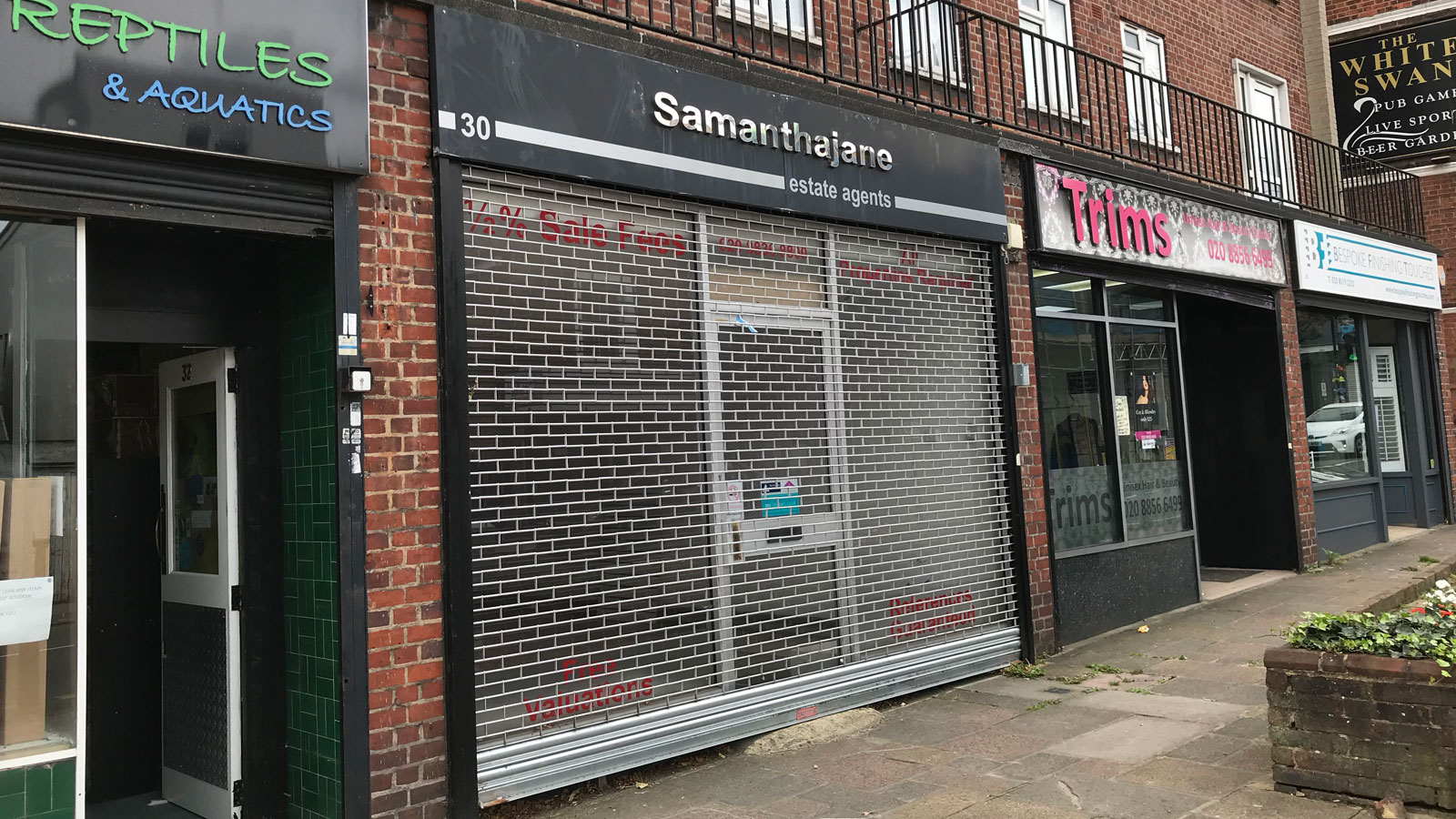
This could soon be a bakery – if council officers approve
The team behind Charlton Bakehouse, which has been delivering to doorsteps across SE7 and beyond during the pandemic, are hoping to set up shop in a former estate agent in The Village.
A planning application has gone into Greenwich Council to convert the former Samanthajane office by installing an extraction system including an odour control system and silencers. (See the application and comment or search for 20/0517/F)
With Charlton Village blighted by shop closures and in its possibly its lowest-ever ebb – and with no sign of a plan to revive its fortunes – the proposal is likely to gain a lot of support.
The application actually first went in before the lockdown – but as with other local businesses, word spread about the Bakehouse while people were stuck at home.
It still offers free deliveries on Tuesdays in SE7 and on other days in SE3 and SE10 from charltonbakehouse.com. We recommend the cinnamon buns.



 The Charlton Champion