
Eastcombe Avenue, courtesy of Neil Clasper.
Out here in the fields… I fight for my meals

Ever wandered over to Asda on foot through the alleyway opposite Victoria Way? Ever thought your life seems a little duller for it? I can’t help thinking that the Woolwich Road would look completely different if something more pleasing to eye was placed here.
This spot used to be an old industrial estate and retail park, playing host to 80s giants such as Queensway furnishings and Harris Carpets. Indeed you can still see the turnings in the roads that used to funnel traffic from Woolwich Road, but these have now been blocked off by fencing. Now it’s just broken tarmac, mounds of earth and scrub-land topped off with a rather dirty looking willow tree.
Sightings of rats there are fairly common, and it is also provides a shelter and pedestrian highway for a man selling knocked off DVDs.
I’m told this plot of land is worth well over a million pounds and is actually owned by a bank. There’s no way that Greenwich Council will be able to buy this land so the bank is just sitting on it and waiting as its price rises and rises. Every time I walk past this wasteland I think to myself, every second I’m walking past this land someone out there is getting slightly richer. Whilst my life is slowly getting duller.
I asked the council if the bank had any plans or if there had been any interest to build on it. There isn’t, although my enquiry did bring something else to light. About fifty metres further down the road, past the set of isolated houses as you travel eastwards down Woolwich Road, an extension to the Millennium Business Park is to be built. Here’s a map highlighting the two areas if you’re not sure where I mean:

Just behind Sports Direct, the council has granted outline planning permission for redevelopment of the site comprising 4,160 square metres of retail units, 6,715 square metres trade units, 20 residential units (16 x 2-bed, 4 x 1-bed) and associated access and car parking. For more details please visit Greenwich’s planning site.

All this seems rather exciting. A rejuvenated business and retail park – but they have done the right thing and lined the north side of Woolwich Road with houses and convenience shops. There are even plans for a piazza.
A piazza? Between the retail park and the houses, perhaps there’ll even be cafes and restaurants. Have you ever imagined eating ‘al fresco’ on the Woolwich Road?
No talk of the wasteland I was originally referring to though. As one site is beautifully sculptured into a multi-purpose residential/ commercial complex, another site remains desolate scrubland.
So what do we want? Are they sitting on this land in case the up-and-coming O2 and Greenwich Millennium Village floods into New Charlton and we become part of the Las Vegas of London? Is there a more simple purpose that this wasteland could serve? I’ve heard someone say that it should be a children’s playground. A creche for their parents to take them to whilst out shopping. Personally I wouldn’t mind if it was at least just levelled, the fence taken down and we could just have it as grass. Perhaps we should do something. We could urge them into selling up or building something.
Perhaps we could even break in there and doll it up with some guerrilla gardening. Who knows, but a walk to Asda will always be dull as long as it’s kept the way it is.
The stuck bus of Charlton

I can’t help noticing that as crowds at The Valley have got smaller, the signs warning of bus diversions around matches have got bigger, with huge red panels warning of changes to the 380 and 486 services. If only bus drivers took notice of them too – sights like the one above, where a 486 got caught in the departing crowd after yesterday’s match against Sheffield Wednesday, happen from time to time.
Not sure why the 380 needs to be shifted – the smaller crowds for football mean getting through Wellington Gardens and Charlton Church Lane is less of a problem.
But the police close Charlton Church Lane for a short while after matches, so the 486 is certainly affected. But when even the bus drivers can’t even follow the diversions, something’s not working properly.
Charlton’s Friday Photo, number 2: 29 October 2010
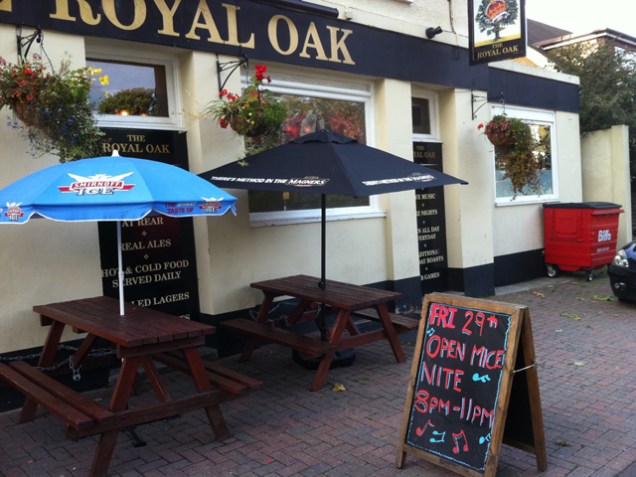
Open mice at the Oak? Tonight? Cripes.
O2 bosses back Charlton station bus boost
O2 arena bosses are ready to back locals who want to see more buses between Charlton and North Greenwich stations.
Residents told a meeting of Charlton Rail Users’ Group last night they wanted to see one or more routes to the Greenwich Peninsula diverted to supplement the existing 486 service which serves the Dome and the Jubilee Line stop.
Charlton station is promoted as an interchange for the O2 – but only the 486 stops directly outside the station. A further two services to the entertainment venue, the 161 and 472, call at two separate spots close by – prompting bus users to do what was dubbed a “dance of death” between busy roads to get the first bus to North Greenwich.
The O2’s transport strategy head Geoff Symonds said he would support diverting buses via a loop in Charlton Church Lane as part of plans to make Charlton station “more of a hub” for for people travelling to the venue.
Mr Symonds told the meeting he was working on plans to ensure more than 75% of O2 visitors continued arriving by public transport, and plans for an express bus link between Charlton and North Greenwich on event nights were also under consideration.
“Less than 1% our visitors overall come via Charlton station, and of our car users, between 80% and 90% come from Kent,” he said. “The next stage of our strategy is to make Charlton station more of a hub.”
The O2 had already been successful in persuading Transport for London to make more bus services call at North Greenwich, he told the meeting.
“The Tube closures have forced us to be creative, and we did run express buses from the O2 to Charlton which were used by around 2,400 people on event nights. We actually had complements about how good the service was, when we would usually get complaints about replacement bus services.”
Charlton’s late night train service would need to be boosted to make improved bus links a success, he continued, explaining that the O2 had paid Southeastern to run extra trains from Charlton when Guns N’ Roses played at the venue, fearing the temperamental band would play beyond the Tube’s closing time.
“It paid off, because they didn’t come off stage until 12.40am,” he said, adding that the venue had secured a train service to 2am.
Southeastern’s public affairs manager Mike Gibson told the meeting Charlton Station had been awarded “safer station status” by the Department for Transport, after improvements to lighting and CCTV, a 30% annual drop in crime and positive results in a passenger survey. Staff monitored CCTV 24 hours a day, he said, and could make announcements over the station’s PA or call police if they saw trouble.
12:25PM UPDATE: It’s emerged that Thames Clippers – owned by O2 backers AEG – is cutting late night boats from central London to Greenwich and Woolwich from next week.
Thanks to David Thomson for the Charlton station photo.
Charlton history: The Horn Fair
The Charlton Champion launched on October 18 – St Luke’s Day, and once the date of Charlton’s infamous Horn Fair. Greenwich Guide author Alan Palmer describes a local tradition that led to a Victorian moral panic…

Many residents of Charlton will recognise the name from Hornfair Road or Hornfair Park. Some will have gone along to one of the revivals held this century in the grounds of Charlton House. The modern fair is a pale shadow of the original, which was a much more riotous occasion, and one of London’s most popular fairs, according to contemporary accounts.
The fair was described by Daniel Defoe, the author of Robinson Crusoe, in A tour thro’ the Whole Island of Great Britain (1724-1727) as:
Charleton, a village famous, or rather infamous for the yearly collected rabble of mad-people, at Horn-Fair; the rudeness of which I cannot but think, is such as ought to be suppressed, and indeed in a civiliz’d well govern’d nation, it may well be said to be unsufferable. The mob indeed at that time take all kinds of liberties, and the women are especially impudent for that day; as if it was a day that justify’d the giving themselves a loose to all manner of indecency and immodesty, without any reproach, or without suffering the censure which such behaviour would deserve at another time.
It was suppressed because of the drunken behaviour of fair-goers in 1874.
We know that in 1268 King Henry III granted a three-day fair to the Abbey of Bermondsey to be held around Trinity Sunday, which is the eighth Sunday after Easter, that is, around May or June. Bermondsey Abbey owned the manor of Charlton at the time.
Around the 17th century the date of the fair was moved to 18 October, which is the feast day of St Luke. Charlton’s parish church is, of course, dedicated to St Luke. In medieval pictures Luke is invariably seen in writing or painting posture, with a horned ox or cow prominently displayed. It is likely that the carrying of a large pair of horns on a pole indicated the opening of St Luke’s Fair, and may be the origin of the horn motif of the fair.
The fair would begin with a parade from Bermondsey to Charlton, with the revellers wearing horns, and blowing on the musical versions of them. Many would wear fancy dress, including cross-dressing. The tradition of the parade was revived in 2009 – the IanVisits blog describes the start.
An even more notorious fair used to be held in Donnybrook, which is nowadays a peaceable suburb of Dublin, probably not unlike Charlton. It was licensed by King John in 1204 and was suppressed in 1855 for the same reasons as Charlton’s Horn Fair. The word “donnybrook” entered the language as a slang term for a brawl. Just think: if things had been slightly different we might have been calling a punch-up a “charlton” instead!
Charlton’s Friday Photo, number 1: 22 October 2010
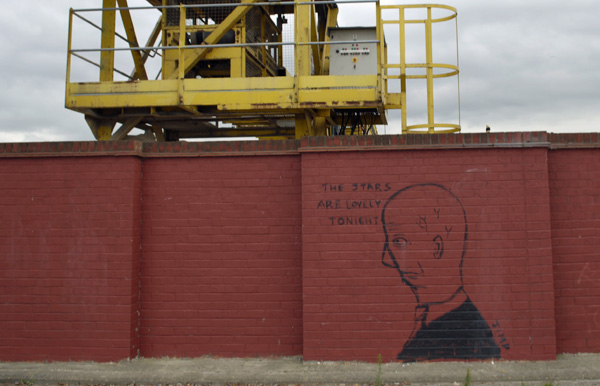
Taken on the riverside walk between the Anchor & Hope and the Thames Barrier.
– Want to submit a photo for this section? Get in touch.
 The Charlton Champion