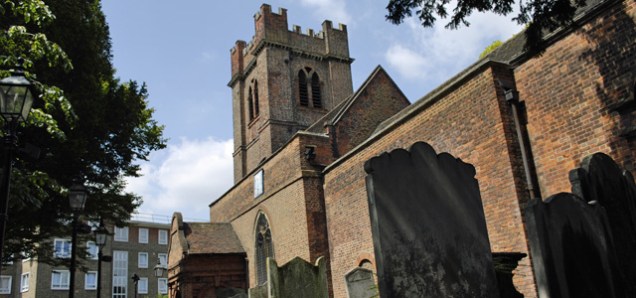
Spooky goings-on at Charlton House this weekend

Once again, this Halloween Charlton House will play host to a ghostly performance by Phantasmagoria Events. Tours run every 15 mins on Saturday 29th October and Sunday 30th October between 7pm and 9pm. Every tour lasts one hour and tickets are available at Greenwich Theatre’s website. Here’s the ghoulish description of their show:

Way back in time, when gods and monster rules an ancient land, an iron age community lived near the site. They created a portal to the spirit world – From the four corners of Greenwich, a legion of the borough’s most horrid and historical phantoms are drawn to the imposing Jacobean mansion. Once a year, at Halloween the portal opens to allow the trapped spirits to ascend to a higher realm. In order for the ancient magic to work, 13 spirits are needed. However, there is a catch. Only 12 spirits are in the house. They meet you, greet you, tell you there story, however they are watching you like a hawk. You could be the 13th. 

There is actually a real ghost that lurks through the halls of Charlton House (no, really!). It’s said to be Sir William Langhorne who bought the house in 1680. At the age of 80 he married a 17-year-old bride from Charlton Village. He was desperate to have a child to inherit his wealth but died two months after the wedding before his wife had conceived. He still haunts the grounds in the hope of finding a fertile bride.

Perhaps even more scary is that back in the 1990s GMTV devoted a whole five minutes of programming to this story, anchored by the timeless Lorraine Kelly. Enjoy:

William Bance: The Bard of Charlton

Following on from this weekend’s parks reminiscence open day, Charlton Champion historian Barbara tells us about the Victorian man who was inspired to create poetry by Hanging Wood – today’s Maryon and Maryon Wilson Parks.
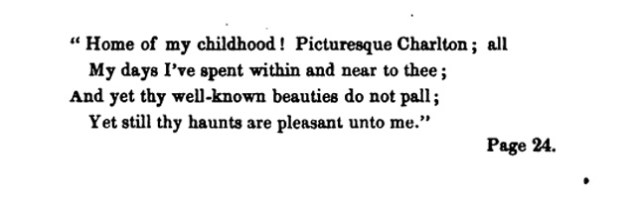
William Bance is not a name that many people will be familiar with. He is rather an unlikely poet, with only four known published works. Born in Charlton in 1806, he spent his whole life here until his death in 1866.

The 1841 and 1851 censuses give us a few clues to his life. He lived in The Village, known as Old Charlton at that time, with his wife Ann, who he married in 1830, and his six children.

The census shows that William was a gardener, a job that was common in Charlton, at a time when it had extensive market gardens and big houses with large grounds to be maintained. So how he came to write poetry is anybody’s guess. His wife is listed in the census as being a bookseller, so this may have been the spur to his writings.

I found his first published collection of poetry when searching for some information on Hanging Wood. It was published in 1844, and entitled ‘Hanging Wood, Charlton: and other poems’. (Free to download from Google Books).

I can find only three other published works of his – ‘Ralph: a Legend of the Gipsies’ (1845); ‘The Happy Village: and other poems’ (1848); and The Battle of Balaclava: a ballad’ (1862). Only ‘Ralph’ had any longevity, with reprints and free downloads available. The Happy Village collection remains tantalisingly elusive – I wonder if he is writing about Charlton Village in this book?

He’s not the greatest poet, but the interest is in what he’s writing about. His poems reflect aspects of his life in Charlton in the Regency and early Victorian eras, a time of great change.

In 1806, Charlton would still have been a quiet rural village, surrounded by fields and market gardens. Charlton House and St. Luke’s church dominated, and there were a few grand houses occupied by the clergy, the landed gentry and senior army and naval officers from the Royal Artillery, the Arsenal and Dockyard in Woolwich.

By the time William Bance died in 1866, the railway linking the area to London had been built, and new housing was appearing along the lower road, Victoria Way, Maryon Road and Lansdowne Lane.

So what about the Hanging Wood poetry collection? The main poem is long – 20 pages, with 9 other shorter poems. He writes about walking with his wife through Hanging Wood, which was a prominent feature of the area at the start of the 19th century, covering what are now Maryon and Maryon Wilson Parks.

A sketch taken from the poem shows that the view from there when he was writing was somewhat better than it is now, as he describes being able to see to Woolwich:

‘Woolwich! As I gaze on thy town before me,

A glow of warm respect for thee I feel;

Thou art a nursing place for England’s glory,

For her stout hearts of oak, and hearts of steel.’

The sketch shows, amongst other things, the then newly built chimney of the steam Factory at Woolwich Dockyard that remains today on Woolwich Church Street.

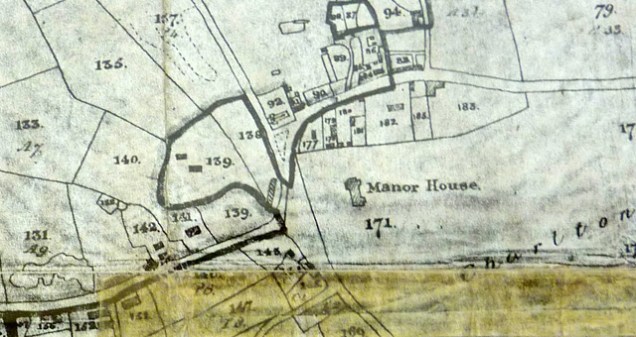
There are also family details in the poems. He writes of the house he used to live in as a boy and describes the village green with its elm tree (see map), which was later ‘enclosed’ (swiped by the Maryon-Wilsons) into the Charlton House estate in 1829 when the road from Charlton village to Woolwich was built.
Of the other poems, of interest is ‘Lines on Witnessing a Funeral in Charlton Church Yard’ (1843), where we get what is possibly an eyewitness account of the funeral of Edward Drummond, who was assassinated in mistake for Sir Robert Peel.

What I realised when doing this piece was that most of our published history is of royalty, the aristocracy and government. Not many ordinary, working-class people get remembered.

As a humble Charlton gardener, he would have been long forgotten and left no mark. But for William Bance, his poetry gives him his 15 minutes of fame and, thanks to Google Books, a place in history.

Open day for the Charlton Parks Reminiscence Project

Earlier this year the Greenwich Mural Workshop were given a lottery grant to initiate a 15-month period of research known as the Charlton Parks Reminiscence Project. The idea for this project is to gather memorable stories from local people relating to Charlton’s various parks over the past 50-100 years (Charlton, Hornfair, Maryon, Maryon Wilson, Thames Barrier and Gilbert’s Pit).

In the run up to the Olympics they will be holding three events to gather more stories but at the same time display photos, maps, interviews and information they have collected already. This Saturday, the 1st of October, sees the first of these open days as Charlton House opens its doors. The Old Library will be open between 1 and 4pm and the public are welcome for the whole afternoon or just to drop-in. You can learn more about the project or even contribute yourself if you have your own story. They are also looking for volunteers to help in their research and undertake interviews.

Charlton history: The man who took a bullet for the PM

Inside St Luke’s Church, Charlton Village, lies the unintended victim of an assassination attempt on a British prime minister. Charlton Champion historian Boneyboy tells the story of Edward Drummond…

St Luke’s Church is the burial place of the only British prime minister to be assasinated, Spencer Perceval. But less well known is that the unlucky victim of a later attempt to assassinate a British prime minister died in Charlton, and is also buried and commemorated in St Luke’s. The subsequent trial of the culprit, and a parliamentary inquiry, established an important principle of British law which lasted for over 120 years.

In 1843, 31 years after Perceval’s death, Daniel McNaughton attempted to shoot the Prime Minister Robert Peel outside Peel’s home in Whitehall. In what seems to be a case of mistaken identity, McNaughton walked up to Peel’s personal secretary, Edward Drummond, and shot him in the back.

Drummond was treated by doctors, and his wounds were not thought to be life-threatening. But five days later Edward Drummond died at Charlton and was buried in the Drummond family vault in St Luke’s. It’s possible that his medical treatment – including blood-letting and leeches – contributed more to his death than the wound or his brief stay in Charlton.

Edward Drummond was a wealthy man from a family who owned Drummond’s Bank. He lived in Whitehall, so the reason that he died and is buried in Charlton wasn’t initially clear to me. However the 1841 census, records that the Rector of Charlton was the Reverend Arthur Drummond, and I think it’s likely that Arthur was Edward’s brother, and that after the shooting, Edward went to Charlton to convalesce.

Arthur Drummond was also a wealthy man. The 1841 census list nine servants living at the rectory labouring to support Arthur and six member of the Drummond family.

The man who shot Edward Drummond was immediately overpowered and arrested by constables. He was Daniel McNaughton ( also known as M’Naughten and various other spellings) a wood turner from Glasgow. McNaughton seems to have links with a number of radical political groups including the Chartists. In 1842, a year before the assassination, McNaughton sold his business in Glasgow and embarked on a tour of Europe.

When he returned to Glasgow in 1843, he developed an obsession that he was being persecuted by the Tory Party and that he was being followed by their spies.

At his trial, McNaughton admitted shooting Drummond but said that the Tories in his native city had compelled him to do it. The defence called witnesses about his delusions and doctors who testified that he wasn’t responsible for his actions due to his insanity. He was found not guilty but sentenced to spend the rest of his life in the State Criminal Lunatic Asylum at Bethlem Hospital (formerly Bedlam) and was later moved to Broadmoor where he died.

The trial and verdict caused an outcry in the press and parliament. A House of Lords inquiry led the development of the M’Naughten rule which defined in British law the principle of defence on grounds of insanity.

What happened to the Bramshot Avenue shops?

Charlton Champion reader Boneyboy has a question I’ve been pondering too.

Does anyone know whether there are plans for the two vacant shops/takeaways in the part of Bramshot Avenue to the west of Eastcombe Avenue?

There is some sign of activity at what was the Desi Spice take away – the front of the premises have been repainted. Does anyone know if this means that there are plans to reopen?

Family Fish and Chips next door to Desi closed about 5 years ago. Pre-ordered fish was always great, the chips were excellent, and conversatons with the owner were… somewhere between confusing and entertaining. I recently spotted that the premises were for sale for around £10K.

About 15 years ago there were 7 business premises on this parade, including a sub-post office. Now only retail offering is the excellent Toy Box newsagents. Two shops have been converted to residential, the two takeaways are vacant, Arena Minicabs operate from another and there’s dental technicians in the other.

There’s plenty of other examples in the locality of corner shops and small parades dropping out of retail use, so what is the best use for these buildings? Should they stay in some type of commercial use (such as a mini cab office) or is retaining business use too disruptive, and is it better for the areas to allow these premises to be converted to homes?

As far as I can recall, the parade went into a tailspin after the post office went in the first big round of post office closures about six years ago. But what’s the future for these shops? Your thoughts – and memories of what was there – are welcome.

Street parties: Do you have any memories?

Today’s announcement of a royal wedding got me thinking back 30 years, and how similar these times feel to the early 1980s. More specifically, it got me thinking back to 29 July 1981, when Prince William’s dad got married – because I was at street party, in Tallis Grove, Charlton, where my grandparents lived.

Somewhere at my parents’ house, there may still be a small Charles & Diana cup obtained at that party.

I don’t remember any details of it – I was a few days short of being seven years old – but it remains a vivid memory, probably because I don’t recall anything like it happening since then. Indeed, even that 1981 street party must have been a bit of a throwback to the past – the photo above, from the wonderful plumstead-stories.com, is of a 1953 coronation bash in Ancona Road, SE18.

Indeed, the site has a wonderful gallery of street party photos dating back to 1918.

Do you have any memories of any street parties in Charlton, or the neighbouring areas? Did they really die a death after 1981? Do you have any photos? I’m not interested in predicting what’ll happen next year or your views on royalty – I’m just after talk of cake, bunting, and cherryade. I’d love to hear any memories, and perhaps we could even publish any photos here.

Invicta School bombing – 70 years on

From CAFC fan site Charlton Life, a message from contributor Tom Hovi:

On 14th November 1940, Invicta Road School near Blackheath Standard, was being used as an Auxiliary Fire Station when it was destroyed by a Parachute Mine killing 12 firemen and 2 civilians. The charity Firemen Remembered is planning on erecting a memorial plaque at the school to honour those killed and to create a lasting memorial to their sacrifice.

If anyone knows any surviving family members or descendants of those killed, or the descendants of anyone who served at this AFS Station during the war, we’d love to hear from them as we would like to invite them if possible to the unveiling.

You can either contact Stephanie Maltman of Firemen Remembered via www.firemenremembered.co.uk.

There have been some hitches with the plan since it was first announced earlier this year – the original idea was to unveil it today, the 70th anniversary of the attack. But the charity is still hoping to to do something next year.

Photo courtesy of the London Fire Brigade archive.