Maryon Park drawing dominates Canadian art show

Interesting news from Vancouver, where a five feet by eight feet drawing of Maryon Park is the lead piece in an art exhibition in the Canadian city. It took artist Adrian Walker five years to complete the piece after visiting Charlton in 2006.

Like many other visitors, Walker was alerted to the South London park’s beauty through its appearance in the 1966 Michelangelo Antonioni movie “Blow Up”. He knew he would one day create a painting of Maryon Park. The scene became an obsession, realised during a 2006 visit to London to attend the Jeff Wall exhibition at the Tate Modern. An assistant to Wall in the early 1990s, Walker is now an Instructor in the Media Arts, Art & Technology in tertiary education.

“I’d already seen a series of photographs of Maryon Park taken for ‘Blow Up’,” says Walker.

“Confronting Jeff Wall’s large-scale black and white photographs at the Tate Modern gave me the final impetus I needed to embark on the project.”

Walker visited Maryon Park, taking numerous photographs. On his return to Canada he re-worked them in Photoshop to give the image a menacing and brooding feeling in line with the enigmatic movie scene. The next phase was sketches and drawings. “ I proceeded to develop several studies in oil on masonite. These suggested to me the scale and overall palette,” says Walker.

The artist chose graphite powder as his medium as he liked the tactile feeling of working powdered pigment with his fingers. It was also a way of imparting a sense of depth and gesture onto the 40 square foot canvas. “From the early stages , it was clear I would end up building this image up through many successive layers of graphite powder.” he says. The final black and white execution is a compliment to the imposing character of Maryon Park and its starring role in Blow Up.

If you happen to be in Vancouver, the exhibition is at Walker’s school, York House, until 10 November.

Kate Humble springs into Charlton for park campaign

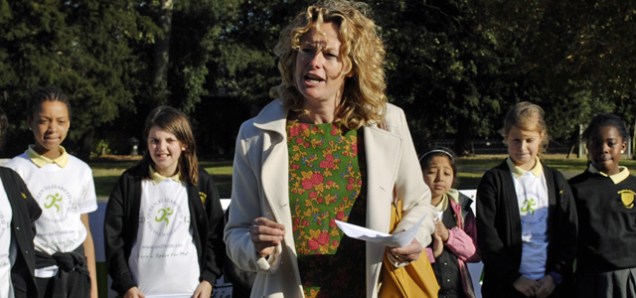
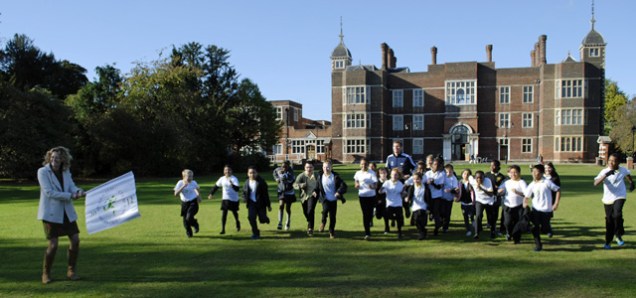
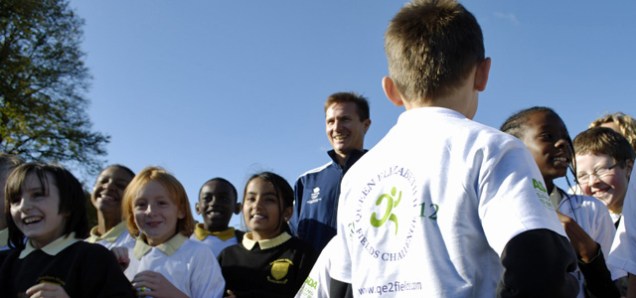
Springwatch host Kate Humble and athlete Roger Black were in Charlton Park this morning launching a scheme to protect Britain’s open spaces from development.

Save A Space For Me – part of the Queen Elizabeth II Fields Challenge – aims to permanently protect 2,012 open spaces, including footpaths, paths and playing fields, from development. The idea is to create a legacy from next year’s Olympics and Diamond Jubilee.

Visitors can nominate their local open spaces, and volunteer to help look after them too.

Humble and Black were joined by children from Charlton Manor primary school, Greenwich mayor Jim Gillman, Olympics cabinet member John Fahy and Eltham MP Clive Efford.

Humble said: “Research shows time outdoors is good for us, both physically, and mentally – but we don’t need research to prove it, as we all know a couple of hours outside in the fresh air makes us feel a whole lot better than sitting in front of a computer, or lying on the sofa eating crisps.

“Sadly, many of our parks and open spaces are under threat, and there is increasing pressure on local authorities to sell off green spaces. They’re valuable economically, but that’s very short-termist. We’ve got to think long term.”

Before challenging the Charlton Manor pupils to a race across the park, Roger Black hailed a “great” project, adding: “There was one word which kept coming up when we were bidding for the Olympics – legacy. That’s been a real challenge for people – for some it’s the buildings, for others it’s about the medals, but for me it’s always been about these guys here.

“It’s been about every child in this country knowing what the Olympics stands for, enjoying sport and getting engaged in sport, and that can’t happen if we don’t have spaces like this across the country.”

One local open space which has been under threat has been Hervey Road playing field in Kidbrooke, just half a mile from Charlton Park, and until recently was the planned site for a new special school to replace one in Plumstead.

“The council is going to be reaching a decision shortly on the development of Willow Dene school on its original site,” John Fahy said. “This will give us an opportunity to look at the future of Hervey Road, which in the long term I believe will be sustainable.”


To “save a space”, visit www.qe2fields.com.

4,500 demand Maryon Wilson animal park is saved


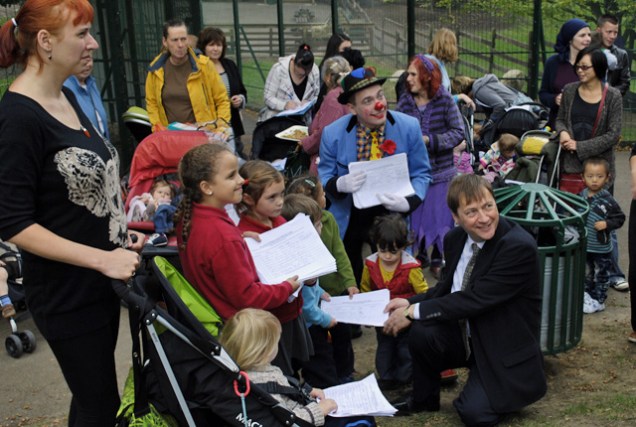
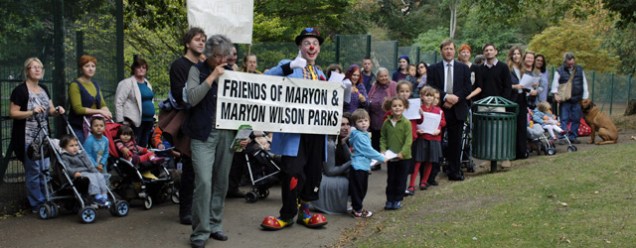
Protesters gave a Greenwich councillor a 4,500-signature petition demanding Maryon Wilson Park’s animal centre stay open at a demonstration in the park this lunchtime.

Around 45 people turned out for the Wednesday afternoon to present the petition to Charlton ward representative Allan MacCarthy and to highlight the threat to the future of the park, which faces having its £43,000 funding cut by Greenwich Council in April.

Cllr MacCarthy said he and his fellow councillors were “trying their level best to get a positive outcome” for the park.

“Hopefully we can say something soon as we’re working on it – believe me, we’re working on it,” the Labour councillor continued.

“I’ve lived in Charlton all my life and I’ve known this facility all that time, so you know where I’m coming from.”

Friends of Maryon and Maryon Wilson Parks chair Tim Anderson said he was delighted with the turnout, which saw groups from Charlton School and Thorntree Primary School join parents, grandparents and toddlers from around the local area.

“It’s a unique facility in south-east London, and was bequeathed to the people of London – it has to be saved,” he added.

The petition will be handed over at a full council meeting later this month, when a Friends member is likely to ask questions of councillors.

Options currently being pursued include handing the animal park over to a trust – although that would not immediately solve the question of funding the park.

The Friends group is posting daily updates on the campaign at its website. Some 7,500 names have now been collected in various online and paper petitions.

Heard of the Charlton Society? Find out more on Saturday…

You’ve probably heard – especially if you read the local blogs – of the amenity societies that play a big part in the way this part of south-east London is run. Personally speaking, they’ve a pretty patchy record of late and I don’t think the wider glare of publicity has done them any good.

At worst, they’re closed and suspicious of outsiders, and used by councils and other bodies instead of actually talking to people. The Westcombe Society‘s chairman once threw me out of a “public” meeting with LOCOG because I wasn’t a member, but wielded a press card instead.

The Blackheath Society‘s been left in a bit of a tizz after blowing a huge sum of money on a court case against a music festival on the heath, while the Greenwich Society shot itself in the foot by backing the almost-universally unpopular Greenwich market hotel.

At best, though, they can be a uniting force for good. The Brockley Society, for example, automatically includes anyone who lives in its patch as a member.

But did you know there’s a Charlton Society? It has no website, and the only wider publicity is a small sign on the notice board at St Luke’s Church. But yes, there certainly is a Charlton Society, it’s been around since the 1960s, and it has a role in every planning application in SE7. If you want to a build an extension, they’ll know about it.

That is, alas, about all I know about it.

Perhaps considering the blunders made by other societies, it’s probably a good thing that the Charlton Society has a profile lower than the average MI5 operative. But it’s getting a website soon, and it’s holding an AGM on Saturday at Charlton House. And you, yes you, are welcome to come along.

Here’s chair David Gardner to tell you more:

The Charlton Society has its 42nd. AGM next Saturday 15 October, in the Grand Salon at Charlton House. The Society has been flying the flag for the conservation and improvement for Charlton – with some great achievements under our belts and many more challenges ahead.

We have had an active year on planning, transport, heritage and environmental fronts – and we have started to build relationships with new partners as Charlton’s civic society gains strength. Next year we have the Olympics, the 200th. anniversary of the assassination of PM Sir Spencer Perceval, buried in St. Luke’s and Greenwich becoming a Royal Borough. We also have the Charlton House estate probably being transferred to the management of a new Trust and the future of the animals in Maryon Wilson Park remains in the balance. Two tremendous assets that really make Charlton distinctive. We will have our first hotel under way and (probably) an application for a new Sainsbury’s supermarket both in Charlton Riverside. We should also, after four long years waiting, have the outcome of the Conservation area review so vital to our heritage in Charlton village.

We have also had an active social and lecture programme as well as our first Annual Dinner. But we do need more support and, therefore, I hope that you might consider joining the society if you are not already a member (£10 or £7 for concessions), or attending the AGM next Saturday where we will be joined by our local councillors, the Deputy Mayor and Lord Gough, our President. Refreshments will be served. If you are able to be involved more during the year then do contact me or our secretary, Roden Richardson.

There’s been a revival of community activism in SE7 over recent years, with the establishment of the Charlton Central Residents Association and the birth in recent months of the Charlton Riverside Action Group, while the Charlton Rail Users Group has already headed off plans to cut train services during the Olympics.

But if these energies can be ploughed into the Charlton Society too, then we can have a group that represents the broader community instead of a small sub-section. It’s easy to carp at these groups – and sometimes they can make it very easy to carp – but here’s an opportunity to get involved and make Charlton a place to be proud of.

So, what are you waiting for? Charlton House, Saturday, 2.30pm.

(If you want to find out more now, here’s the latest Charlton Society newsletter.)

Maryon Wilson Park’s wall of buggies – and a free cuppa


The campaign to save Maryon Wilson animal park is moving up a notch, with a “wall of buggies” protest planned for Wednesday lunchtime. The idea’s simple – to form a wall of buggies for an hour from 12 noon around the enclosure. “We are protesting against the planned cuts, which would mean losing the animal centre forever,” organisers say.

Sounds like too much effort? Well, The Big Red Bus Club children’s playgroup is offering a free cup of tea and biscuit to anyone who takes part, so you can recuperate afterwards. Look out for volunteers giving out vouchers.

More details at the Friends of Maryon and Maryon Wilson Parks website.

William Bance: The Bard of Charlton

Following on from this weekend’s parks reminiscence open day, Charlton Champion historian Barbara tells us about the Victorian man who was inspired to create poetry by Hanging Wood – today’s Maryon and Maryon Wilson Parks.
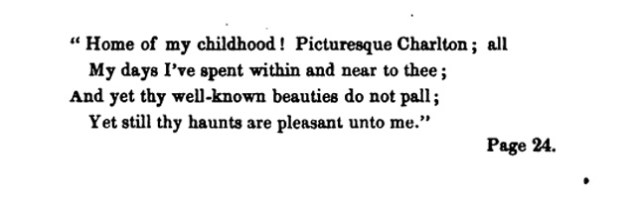
William Bance is not a name that many people will be familiar with. He is rather an unlikely poet, with only four known published works. Born in Charlton in 1806, he spent his whole life here until his death in 1866.

The 1841 and 1851 censuses give us a few clues to his life. He lived in The Village, known as Old Charlton at that time, with his wife Ann, who he married in 1830, and his six children.

The census shows that William was a gardener, a job that was common in Charlton, at a time when it had extensive market gardens and big houses with large grounds to be maintained. So how he came to write poetry is anybody’s guess. His wife is listed in the census as being a bookseller, so this may have been the spur to his writings.

I found his first published collection of poetry when searching for some information on Hanging Wood. It was published in 1844, and entitled ‘Hanging Wood, Charlton: and other poems’. (Free to download from Google Books).

I can find only three other published works of his – ‘Ralph: a Legend of the Gipsies’ (1845); ‘The Happy Village: and other poems’ (1848); and The Battle of Balaclava: a ballad’ (1862). Only ‘Ralph’ had any longevity, with reprints and free downloads available. The Happy Village collection remains tantalisingly elusive – I wonder if he is writing about Charlton Village in this book?

He’s not the greatest poet, but the interest is in what he’s writing about. His poems reflect aspects of his life in Charlton in the Regency and early Victorian eras, a time of great change.

In 1806, Charlton would still have been a quiet rural village, surrounded by fields and market gardens. Charlton House and St. Luke’s church dominated, and there were a few grand houses occupied by the clergy, the landed gentry and senior army and naval officers from the Royal Artillery, the Arsenal and Dockyard in Woolwich.

By the time William Bance died in 1866, the railway linking the area to London had been built, and new housing was appearing along the lower road, Victoria Way, Maryon Road and Lansdowne Lane.

So what about the Hanging Wood poetry collection? The main poem is long – 20 pages, with 9 other shorter poems. He writes about walking with his wife through Hanging Wood, which was a prominent feature of the area at the start of the 19th century, covering what are now Maryon and Maryon Wilson Parks.

A sketch taken from the poem shows that the view from there when he was writing was somewhat better than it is now, as he describes being able to see to Woolwich:

‘Woolwich! As I gaze on thy town before me,

A glow of warm respect for thee I feel;

Thou art a nursing place for England’s glory,

For her stout hearts of oak, and hearts of steel.’

The sketch shows, amongst other things, the then newly built chimney of the steam Factory at Woolwich Dockyard that remains today on Woolwich Church Street.

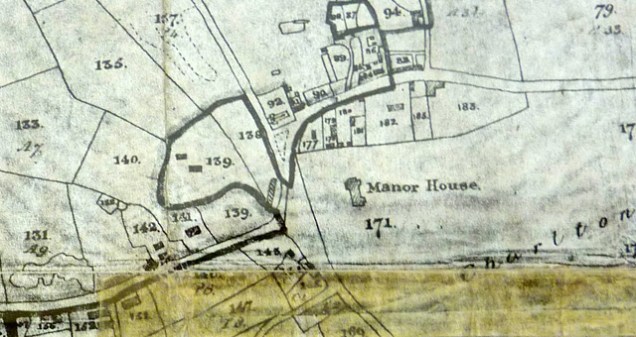
There are also family details in the poems. He writes of the house he used to live in as a boy and describes the village green with its elm tree (see map), which was later ‘enclosed’ (swiped by the Maryon-Wilsons) into the Charlton House estate in 1829 when the road from Charlton village to Woolwich was built.
Of the other poems, of interest is ‘Lines on Witnessing a Funeral in Charlton Church Yard’ (1843), where we get what is possibly an eyewitness account of the funeral of Edward Drummond, who was assassinated in mistake for Sir Robert Peel.

What I realised when doing this piece was that most of our published history is of royalty, the aristocracy and government. Not many ordinary, working-class people get remembered.

As a humble Charlton gardener, he would have been long forgotten and left no mark. But for William Bance, his poetry gives him his 15 minutes of fame and, thanks to Google Books, a place in history.

Dirty windows and smelly bins – who can help?

Brenda asks…

I have some questions on boring household stuff – I am looking for a window cleaner for the SE7 area. I’m also after a reliable wheely bin cleaner. Not like the one I used before who turned up the second time and collected the money in the secret place without doing the ruddy cleaning. I’ve asked a few to call me back but no joy. My bins are kicking up a stink!

Can anyone help?